▲ 259 points
back
256 comments
An AI-generated article which summaries a pre-print release which surveyed 15 people at 15 companies about their thoughts on whether the arrangement was working for them. Of those 15, a grand total of 6 (unidentified) people at 6 (unidentified) companies (all in the same country), said they "thought" productivity had increased. Not a single data point was taken about whether it actually increased. The questions that these 15 people were asked was not disclosed.
An informal survey, of unknown content, of 15 unidentified people, with 6 of those people being in the "boosts productivity" camp. Cool beans. I guess that settles the matter once and for all.
It's 15 companies that adopted a technique and it's part of a broader constellation of experiments in this area which have been confounding the traditional logic that productivity would decrease. https://www.4dayweek.com/research
The people representing the businesses in the preprint hold titles like co-founder, CEO/founder, COO, General Manager, and CEO. The size of the business and sector are also noted. I think your framing of them as "unidentified people" is therefore off, it is certainly not the same as a journalist conveniently using "unnamed sources", this is standard academic practice.
Different companies measure different things, but they do measure and that is addressed in the paper. "revenue (DM10), profit (DM4), other financial targets (DM2, DM6), customer/client satisfaction ( DM8, DM6), story points (DM14), sprint goals (DM7), billable hours (DM12), capacity ( DM4), response rates (DM10), standard operating procedure metrics (DM9), sick leave (DM1, D M 4. DM9, DM15), lodgements (DM12), employee happiness (DM6, DM15), projects delivered on time (DM15), and net promoter score ( DM4)". There were also other benefits like hiring and retention.
So this is not what "unidentified people" "thought" about productivity, this was founders and the c-suite using their existing favoured metrics. On those metrics a large number of them reported an increase in productivity, and a larger group reported no deleterious effects on productivity. This is broadly consistent with the trends in the wider research into this area globally, which continually go against the predictions that productivity will drop. Is it universally applicable? I don't think anyone is claiming that.
I've followed this area for a while and, sorry to be impolite, it is your summary that is less accurate than the the one you accuse of being AI-generated.
Papers like this should be called opinion surveys.
Calling it a study is a disservice to science. As Feynman said, anything where they have to put science as a suffix is usually not science.
What a hollow dismissal of based on acrobatic leaps of semantics.
The word 'study' is no sacred possession exclusive to the natural sciences, and there is nothing wrong with properly conducted surveys as a method in sociology, economics or psychology.
If surveys targeting the very people responsible for optimising their businesses' productivity, with no incentive to falsify their conclusions, is good evidence. Without any other way to systematically measure the change in productivity across a plethora of different businesses implementing a four-day workweek, it is as good as it gets — much better than purely theoretical assumptions that productivity must have dropped.
You can find the study here if you wish to critique its methods: https://www.nature.com/articles/s41599-026-07536-x
> As Feynman said, anything where they have to put science as a suffix is usually not science.
This is such an absurd thought-terminating cliche. Science suffixation seems more an indicator of the age of the field, not its scientific rigour. Are "climate science" and "computer science" not science?
On the flip side, just because it says "ology" at the end of a word does not mean it's a science.
Edit: It’s becoming ever more increasingly common on HN to get downvotes for innocuous respectful posts. If you’re downvoting, I’d genuinely appreciate if you explained what is it that you find offensive about this post. You’re not going to hurt my feelings, I sincerely want to understand what it is that you see as transgressive so I can learn from it. Thank you. Another example which baffled me: https://news.ycombinator.com/item?id=48222383#48227701
> As Feynman said, anything where they have to put science as a suffix is usually not science.
I appreciate Feynman’s contributions—and in fact have been recently revisiting the Messenger lectures—but that seems like an unnecessary jab. The use of “usually” is also a convenient cop-out which makes the remark meaningless because the speaker can pick and choose in any conversation so they always win.¹
I thought about it and picked the first thing which came to mind: Natural science. From Wikipedia²:
> Natural science or empirical science is a branch of science concerned with the description, understanding, and prediction of natural phenomena, based on empirical evidence from observation and experimentation. Mechanisms such as peer review and reproducibility of findings are used to try to ensure the validity of scientific advances.
Seems pretty scientific to me. But alright, let’s check the article to give it a fair shot in context. The only time the word “science” comes up is “Social Sciences”. Again from Wikipedia³:
> Social science (or the social sciences) is one of the branches of science, devoted to the study of societies and the relationships among members within those societies. The term was formerly used to refer to the field of sociology, the original "science of society", established in the 18th century. It now encompasses a wide array of additional academic disciplines, including anthropology, archaeology, economics, geography, history, linguistics, management, communication studies, psychology, sociology, culturology, and political science.
That’s a wide range. Are all of those “not science”?
¹ Assuming your rephrasing is accurate and not missing important context.
Australia also has a 60 year productivity low and a government that is boosting taxes on capital gains on shares/business to basically a worldwide high. So take our experiments with a grain of salt!
Tax changes that have been overdue for twenty-odd years to address house prices and attempt to level the playing field between labour and capital.
Pity they didn't also change the gas tax.
So you're saying that four-day-workweek companies saw no decline in their productivity, in contrast to the Australian average productivity which went down overall‽
That means the four-day-workweek is even better than we thought it was!
What's your point about increased capital gains? Taxing income based on ownership should be higher than income via actual labor. It's insane that's not the case in most places.
How is the recently announced 2026 Australian Government budget relevant to this study done in 2023-2024? There is a whole bunch of other factors to Australia's productivity, not at least the drop in GDP per capita and fall in Total Factor Productivity.
I was contacted this week for a position that was openly 6 days a week. We need to end H1B in this country as soon as possible and keep the 996 schedule firmly out of the United States.
They call you lazy for not wanting to compete against the entire world in your own country.
Quite a leap to attribute corporate greed to H1B.
Think again: this is entirely homegrown.
My company currently has roles open for "5-6 days per week in the office" - we used to be 100% remote! It's awful.
And at the same time the very same people are 10x more productive because of AI, right?
6 am, 6 pm, 6 days a week. Why is it called 996?
Chinese tech companies' 996 policies, and large Chinese tech companies in general, are newer than that ethic in the US. What I hear about 995.5 (every other Saturday off) from my friend at Xiaohongshu in Beijing sounds remarkably consistent with what I heard from my Google friends 20-25 years ago, from working hours to on-site amenities that kept you at work. You're spotting a correlation, but I think causality probably goes in the US -> China direction on this.
In the early to mid 90s, I worked at a Silicon Valley based software startup. We had something called "The Century Club". You made the club if you'd done 3 consecutive months in the last year without working less than 100 hours in any week of those months (averaging 100 hours was not good enough). More engineers were in the club than not. We were told that making the club was not mandatory, but nobody in the club was ever fired and most not in the club were eventually fired.
The next startup I was at had a similar culture without the cute name. I remember my most exhausting stretch there was coming in on a Saturday morning, for a database migration that had to happen outside business hours, and working straight through without sleep (other than nodding off at the keyboard) until Monday afternoon. Our CEO was kind enough to bring us food. Even in regular times there, I would go exercise from 10-11 PM, and more often than not I'd go back to the office after.
A decade later I was at Amazon. Our entire group of ~100 engineers was required by our VP to work weekends, in the office, for months at a time when approaching ship dates. The VP would send an email every Friday during this period to remind us to be there. Of course he wasn't there.
Those were all pretty counterproductive, but didn't seem that unusual. The difference in the US back then was that even asking about such things during an interview would often result in no offer because the candidate didn't have a "good" work ethic. Things have gotten a lot better in the US in the last 10-15 years, but a lot of that came from competition for talent. The more that competition eases, the more likely it is that we'll go backwards on this.
Relating back to the article... For the last 3 years of my career (I retired a few years ago), I worked 4-day weeks, and it was all remote. This is just as anecdotal as the article, but I felt I got far more done, with higher quality, than at any point in my career. It was such a revelation.
I remember one business class anecdote, where the conclusion of changing workplace conditions (light, music, etc. both ways) was that productivity studies increase productivity ...
It's Hawthorne effect
https://en.wikipedia.org/wiki/Hawthorne_effect
Related to it we have novelty effect and bunch of other psychological effects that are hard to isolate in human science. In this sector, a lot of studies cannot be repeated.
Only if you do bad science experiments without a control group, otherwise you'd see the control group productivity boost as they'd also be under the same scrutiny. I didn't read the study methodology, so I'm not comparing to that, only responding to your comment in isolation.
Not the first study, and they all largely report the same results:
https://www.nature.com/articles/s41562-025-02259-6
https://www.theguardian.com/money/2019/feb/19/four-day-week-...
Here in NL lots of people do 32 hour weeks (legally your employer cannot deny you this if you ask for it), and I've literally never seen it be an issue productivity/team-wise, and people's QoL raises dramatically having an entire extra day free to themselves.
Four-day work weeks are for cowards.
Take all that AI productivity and found a one-day work week company. One day of focused collaboration each week, let bots and brains chew on stuff in the interim.
Oh no, I can't tell if this is sarcasm or not, lol
Speaking as an American, I don’t give a shit if it increases productivity or not. Productivity has gone up exponentially with technological advancement since the advent of the 5 day work week. We, as a species, should be minimizing work to 3 or 4 days a week with equal overall pay. Corporations should be fined heavily for contacting an employee after working hours. On call should require corporations to pay hefty overtime. This is a compromise because really and truly corporations should be illegal. Employee owned co-ops are more humane.
Speaking as an Australian, our productivity has been lagging[1] compared to the US, largely due to the availability of cheap labour (attributed by economists to foreign students)[2].
I heard one economist on the ABC give the example of carwashes[2]. From the 1990s to the early 2000s, car washes in Australia were largely automated and hand-wash car washes were relatively uncommon. However, the abundance of cheap labour has since led to a proliferation of hand-wash car washes.
1. https://files.littlebird.com.au/SCR-20260525-ietj.png
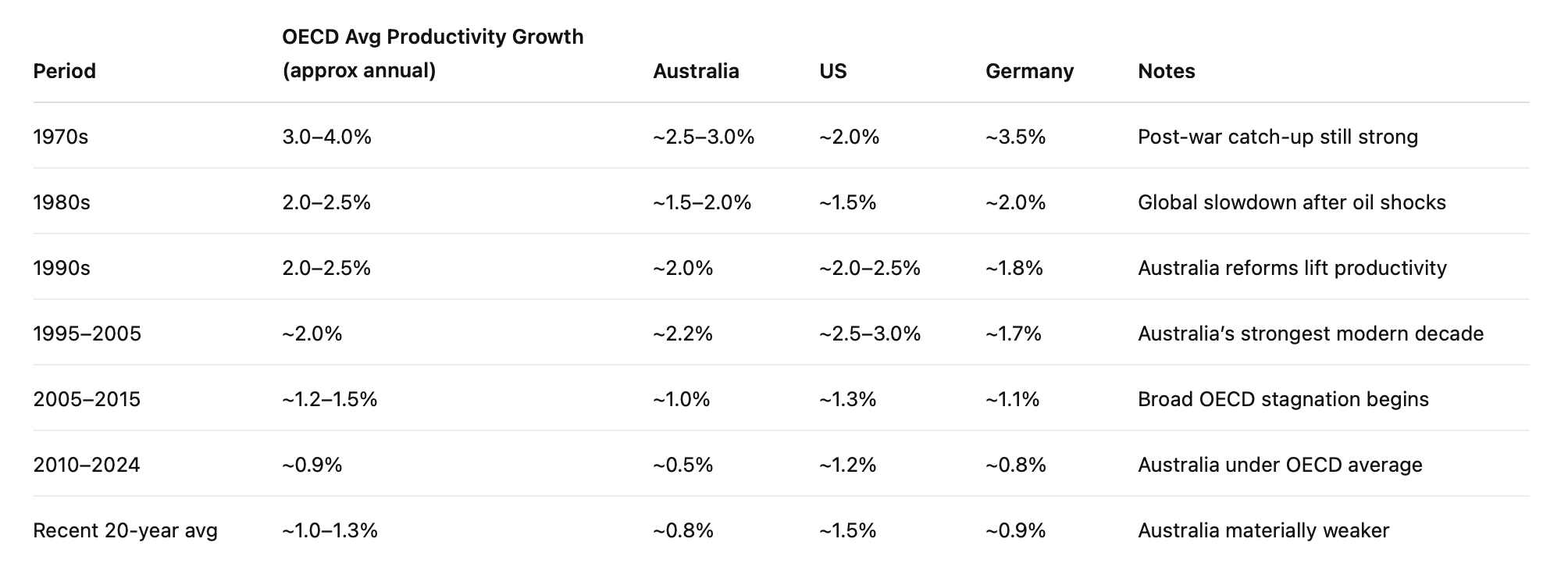
2. https://www.abc.net.au/listen/programs/abc-news-daily/the-pr...
That would be ok in a non-globalized world. In our world, any country that implements those laws will see a lot more offshoring.
> Employee owned co-ops are more humane
Speaking as someone born in Yugoslavia.
That's almost how it was in Yugoslavia. Companies where "owned by society", but workers had voting rights. Whenever there was a vote to decide whether extra profit should be used for capital investments and/or operational improvements or assigned to salaries budget, everyone voted to increase their salaries.
Not every employ should be a co-owner, or at least not everyone should have voting rights.
Given the gargantuan amount of data showing productivity relative to wage gains, or productivity relative to time worked, or productivity relative to physical office proximity, and the absolute staunch refusal of business to listen to any of it, I can only assume one thing:
The point was never productivity, it was about humiliation and control.
If it were about productivity, workers would be paid substantially more to reflect the immense productivity gains we’ve created through automation; we are not.
If it were about effective time management or efficiency, we would be on four-day, 32 hour work weeks to reflect the real productive output of labor; we are not.
Just like how RTO excuses of “mentoring Juniors” and “improving team cohesion” went out the door for mass layoffs, despite data showing that a flexible schedule adapting to the needs of the team rather than whims of leadership have better outcomes and higher productivity; we now pay higher commute costs, fuel costs, energy costs, and opportunity costs so real estate investments don’t invert.
It’s all bullshit and lies, and this is one more study to add to the Alexandria-esque library of research proving that there is no single good way of working, and the insistence of refusing to change how we work is ultimately costing us more than if we just learned to adapt.
Glancing through the study, I'm curious about both sample bias, and the lack of formal measurement. I'm not an expert in this type of thing, not even an amateur. I'm poking holes to see what's left.
"Participants were identified via media reports featuring Australian firms trialling the 100:80:100 model, in addition to companies listed on recruitment sites that specialise in 4DWW jobs. In other instances, eligible organisations were recommended by the participants themselves."
I'd expect organisations with positive results will be the ones recommended by other participants - "talk to these people, it worked for them too!"
I'm also interested in whether or not organisations converted all staff to 100:80:100, or if it was optional. Is the performance driven by peer pressure?
Finally, the participants' measures of productivity will have significant lag time in them, so it depends on trial's length, e.g. "revenue", "profit", "csat", "projects delivered on time", "net promoter score".
Table 1 has "Duration", but the units are unlabelled, if it's weeks, it's less than a year, months is probably better for seeing performance changes.
It's an interesting qualitative study, I'd certainly like a four day work week with no change in comp.
Basically every study shows a four day week works best. The issue is why we never go with what the study shows.
As someone working on a Sunday on a rainy memorial day weekend. Bring back the 5 day week!
But how will a consulting company bill for the 20%?
If you look at Australian IT companies they're management and consultant heavy. Roles like architects, review boards, program managers etc., exceed actual engineering roles. In such a set up it takes forever to get any real work done.
Then Australian real wages have also declined. So there is already low motivation to work beyond the minimum expectation.
Australia also has strong social security, at least until now, and there are plenty of odd jobs due to the real estate and tourism industries, so there is little pressure to survive unless you owe too much credit.
Automation and technology adoption also lags behind. For example, people still wait thirty minutes on a call to get an appointment with a doctor instead of making an online booking.
For all of these reasons productivity has been low and declining. An extra day off work is a strong stimulus for squeezing what gets done into the rest of the days.
In my opinion this is an extreme, just as the work yourself to death culture in India and China is. On a scale of a few decades economies where people worked agressively harder have grown tremendously but at the expense of the long-term wellbeing of the people. Places like Australia that were well off and felt little pressure to compete have sustained good quality of life but at the expense of having no competetitve edge anymore.
Working based on time i.e. 5 days a week is already problematic. We all see the pay by the hour workers like pool cleaners, vendor machine stocking people etc spending lots of time dragging out their work as they get paid by the hour. It makes perfect sense from their perspective and yes not everyone drags the work.
Fixing the work week to just 5 days have similar issues. Some weeks will be less work and other weeks more work but you spend the same five days there. So the what you learn that matters is to spend 5 days physically there and perform a minimum workload so you don't get fired. You drag the weeks with less work and pick up inefficient habits as a result. That is what a 5 day working week teaches. Again there will be exceptions.
Now assuming this study is correct I am not surprised with the results. You just incentivized workers to get the same amount of output done with the condition that you gain 1 day off. Off course workers will find better and quicker ways of working to get that day off.
Even if we did a 4 working day week the problem of working based on time either fixed or paid by the hour remains. The incentivisation is the problem.
given all the gains in productivity over the past 50 years thanks to technology, we should naturally have a universal (in developed countries at least) 4-day work week by now. Otherwise, what was the point of all those gains in productivity?
capital, not labor, captures almost all those gains
I expect when it applies to more company, we should see employees got 3 days off will simply find a second job to increase income. When that happens, you will see the productivity drop.
4-day work week is one of the fastest ways to distribute AI productivity gains back to public
I haven’t had a solid schedule since Covid, work just happens whenever and I weave my personal life into it. Sometimes it’s late nights and a weekend, sometimes I take off a random Wednesday and do errands.
USA: So what I hear, is we need to work 6 days per week + AI? Correct?
What a huge surprise. Every one of these studies shows the same thing.
Same as every study of open-plan offices shows that they suck.
The psychopaths in charge do not care.
Here's the paper, with no paywall.
https://www.nature.com/articles/s41599-026-07536-x
Hopkins, J., Bardoel, E.A. & Djurkovic, N. The four-day workweek in Australia: insights from early adopters of the 100:80:100 model. Humanit Soc Sci Commun (2026). https://doi.org/10.1057/s41599-026-07536-x
Corporations really dont care about productivity. Wfh has shown we are more productive
Won’t we face an economic decline if we continue reducing the work week even further?
> What success looks like differs by industry, and a rigid, one-size-fits-all measurement would have made the findings less applicable to the real world [...] Burnout emerged as a major theme in the findings.
This is the actual problem to discuss, not the days per week.
Stressors vary a lot by industry and experience level. A senior manager in IT may do more than 40 hours a week plus be on-call with almost no stress as long as their projects are doing well. Meanwhile, there may be no sane amount of overtime pay that will convince a young guy doing roofing in his first year, and he's highly stressed out either way.
Anyone spinning this as a political issue is plain ignorant.
Now do 3, 2, 1, and perhaps 0 days... but seriously, this probably just resulted in employees squeezing out some of the slack time they would otherwise have with an extra day.
