▲ 222 points
back
124 comments
I really like what https://www.deepfission.com/ is trying to do. They have the absolute simplest model for nuclear fission that I can imagine. They’re digging one mile (1.6 km) holes dropping low enriched nuclear fuel to the bottom, and filling them with water. The pressure from the one mile column of water is perfect for the reactor. From there, it’s basically a geothermal well.
No need for an expensive containment dome, or expensive plumbing. If anything goes wrong, the nuclear fuel is already a mile underground. When the fuel is used up, they can leave it where it is since it’s below the water table. No need for expensive and hard to source highly enriched uranium.
The hard part is digging the wells, but that seems trivial compared to Quaise, who’s trying to dig 3-20km wells. The Deep Fission wells can just go anywhere (perhaps next to a disused former coal turbine?).
> They’re digging one mile (1.6 km) holes dropping low enriched nuclear fuel to the bottom, and filling them with water.
> When the fuel is used up, they can leave it where it is since it’s below the water table.
To do both, they’ll have to guarantee that that column of water stays isolated from groundwater for a long time after the fuel is used up.
Reading https://www.deepfission.com/faq, they answer that question with
“Importantly, the mile-deep column of water in the borehole is expected to provide the pressure conditions required for safe reactor operation. Water within the borehole is also intended to contribute to the reactor’s thermal management system”. So, what do they do if their drill hole starts leaking, and they lose pressure?
and
“Our boreholes are expected to be lined with multiple layers of casing, including steel casing and concrete intended to maintain structural integrity and isolate surrounding geological formations”
I don’t think those are good answers. They say what they want to do, but almost nothing about how they’ll do that, and try to avoid making hard statements on the what by using “is expected” and “is intended”.
What a waste of perfectly good reprocessing input. "Spent" convention nuclear fuel retains 95% of its energy. Discarding "spent" fuel is a shamefully profligate energy practice we can get away with because we're using not nearly enough nuclear power, making and virgin fissiles are dirt cheap.
> To do both, they’ll have to guarantee that that column of water stays isolated from groundwater for a long time after the fuel is used up.
I wonder if just letting the water gradually dissolve the uranium might not be fine, actually. If it is done far from wells and rivers used for drinking water, then the small amount of radioactive minerals that slowly seep out might not pose a danger. I can't find any studies to back it up, but I imagine there are places on Earth at which enriched uranium buried 1.6km underground poses no threat. I am no expert, so I would love to hear what others think.
>I don’t think those are good answers.
Steel and concrete are what we use above ground so.....
>They say what they want to do, but almost nothing about how they’ll do that, and try to avoid making hard statements on the what by using “is expected” and “is intended”.
They say nothing about how because those are trivial problems in the well (and oil) drilling industry.
I'm sorry, I've worked in advertising for much of my life, and I just can't get past the top line "Advanced Nuclear for the AI Era". That reads as an extremely desperate or opportunistic marketing pitch to me. Kind of like when you get a brochure for a condo in a high rise that will never be built...except even more shameless?
I think it’s a nod to the idea that AI is set to boil off the oceans unless some seriously novel ideas about power generation take hold.
They kind of have to shoehorn “AI” in there have any hope of raising capital these days.
Probably because AI datacenters would benefit from tech like that.
Create a small sun a mile under the ground, what could go wrong?
Also the actual article it seems has nothing to do with fission, they are focusing on extracting the heat already down there. "superhot rock needed for next-generation geothermal power"
It's an extremely stupid idea. Your whole water column is going to be contaminated with fission products. And you won't be able to get any reasonable amount of power out of that contraption.
And even if you are stupid enough to actually do this, the fuel efficiency will be terrible. Your only negative feedback for fission is the Doppler effect and thermal expansion. So you will only be able to utilize a tiny percentage of the fissionable materials.
That sounds like an absolute nightmare to get approvals for.
This echoes 'safe fracking' claims - and now many people in proximity have gas coming out of their facets. Digging hazardous materials out of sight into a potentially unstable or potentially becoming leaky structure is never a sound strategy.
>They have the absolute simplest model for nuclear fission that I can imagine
Agree. What I don't understand is: why has it never been done before? They can't possibly be the first to come up with this idea, which doesn't seem to rely on any novel technology.
below and penetrating the water table with the potential for short and long half-life transuranic fissile products and a path of least resistance for any runaway conditions which is directly to an uncontained well head... with the extra bonus of installation proposed in 'spent' hydrocarbon bearing regions which implies reduced density substrates with all the tiny seismic outcomes and risks.
perfectly safe /s
What are the side-effects of regularly detonating nuclear bombs at that depth?
From the thesis: https://www.proquest.com/openview/624989df3cdd8055a6cee9affc...
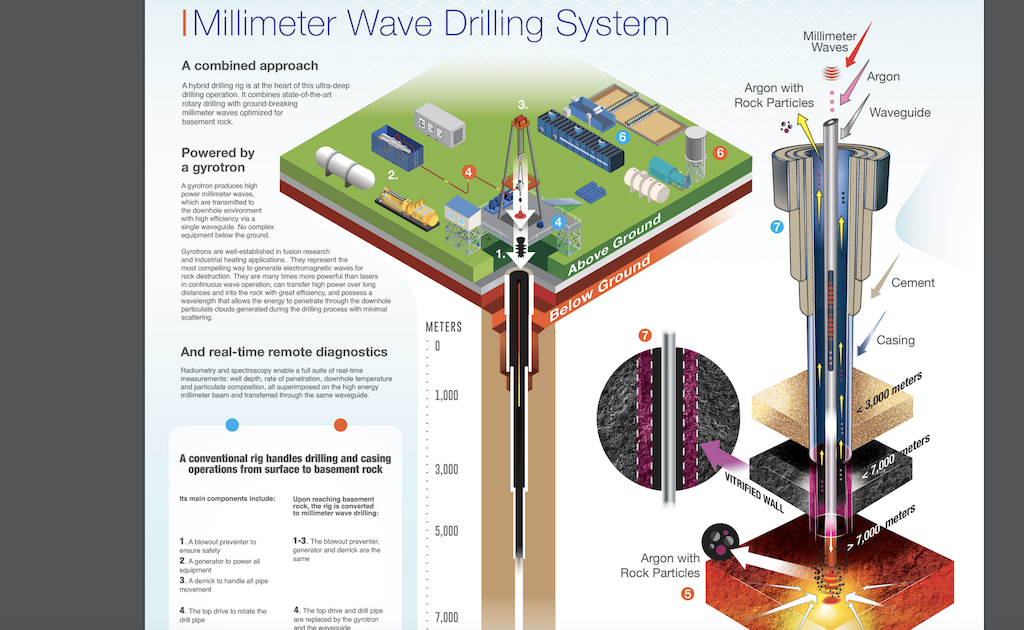
"For the application in EGS drilling, this device uses a metallic waveguide to carry the millimeter wave (MMW) beam to a standoff distance from the crystalline rock. Argon gas is used as the waveguide fill medium due to its ability to stay transparent to MMW’s at such deep depths and thus higher pressures [12]. Purge gas is also used to pump out the excess material that has been transformed into smaller particles (Figure 2.4). "
As a former geologist involved in drilling, thats going to get real expensive, real fast, in terms relative to regular mechanical drilling thanks to the requirement for argon. Perhaps theres an economically efficient changeover point at depth as mechanical drilling becomes less capable due to increasingly plastic deformation.
You don't need a significant flow of argon, just enough to keep unwanted gasses out of the waveguide.
It's possible there exists a material that is transparent to mm waves, airtight, and can survive the conditions at the bottom of the hole. In such a case they could cap the waveguide and prevent any gas leakage.
I'm quite sure Quaise is well aware that Argon isn't cheap and are already exploring multiple avenues for reducing its usage.
It is interesting that they have to use Argon instead of the more typical Nitrogen or SF6. A waveguide with such a significant pressure differential is decidedly unusual and a unique challenger for what they are doing.
There is definitely an economic changeover point, I’m sure I read they will use conventional drilling down to a certain depth, before switching to MMW
I doubt argon is the purge gas.
You mean the argon gas used as medium specifically? I assume the purge gas is something else, cheaper?
Why mmwave instead of ultrasonic? FWIU 28 kHz shreds the quartzite in granite?
Naively, I wonder how much the density of argon gas helps here, in terms of being able to recover and reuse the argon gas in a relatively closed-loop system.
Fwiw, I'll share some surfing:
Nice article on an earlier demo: https://newatlas.com/energy/quaise-energy-millimeter-wave-dr... ; linked from this (nice but lots lots of ads): https://newatlas.com/energy/quaise-energy-millimeter-wave-dr... .
Company https://www.quaise.com/ on YT https://www.youtube.com/@quaise
MS thesis (2024; browsable) on the vitrified wall, for that and its intro: https://www.proquest.com/openview/624989df3cdd8055a6cee9affc...
Search for papers "Millimeter Wave Drilling for Deep Geothermal Energy Production" https://scholar.google.com/scholar?hl=en&as_sdt=0%2C33&q=Mil...
That's impressive.
But why are there no near-term products? If you can cut through granite and such this way, it ought to be useful for other cutting jobs. There should be useful tools, such as small units for drilling pipe holes through concrete and rock. Going for a 10km hole as the initial product raises the suspicion that the real product is the stock.
> There should be useful tools, such as small units for drilling pipe holes through concrete and rock.
We already have cheap and effective mechanical drills capable of these tasks, and it's unlikely a brand new technology can compete with those on cost.
Unlike in the actual design niche, where mechanical tools are infeasible due to the temperatures involved.
For shorter holes traditional mechanical methods work just fine. If you are going to build a giant excavator you don't waste time making shovels for gardeners.
The problem drilling deep into ground is that the power source on the surface of earth and drill bit deep underground are connected by long floppy noodle while the hole is getting crushed from the sides by bunch of elephants. It is difficult to transfer rotation from the motor/power source at the top to the boring head, and reinforce the walls to prevent them from collapsing, having whole thing heated to few hundred ℃ doesn't make it easier on hardware.
In case of something like underground tunnels these problems are avoided by having hole big enough to fit the drilling machine as well as all the equipment and crew to reinforce the walls with concrete.
The fact that people have made a way to drill few hundred to few km using mechanical means is already an engineering marvel. In the context of everyday manufacturing beyond the hole depth to diameter ratio of 5:1 things already start to get more complicated. With more specialized techniques you might get 10:1 - 100:1. A bit easier for softer materials like wood or if you don't care about precision. But for deep underground drilling we are talking about ratio of thousands to 1.
It's not like they are not making tests at shorter depths. Once technology is sufficiently developed it might also trickle down to some shorter few km holes if geological conditions are right. Although probably never for something like few dozen meter water wells or making a hole in concrete at construction site. Not sure how well it works in soft dirt. Who knows about distant future, we now have relatively cheap desktop laser cutters, laser pointers, measuring equipment, microwave ovens, but those were not the initial products when developing those technologies. On the other hand some tech like wire EDM has remained niche manufacturing technology, even though modern electronics and software could allow making it much cheaper.
Wow. That's interesting. Thats tx of 300ghz.
Very interesting application of radio waves.
This company was previously featured on a video by Real Engineering: https://www.youtube.com/watch?v=b_EoZzE7KJ0
Its worth noting the original article was written July 2025. Not June 2026
They made the laser drill from The Core IRL?
Except that it is not a laser but a high power radio transmitter made with a vacuum tube (gyrotron).
For generating the highest possible power of radio waves, vacuum tubes remain the only solution.
This drilling method resembles more a microwave oven (which uses a magnetron), than a laser.
Might want to do yourself a favor and figure out the implied question behind 400(?)
It's... not a lot of work. At least for me personally it rubs me the wrong way to name an important metric in Fahrenheit and then to give an estimate with a question mark for the proper SI unit.
Looks to me like the author wrote themselves an inline note and forgot to remove it before publishing.
This company might not be very good at getting deep, but they have definitely figured out how to get press attention.
I have been hearing about them for years in connection with enhanced geothermal, and while other companies are out drilling functional wells, Quaise is just getting basic drilling going, with seemingly zero promise of being cheaper than the alternatives.
Can someone explain how this works? A gyrotron is some kind of maser (like a laser but with microwaves). Are they vaporizing the rock?
Gyrotron isn't quite a maser, more akin to a free-electron (i.e. electron beam) RF source. AFAIR (might be wrong, but based on what I could find there: https://www.thinkgeoenergy.com/wp-content/uploads/2021/03/mi...) they aren't literally vaporizing the rock, rather locally heating it til it crushes into particles that can be blown away.
Impressive, but how long did it take to drill 100 meters? I didn't see a mention of that.
They mentioned about 1 hour per meter at 1 MW.
I think we can use 1 Gulf War for units
How do they keep the temperature of the borehole high enough so that the vapours don't condense on the borehole(and equiment) on their way out?
Gotta need that to reach the source of White Rabbit signal at 8500 meters! ;-)
> it has successfully drilled to a depth of 100 meters, a milestone...
Nope that's a 0.1kilometerstone.
Or a hectometerstone, if you will
Does it vaporize the granite?
It turns it into granite cotton candy.
Finally we know how piramids were built