▲ 501 points
back
136 comments
A tangential observation: the video on the linked page wasn't what I expected. I thought Mistral was a european AI company, so I didnt expect the video to be filmed in San Francisco featuring three people who don't seem to be european.
I'm not against them being a global organization, that's wonderful. I was just surprised. I expected a parisian office and european accents.
Unfortunately Europeans are terrible customers for making money. They ask a lot of questions and they're very stingy with their wallets. Americans on the other hand ...
~Any borderline-large European tech company will have an office on the US west coast, for sales if nothing else. And probably sales engineering. The timezone difference is eight to ten hours; there is really no way around it.
(I did work for one which had an office in Vancouver, instead; same tz.)
Another company like this is Blackmagic Design. Despite being overwhelmingly based in Australia, you'd think it was an American company based on office listing ordering on https://www.blackmagicdesign.com/company/offices and /company page.
To the best of my knowledge, most of the founding team started their careers in the US ( meta,etc..) and their primary investors are US VCs. In that regard, they smartly benefit on both side : US funding and European brains
There is even like an american flag flying high in the background
I’ve always thought the US Postal Service is such a technological marvel. They somehow manage to identify and route billions of pieces of mail and I have to imagine their tech is significantly more primitive than this. Not only that but US addresses are absurdly non-standardized, you can often write the same address multiple ways and have it deliver to the same location. I’m sure there’s plenty of published knowledge in this area, but whenever I see announcements about OCR it feels like this should be a solved problem if it’s been accomplished at the scale of USPS for many years.
My father once received a letter from Algeria, with 3 words on the envelope : his first name, "Créteil" (the town where he lived, ≈100k inhabitants), and "France". Of course, in the 70s there was no Internet nor central database to find him, yet the postal service managed to deliver the letter. He was a very active social worker, managed a youth football team, etc. which made him locally well-known by his first name.
Nowadays, many people can't find anyone or any place unless their phone helps them. And postmen never stop to chat. Such a letter would not pass through the technology process, and probably not through the human network.
I used to part time for the (Danish) mail service.
The only sorting that was done automatically was the post codes. That was enough to get the letter to the right post office. The rest was done by the mailmen/women early in the morning.
It was a lot of fun trying to figure out what was meant by some of the addresses. The older people in particular often knew the story of why certain places were sometimes addressed in certain ways, or could guess the addresses based on the names of the people living there.
Great video by Tom Scott on this subject:
IIRC the USPS was one of the first big budget orgs behind early OCR systems all the way back in 1965.
The USPS Remote Encoding Center in Salt Lake City examined 841,260,847 images of poorly written addresses in fiscal year 2025. [0]
Unfortunately the page does not have a base rate--the total number of mail pieces that were not prepared for automated processing. Total first class mail, which includes a lot of bills prepared for automation was 25.7 billion [1]. If 10% of that are non-automated, then .8 / 2.57 = .31 or a third of mail not prepared for automation is handled by "employees look at the image and type in address information"
0. https://facts.usps.com/remote-encoding-center-rec-decipherin...
1. https://about.usps.com/what/financials/10k-reports/fy2025.pd...
There's a lot of weird edge cases with US addresses. Carmel by the sea doesn't have street numbers. Florida keys addresses are often just a mile marker. The mail gets delivered because a human on the route is familiar with them.
>... US addresses are absurdly non-standardized.
Laughs in Indian addresses.
Fun fact: one of Yann LeCun's first 'deep learning' projects was on OCR for postal codes (MNIST).
USPS can also make a list of every address, that's not possible generally with freeform text
It'll be interesting to see how this ranks against https://github.com/baidu/Unlimited-OCR
It's cheap at $4/1k, but I'm hesitant to even benchmark this one again since the previous versions were all "98% accurate based on internal benchmarks of 4 pdfs" and ended up falling short of almost everything else on the market [1].
Even in this one, they just report that OlmOCRBench and OmniDocBench have "known limitations" and that's why they report flagship numbers from their internal benchmark.
https://getomni.ai/blog/benchmarking-open-source-models-for-...
All AI labs really need to stop using truncated y-axes for benchmark bar charts...
https://mistral.ai/_astro/cm-engish_ZhlvoT.webp?dpl=6a3a94bd...
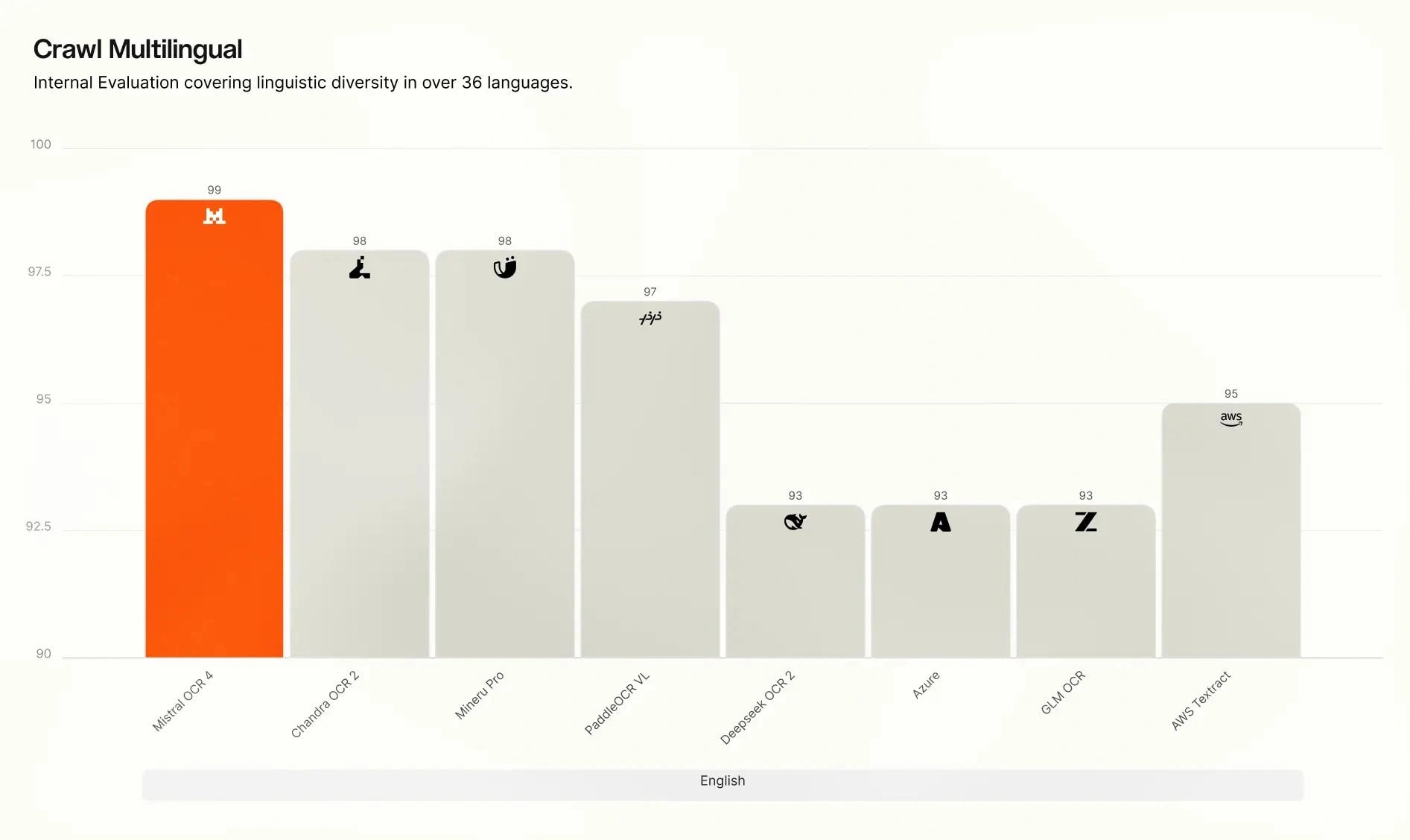
Little on differences other than bounding boxes and double the price compared to their previous OCR v3 model from December - https://mistral.ai/news/mistral-ocr-3/ - other benchmarks were used back then.
Tested with Malayalam, normal handwriting got accurate but a slight different style got detected as kannada. Have samples if required, which sarvam got done with 99% accuracy leaving one text error.
Recently I tied OCR with Opus 4.8. (I know, not technically right tool for the job). All I needed to do was extract dates from receipts. It got about 20% of the dates wrong yet rated all as “high confidence”.
Should have probably tried a more OCR specific model
"A note on out-of-scope use. OCR 4 is a document-understanding model, not a decision-maker. It is not intended for medical diagnosis, legal advice or judgment, high-stakes financial decisions, safety-critical systems, real-time/latency-sensitive processing, or non-document inputs (raw audio, video, etc.). "
Can't wait for the "oh so innovative" manager who will suggest during the next meeting "Ok... but what if WE used it for high-stakes financial decisions on non-document inputs like a photo from my phone?"
I guarantee you somebody on HN is going to comment about this "idea" next week.
The comparisons rank it against GPT and Gemini but not Claude. Is Claude's vision support simply not competitive when it comes to OCR tasks?
I was processing 55 year old paper files, most of them severely degraded, with its predecessor model. I was very impressed! I also tried Abbyy Finereader but it didn't even come close in my experience.
This runs for free on CPU https://github.com/kouhxp/textsnap
Does anyone know of OCR benchmarks that include hand-written documents? I'm currently using Gemini pro 3 for this, and error rates are quite good, but it's a little bit pricey, and I'd be interested in a cheaper model that could perform as well, but almost all the OCR benchmarks I'm aware of (and I believe all the ones included in this announcement) are about printed/typeset text.
This has been a niche where Mistral has actually been successful. Btw, Hindi and Japanese are bucketed in "Rare Languages," which is odd.
> On our internal multilingual evaluation, OCR 4 leads across all eight language groups — English, Western Europe, Eastern Europe, Middle Eastern, Chinese, East Asian, Southeast Asian, and specialized languages (Hindi, Japanese, Georgian, Bengali, Armenian, Hebrew, Greek, Gujarati, Tamil, Malayalam, Kannada, Telugu).
The initial version of this page called these "minor languages" (vs specialized language), which is telling. If you're a speaker of one of these: This is why you need a sovereign set of models. (Japanese government: Are you listening?)
Do these models (this one or its competitors) do handwriting recognition?
Given this a test on some scans of magazines, generally pretty impressed with the results. Mags are generally pretty whacky layouts and it does a reasonable job working out what is where and pulling it together into a single coherent md file. The way it crops relevant pics and puts them into the doc is pretty nice.
Haven't compared it with any other high tech OCR estups, but it's way better than the jank that comes as standard with my scanner.
Not well tested. It switched all U.S. (") double quotation marks to UK-style (') single quotation marks, ignoring the source document. Useless in the US.
Is there a complete list of the languages they support, and benchmarks by language, instead of just "Rare Languages"?
Way too expensive. Google vision OCR (which they failed to compare against), is $1.50 per 1k pages. Vs $4 from Mistral.
Are there benchmarks for how this performs on charts, or maybe more accurately, plots? I've yet to find a model that can digitize a plot into X,Y points with some accuracy in my use case of digitizing old datasheets.
Are there any open models focused on LPR (license plate recognition)?
I have found some old ones but curious if there are new ones being developed like this OCR model. I may even try it for the purpose and see if it does well.
1000 pages for $4? damn how does it compare to llama parse I wonder
I wonder how it does compare to reducto, pulse, extendai.
Mistral keeps reminding us that doesn´t just brew great coffee, they can build great AI too.
Hats off to the team.
Mistral O.C.R. (Only Cool Results)
Naive question: is Claude no good at OCR? Was surprised to see that none of Anthropic's models were included in the benchmark comparisons.
Is there something wrong with their certificate? Chromium is saying https isn't valid
Why the chart crimes?!
Not opensource right?
starting y axis from 50 and 95 is a bit mileading
After paying for Mistral and using it for a while I genuinely hated it. It's a productivity black hole and can't realistically compete with anyone. I chose it only because it was European, but no. I'd rather let my one year subscription go to waste than use anything 'Mistral'.