▲ 427 points
back
188 comments
This is in Virgina, which passed the Virginia Clean Economy Act in 2020. This mandated that Dominion (the power company) transition to 100% renewable energy by 2045. Personally, I think this is a good thing in the long run, but in the short run, it means that Dominion has had to invest a lot in building out renewable projects that haven't come online yet.
Lawrence Berkeley National Lab recently did an analysis on electricity prices in the US [1] and found that most of the rate increase in Virginia was attributable to the VCEA, and that load growth had a mitigating effect on price increases.
If you look at the overall report (not just Virginia), the places where electricty costs are rising the fastest are generally not the same places where lots of new datacenters are being built. It's easy to blame datacenters, but there are many factors at play here.
[1] https://emp.lbl.gov/publications/factors-influencing-recent-...
I appreciate that you linked a paper to support your opinion on this matter, though I read the summary PDF a whole lot differently than you did. I’m not sure I’d blame renewables anywhere near as much as you did.
For one thing, energy demand hasn’t been increasing at the consumer level per capita. So you either have a growing population or growing commercial usage (like with data centers) or both driving energy demand.
Is there some literature that points to an idea that it’s faster to build a gas or coal power plant compared to a renewable one? My understanding is that solar is cheaper than gas, right? Even solar plus grid scale batteries are in a similar ballpark. And let’s not forget that other infrastructure like transmission lines and substations do not have any concept of renewable versus not.
The last thing I’ll point out is that we literally have to switch to renewables. There’s no long term versus short term, really, when we think about it. If we don’t make the switch we’ll actually put all of this planet in a lot bigger trouble than asking people to set their air conditioner thermostats a couple degrees higher.
> It's easy to blame datacenters, but there are many factors at play here.
Henrico County currently has 37 data-centres with ~2 gigawatts capacity (expected to reach 3 gigawatts).
Apparently, 1 MW can power approximately 834 homes annually. So 2 gigawatts would be closer to powering > 1.6 million homes.
Surely, that kind of concentrated demand is going to affect electricity distribution costs for everyone, which is what we are seeing now.
So don't allow data centers to connect until enough clean energy has been brought online to meet their needs without impacting cost or availability for retail ratepayers. It's easy really. Say no.
It's so strange to me that the argument previously was "we don't have enough energy generation for EVs and heat pumps to electrify and decarbon" but data centers are thought of as must run load that everyone has to suffer in some way to enable (through increased rates or risk of blackouts), when they have very little positive impact for everyone except a small minority investing in them.
> It's easy to blame datacenters, but there are a lot of factors at play here.
It is because they are the problem. We need as much clean energy as quickly as possible to mitigate climate change, we do not need data centers, broadly speaking.
(if you replaced all of the farmland/ag land, the size of the state of Oregon, harvested for ethanol with solar, you would have more electrical generation than all current US electrical generation combined as of this comment; this is simply a question of will, proven by China's solar PV deployment rates [installing ~90-100GW of solar PV per month])
In the long run, green energy and data centers are ultimately going to be complimentary.
One of the biggest problems with investing in a renewable grid is curtailment and managing demand or production spikes. In California, they already have to turn off solar plants during peak hours to help manage overproduction.
Even if you have massive quantities of energy storage, you don't have enough "inertia" in the grid to keep power levels consistent as DC power sources flick on and off.
Data centers can act as massive variable loads that can ramp up or down that turn excess energy into something vaguely profitable. And they can also help to create demand for more supply of intermittent green energy sources.
I'm surprised that the 404 Media article does not mention anything about this. At least, searching for the word "Clean" did not return any results.
As a Virginian, this is good information to have. I see a lot of ludicrous objections to data centers here (the most ludicrous being water consumption, when most of our data centers have closed-loop systems and regardless the humidity here isn't evaporating water).
I've suspected that the energy regulations and the ruling party's close connection with Dominion Energy (the Governor recently attempted to fire the chair of Virginia Tech's board and replace him with the CEO of Dominion) have had an impact on power use more than data centers themselves.
a different framing of this same information is that Dominion made dumb investment choices in the 2000s and 2010s, locking into electricity that has a fuel cost.
This is the way. Build more data centers and mandate they are powered by solar+batteries/nuclear.
Capacity shortfalls and needs to conserve (i.e., asking customers to reduce usage) are not necessarily 1:1 with rate increases and overall electricity costs. Especially in the short term.
In other words, large “base loads” like data centers could both reduce the average power bill AND contribute to capacity shortages and load shedding.
If everyone turned off their lights 100% of the time they left their workstation, they could power those additional data centers for about one second.
Just use smart lights that feed video into an llm to check if lights should shut down.
Billionaries are willing to have us make that sacrifice!
Turn off computers and phones. No need for DCs then.
not to mention you'll get much farther, faster & easier with timers on the lights than some sort of 100% voluntary participation dream.
"Who needs public schools anyway? I pay my kid's teachers salary directly."
I think the issues are exacerbated by the US going from "regular growth in electricity generation" for decades to "dead flat" for the last ~2 decades. I think we're finding generation isn't just a switch you turn on and reap the benefits of overnight if it's not what you were already planning on doing https://substack-post-media.s3.amazonaws.com/public/images/e...
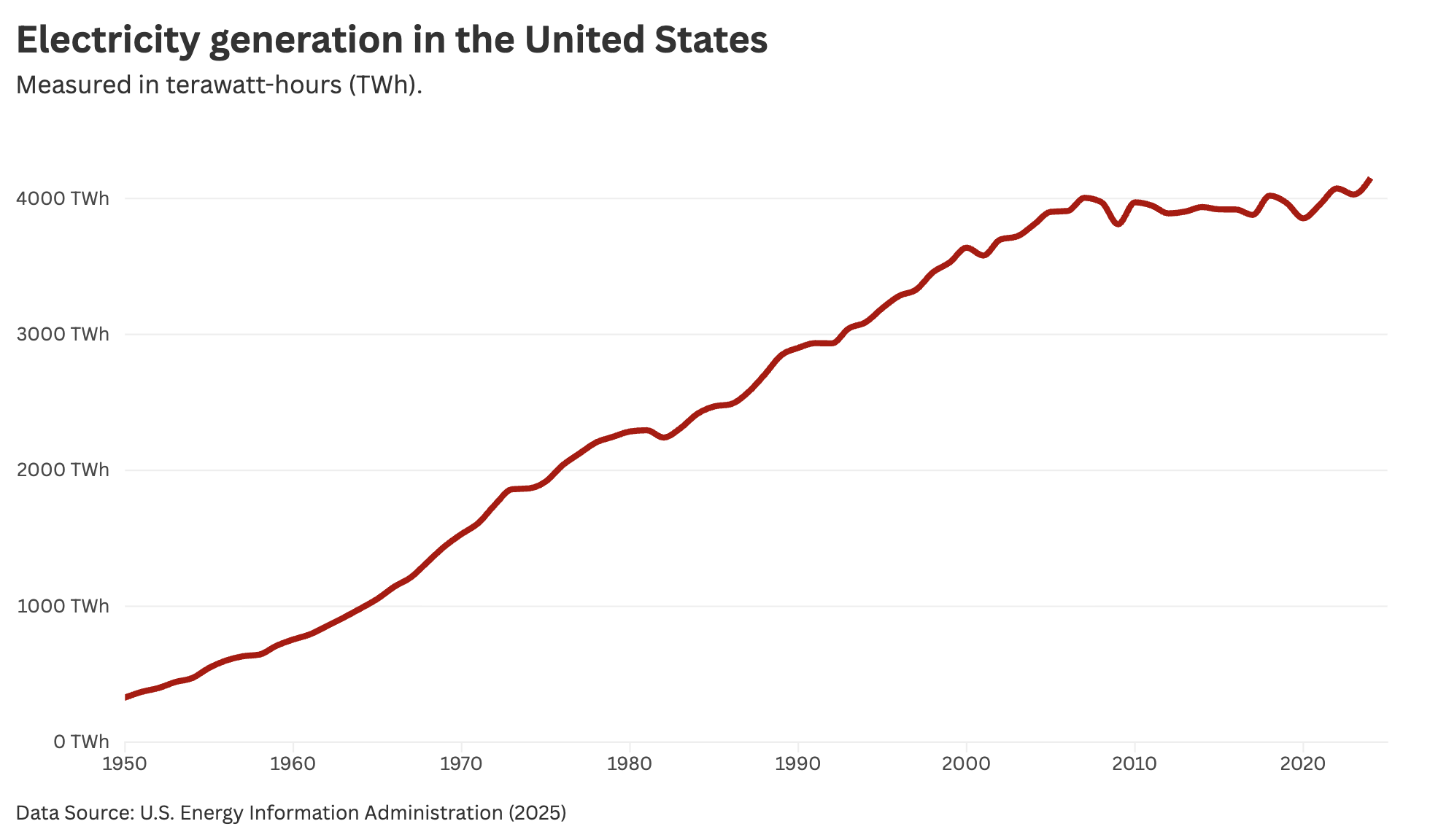
Part of solving that may be in what the article touches on - how to get the generation built before the DC shows up rather than as a promise after.
You want to use a lot of electricity? Great! We sell electricity. We will need cash in advance to handle some upgrades, rather than passing those costs on to other rate payers.
Exactly! Everyone's been conditioned that Data Centers = higher electric bills for residents. Of course, another option is for politicians to put any added costs on the data center companies. One tech guy even proposed, in order to gain wider acceptance, having the data center companies pay the whole electric bill for the town, so that data centers = 0 electric bills for residents.
> passing those costs on to other rate payers.
You are describing the normal process of purchasing things and how prices work. There is no nefarious passing on.
We should redistribute money from the wealthy to households, but I'm not sure if rate price controls beyond what already exists is the correct way to do it. The real issue with these data centers is tax jurisdiction shopping.
My state almost passed one such bill this year. Lobbyists got it put in time-out until this year's legislative session ran out.
Isnt that what virgina did in the new rate class this article mentions? Data centers have to enter long term contracts with minimums (regardless of usage) to help power companies plan ahead.
https://www.wric.com/news/virginia-news/dominion-energy-rate...
Power companies don't want to turn away customers in order to keep prices LOW! If you want that outcome, you need a government intervention (which could be laws around utility pricing, requirments for DC buildout etc)
The greed with which the tech companies and data center providers are consuming electricity will be their downfall. By trying to make a few extra bucks by passing on some of the costs to consumers, it will trigger a huge political backlash that will screw them all. The fact they don't realize this is greed and hubris on their part.
My state almost got a bill passed that would have made data centers pay for the new generating capacity. The House passed it, but the Senate strangled it. Thanks lobbyists!
The text of the article indicates that the county government sent this message to all government facilities, but I suppose that doesn't make for quite as sexy a headline and a public school is technically a government facility.
I appreciate 404 media's mission but isn't there enough stupid shit existing naturally in the world for them to illuminate that we don't need to do this?
It's kinda crazy that data centers aren't on some sort of ringfenced scheme.
This whole just throw it on the grid and residential consumers pick up the increased infra costs is insane
The article didn't include the actual power rates. I think the applicable tariff is $3.316/kW of demand + 16.82c/kWh.
https://www.scc.virginia.gov/docketsearch/DOCS/89pc01!.PDF
Compared to my local utility (and most of Canada), the demand charge is low, but the per kWh charge is high. NSPower's general tariff is $9.089/kW + 15.738c/kWh for the first 200/mth, and 12.674c/kWh after that. Equivalent rates in Quebec and Manitoba are about half that. https://www.nspower.ca/your-business/save-money-energy/busin...
Current CAD/USD is 0.7, so subtract 30% for NSPower's rates in USD.
The ~spice~ inference must flow.
Some of the data centers now run disconnected on gas turbines 24/7, which is better for electricity prices but they can be big nuisance for people living nearby.
I'm confused as to why they've allowed the data center power drain (which they knew was going to happen) to cascade into consumer power prices. Surely they should be charging consumers their existing price and charging the data centers an increased price based on their massive usage.
Without some sort of mitigation, the costs keep rising and it'll drive families away from these cities and/or counties to avoid the cost hikes. This is akin to what we're seeing in a lot of major cities with rent, people are living further and further away from where they work, paying taxes in other forms (time, public transport costs, gas costs for their car inc. wear & tear, etc).
Hardly seems fair or right.
Interestingly, San Francisco has built no more of these AI datacenters and has seen a rate hike larger than that over the last few years. If we could at least get a few more datacenters that would be nice considering the rate hikes approved here.
Unplug the data centers instead.
This is insane reporting. Their own article says the data center buildout happened in 2017. The article they link about it says the same thing. And so rate changes now - in 2026, nearly a full decade after those DCs were built out - are somehow the fault of the measly 37 datacenters there? They don't even say that outright - they're just insinuating this from the title and wording in the artcile to be sneaky about it. This is garbage! They just put "$current_thing bad" in the headline and nobody's really checking that they're straight up lying by omission!
This reminds me of WorldCom. One employee said they knew something was up when the company was posting huge profits but the CEO was sending out emails with progressively more extreme electricity saving measures.
Conserving energy makes sense regardless of nearby data center electricity consumption.
>37 data centers and there are plans to build 17 more, including plans to convert hundreds of acres of _Civil War battlefields_ into data centers.
Those poor battlefields. How rarely it is that anyone thinks of their needs.
Maybe the county could just ask its employees to work from home so that its office electricity bill goes down to zero. A win-win solution!
This is back to the propaganda that people need to recycle because big companies dont want to clean up after themselves.
a few years from now they will advise people to stop eating so much, since they need the farmland for data centers
archived; no ads no trackers: https://nonogra.ph/county-with-37-data-centers-asks-schools-...
Virginia (Dominion) electric rates went up dramatically, and are now in the same rough price band as 29 other states, because they were well below average. Important context, in my humble opinion.
Remember when the grid couldn’t support EVs
? , but amazingly it CAN support Data centres…
Pepperidge farm remembers
"ai" bubble burst cannot come soon enough
but sure would be nice if it would cause an exponential acceleration of fusion development in the meanwhile
however that still has a law of theromodynamics problem of pumping heat into atmosphere
maybe exponential advancement of solar but they've already figured out that cannot improve more than another several percent, and manufacturing is already near peak efficiency
That's nerve...
Do we scale back AI slop for a few days or pull power back from schools? Easy, kids can suffer, give them some ice water.
The AI bubble can’t pop soon enough.
Can someone more up to speed explain to me why with Virginia’s proximity to one of the largest natural gas reservoirs in the world in West Virginia, they don’t just build new power plants to keep up with electricity demand?