▲ 83 points
back
225 comments
https://substackcdn.com/image/fetch/$s_!dIvV!,w_1456,c_limit...
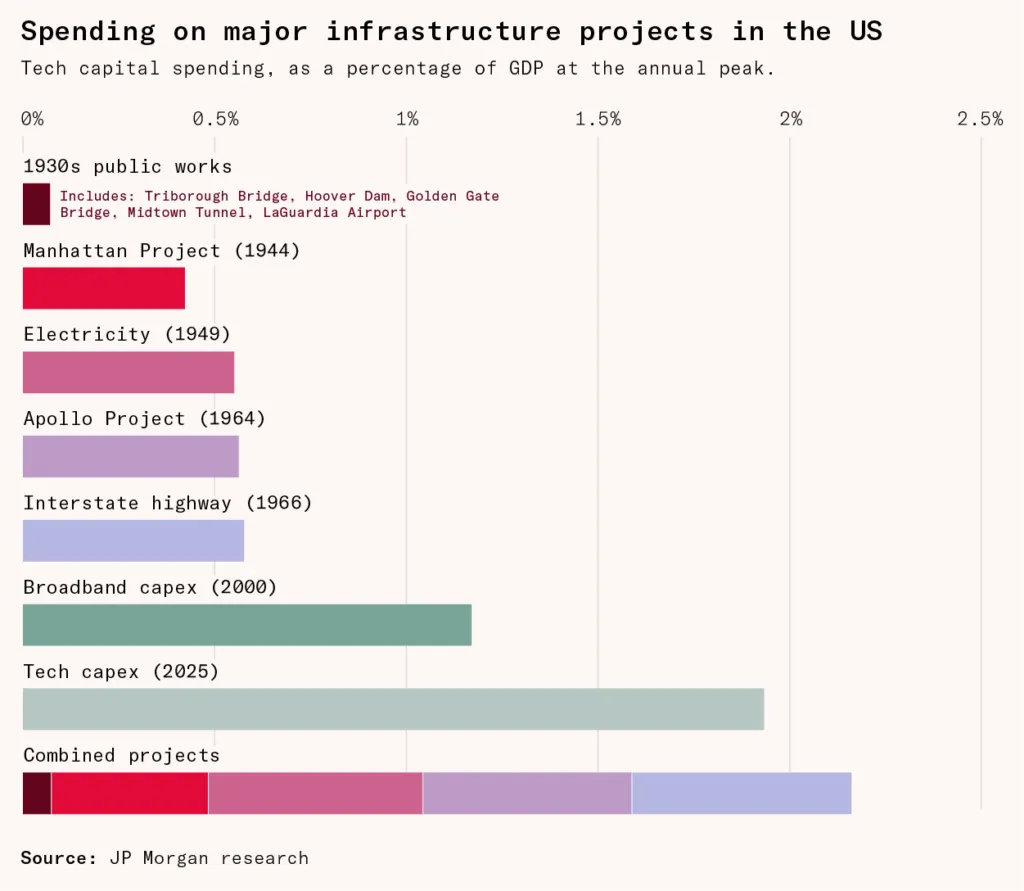
Of the items on this chart, I would say AI data centers are providing the least amount of value per % of GDP spent.
And 1930s public works the highest.
I wonder how public works funding would look if 90% of the nation wasn’t painfully far behind in maintenance.
But also, AI data centers have been around for like 3 years. It’s not surprising they haven’t reached a high level of efficiency yet.
IMO they are not an argument against excessive power use (I know this is not your argument, just a common one), but rather and argument FOR better (read: nuclear) power generation.
"AI data centers" are so non-central and located in places so data-sparse (yet rich in cheap electricity) I consider them more likely fronts for crypto mining.
Remember when we didn't have enough electricity for electric cars?
From the headline:
>the problem is getting it where it's needed.
Same issue with EV rollout. EVs are great if you have a single family home and a few grand to spend on outfitting a fast charger. Most apartment renters however are shit out of luck. I mean it has been how many years now of EV cars on the road and virtually no sweeping buildout of EV chargers in apartment complexes that I can see at least. There was a push for like maybe a half dozen token ev charging spots in new parking garage construction but that has been it for years in terms of that scale, a sort of nicety not something you can bank on having when you go to one of these garages. Street parking EV hookup has also not been rolling out at any serious scale. There is 1 single ev street parking spot in my neighborhood; they put it in years ago and nothing more has been built since.
I know someone with an EV in an apartment without a hookup for them, and charging it is a legitimate constant chore as they have to plan to go somewhere offsite to do it. Frequently they can't take the EV and have to resort to the gas car because the EV is at 20% charge or something.
I think what we are seeing with EVs is akin to general K shaped economy phenomenon. The rich and rich government leadership assume rollout must be going well, since they can charge conveniently at their house and they see many other Teslas in the parking lot of the country club or the luxury shopping center. Never mind actually considering how a renter's experience might be different, and renters are the bulk of our cities.
We still don't.
Until free/at cost car charging is provided at work when the sun shines you're just moving the place where combustion happens.
This may be a worth while trade in downtowns where the main form of car pollution is engine exhaust at an average of 20mph.
Yeah seemingly this is not a problem with data centers. I am sure it was astroturfing all along. Also you never hear about climate change even though that's the cause of the heat wave in Europe and the US
I think Elon Musk would have happily built gas turbines on high-rises if we let him build them in the middle of the city to power those electric cars. I don't think that's a good idea, though.
Have you seen the price of electricity?
That's with only about 5% of cars being electric.
We've consumed nearly all of the slack in transmission capacity.
I'm expecting transmission costs to balloon.
Project Kilby is probably the most intelligent approach to this problem so far.
https://www.chevron.com/newsroom/2026/q2/chevron-signs-20-ye...
The idea is to bring the data centers, power generators and energy supply together in the ~same physical space so the only thing you have to transmit is data. Moving energy is way more expensive than moving information.
Are you really saying that in 2026, a year when only the nuts are still trying to claim climate change isn’t a thing, the most intelligent approach to the problem of powering data centres that are mostly being built for the purpose of juicing share prices is gas turbines at an industrial scale? The most intelligent approach is to not build the things. The next most intelligent approach is solar and batteries nearby. Way down the bottom of the list is burning gas to power them.
> Moving energy is way more expensive than moving information
But this project is still moving energy- it's just moving natural gas instead of electricity!
The ocean tidal power data center idea was a neat one.
Question for the experts: does the power crunch mean that AI hyperscalers will turn off previous generation GPU datacenters to free up power for their new Vera Rubin GPUs?
I think it’s more likely we’ll raise prices until demand lowers enough to match supply.
I think at the very least, once the dust settles, a lot of these datacenters could become really really cool haunted houses, giant escape rooms, etc.
The real "AI" success story will be the person that makes an IRL backrooms theme park in the husk of a datacenter.
Or: laser tag park, the vests you wear are in part old tpu/gpu components.
Or: filming location for the next Bond movie
Apparently they're fast tracking gas fired power plant approvals, so we can expect production to increase and the climate crisis to worsen. https://www.motherjones.com/politics/2026/07/donald-trump-ep...
Supposedly the backlog for gas turbines is over 5 years at this point, so they can approve all they want.
These gas fired plants are just not that meaningful, it's too little to be a big deal - we're limited by gas supply and pricing. Renewables are already most new generation: https://environmentamerica.org/center/updates/renewable-ener...
The primary bottleneck to this growth is the availability of electricity.
The bottleneck for building some AI datacentres and switching them on is electricity, sure, but that's not what drives growth. There also needs to be demand for the additional capacity; people need to be waiting for capacity to catch up so they can do the useful work that grows [society|GDP|something] that they aren't doing right now.
There's also very likely to be diminishing returns from additional capacity if we're near or over the limit of productive use. And there's the opportunity cost of what could have been done with that [money|land|electricity].
This is a much more complicated system than "people say they need more AI -> build datacenter -> power datacenter -> magical growth!"
In the Innovation Adoption Curve, we are absolutely beyond the Early Adopters phase and possibly the Early Majority. The growth rates necessarily have to start trending down because there’s no one left to sell to.
I cannot currently access Fable class models, I am out of usage credits.
Anthropic is removing these larger models from personal plans at the end of the week to focus on selling it to enterprise users.
Putting these more intelligent new models into the hands of more people seems very worthwhile to me.
The most important sentences of the article are:
"Discussions about expanding electricity supply to power the future often become debates about which source is most suitable: gas, nuclear, solar, or something else. But these are a distraction. Far more fundamental is ensuring power can be efficiently delivered where needed."
This is the reason why data centers are not run only on cheap solar power.
1. People fighting back due to never ending effects caused by these massive data centers
2. Companies realising that they are burning half million to get nowhere
3. Circular investment scaring investors
4. And more recently, companies hiring people back coz the AI aimed to replace humans, created more problems than solved them
5. Memory cartel falling apart, again, they did the same thing during 2000s
6. China is making good ML free, supply and demand, destroying the US tech token business model
7. Even META has too much computer power and no enough use for them.
Those are the main reasons why AI buildout is not just slowing down but falling apart faster than expected.
> AI buildout is not just slowing down but falling apart
Premise perverted, FUD averted, false-victimhood denied.
A datacenter did not murder your family.
‘the abundance of [AI] will be limited by the abundance of energy’.
And the reason current US policy opposes clean, renewable energy is --- purely political.
You don’t even need to mention the long-term sustainability benefits of renewable energy. It is simply the dominant option economically. Dollars in, watts produced, fossil energy can’t touch it.
Politics is merely a downstream effect of the root of the problem: corruption and regulatory capture. Regression into the authoritarian petrostate pattern.
That's true, but it's bipartisan policy. The Trump admin obviously is fighting wind, though solar is just too useful to be able to be stopped even by them. But it's also popular among environmentalists to fight solar projects https://v2.courthousenews.com/greens-fight-mojave-desert-sol...
And Indian Point in NY is the classic example of how nuclear was supposed to be replaced by renewables but was replaced by gas (and many solar installations in NY were blocked so we're not coincidentally here): https://www.theguardian.com/environment/2024/mar/20/nuclear-...
So, it's political in that our policy is in line with what most people want: fewer renewable generation stations. But there's no outside enemy to conquer here. We've just collectively decided on this equilibrium.
Who is opposing renewable energy? Texas is projected to top California as the state with the largest amount of solar before the end of the Trump administration.
TFA isn’t about consumer usage, it is about training the next generation models. An interesting thought I heard recently is that a SOTA model has about the same parameters as the number of synapses in a Golden Retriever’s brain that are not dedicated to biological processes like breathing. Most of that should be wrapped in double quotes, don’t take it literally! But that number is about 100x lower than the same synapses in a human brain.
If the next order of magnitude costs 40B, I wonder if it’s even possible to get to the one after.
This is part of why the AI bubble will burst. The only way to make the profit numbers backing the loans to AI companies is to get increased capacity, and the capacity requires energy, and the energy won't arrive in time, only partly due to all the factors here, and partly because building transmission and generation is speculative and can fail for a number of reasons.
US administration can try to pull a China and basically remove all regulatory barriers (following existing playbook of "do whatever we want and wait a year or two for the courts to catch up and stop us"). It'll create havoc that will make people very upset (more so than the people that already protest DCs in their backyards). But even then, it's construction on varied terrain and property over long distances; you can't predict exactly how that will go. Triple the estimated timeline and that is probably doable, but current AI investment likely can't wait that long, unless somebody can pull additional hundreds of billions out of a hat to extend lines of credit or a ponzi-scheme-esque paying-creditors-with-newly-lent-money. In that time the market will realize the hype was hype, the gains were modest, they'll start divesting, and then the house comes down.
One way around that might be to deploy thousands more gas turbines and make rural air quality look like 2010 Beijing. It will probably happen if things get really tight, and we'll see how the current administrations's base responds; if they stick it out, the market gets a reprieve.
Maybe it's the same thing I heard it was six months ago when it was determined that more hardware was sold than twice the nation's supply of electric.
> But if AI is a race with national security implications, they won’t be fast enough.
I really don't think this is the case. As far as I can tell there are two national security things where LLMs have some utility; mass surveilance (ick!!!) or software security. To me that does not justify a huge infrastructure buildout considering the implications of said infrastructure.
Crusoe bypasses the grid completely by leveraging old batteries and wasted resources to power compute.
I don't get why its hard to find electricity for data centers. Just build them where its cheap, like the deserts in China and stuff. Duh.
We should have been building more nuclear. We’re not going to upgrade civilization with windmills and putting on sweaters. Think of how much power we’ll need for millions of robots?
Always double down on bad decisions.
kind of reminded USSR history of 100 years ago - a mostly agrarian country destroyed by war and revolution doing jump into industrialization with electrification being the driving core of it (the other major factor was GULAG - electrification plus unlimited free labor - winning formula :)
https://en.wikipedia.org/wiki/GOELRO
"In 1920, British writer H. G. Wells visited Soviet Russia and met with Vladimir Lenin. Wells believed that it was impossible to realise the Russian revolutionary’s plan, as he wrote in his book Russia in the Shadows:
For Lenin, who like a good orthodox Marxist denounces all "Utopians," has succumbed at last to a Utopia, the Utopia of the electricians. He is throwing all his weight into a scheme for the development of great power stations in Russia to serve whole provinces with light, with transport, and industrial power..."
Our civilization is converging on electricity right now. 200 year ago electricity looked like a set of disparate phenomena. I wonder if in 200 years we'll be basing our society on some new energy form instead of electricity - something like gravitational conductors or some StarTrek singularity generators and plasma coils.
"The primary bottleneck to this growth is the availability of electricity."
We put the cart before the horse, lets stop talking about growth and focus on making it useful first lmao
The politicization of AI has been a huge damper. NYS put a 1 year moratorium on datacenters with some municipalities doing so as well. My town did a 1 year ban, despite us being a retarded location for a data center (more expensive land than surrounding areas, less water access, far from power). US has also been lagging in power capacity, because of the anti-growth segment of politics. More nukes.
Peak demand
Not enough!
Cheap ubiquitous distributed power systems will change the world in many weird ways. Watch small modular nuclear offer home installation for ~$reasonable and getting cheaper every year.
Fast forward 20 years from the advent of essentially infinite energy results in WWIII and a new “Great Detente” but only after all the assholes have wreaked all the havoc they can.
There are dark days ahead but ultimately a brighter future. Sucks to live through that transition phase though.