▲ 255 points
back
55 comments
The Sega CD is my favorite console and I was fortunate enough to have one growing up. Silpheed was unlike anything else. Unlike most FMV games, Silpheed actually felt like controlling a movie. During the first level when laser blasts are tearing through the fleet gigantic ships filling the screen with debris, I could barely believe what I was seeing.
As the article points out, while it is an FMV game, it tries to fool you into thinking it’s a polygon based game. The Sega CD had no 3D capabilities at all (just 2D rotation and scale). But GameArts pulls off the FMV so convincingly, down to the aliasing, that it’s hard to understand (at least to my 12-year old self) how it could be anything other than 3D rendering.
It’s often panned as not the best shooter, but the gameplay was secondary to the experience. I don’t know how it would play for someone who didn’t experience it at the time, but it will always be one of my favorites on the system.
Yeah Silpheed is a great example of designing a game around the strengths of its target hardware. Because they were able to focus the art design around what could be streamed at high quality off a 1x CD drive, the FMV works a lot better than it did in games like Night Trap and Wirehead that tried to shoehorn live action video into a console that wasn't capable of displaying it at a decent quality. The actual gameplay is similar to an early 1980s arcade game like Galaga, but I agree with you that the presentation makes it worth playing at least a few levels of Silpheed even now.
I remember when people would talk about a new game they hadn't yet tried and the first question was "How are the graphics?". They truly did amazing work back then to push the limits of systems so they could present things that the machine wasn't expressly built to accomplish.
The soundtrack is absolutely phenomenal. I pull it up on Youtube once a year or so just for kicks.
Silpheed by Sierra On-Line for the PC — ported from the Japanese PC-8801 — was similarly good, possibly the first game I played with a proper sound card. The MT-32 version blew my twelve-year-old mind.
> Silpheed by Sierra On-Line for the PC — ported from the Japanese PC-8801 — was similarly good, possibly the first game I played with a proper sound card.
I had a similar experience, as it came bundled[0] with the soundcard for my IBM PS/1 286, and it even had speech(!) during the introduction.
[0] https://pixelatedarcade.com/tech_attributes/overview/ibm-ps-...
Agreed :) lots here to play with: https://chiptune.app?q=silpheed
I have a fond childhood memory of singing along to one of the songs with my little brother a lyric we made up "One.. more... hit and you're dead, one more hit and you're dead"
Watching the video linked at the end of the article my first thought was "Starfox, eat your heart out", but watching the gameplay I noted that at its core its a really basic shooter and it can be quite hard to keep track of the enemies and projectiles with the background going nuts like that.
I just saw a video of it. Impressive. Were the enemy ships hand drawn 3D plastered on sprites? Or was there some actual realtime 3D rendered by the CPU? The boss ship I saw looked like realtime 3D.
There's no realtime 3D. This boss fight [1] looks super impressive, but the boss structure is FMV, your ship and bullets and stuff is all sprites overlaid on the FMV. (and the FMV is decoded to sprites too)
(Stated confidently to ensure a correction if I'm wrong)
I think there is realtime 3D used for the player and enemy "sprites" (really 3D objects), including the end of stage bosses. They are small and extremely simple, as this was the maximum the Genesis/Megadrive's 68k CPU could handle. The final boss fight is the exception.
Silpheed was amazing back in the day. It was one of the first titles that really showcased what CD drives could add to games in terms of cinematic experience. The live orchestral music gave it an epic feel and the mecha-design of the SA-77 is beautiful and modern even by today's standards.
I'd be very surprised if player and enemy graphics are realtime 3D. Those look very much like typical sprites where you use different sprites for different angles.
The player ship rotates, but it only is 'rendered' at a handful of angles. This is a very common technique, but here they've used an art style to make it look like realtime 3d.
It's like stun runner on Lynx [1]. The Arcade stun runner was polygon based; but the Lynx doesn't have a chance, so there's just a ton of sprite options for rotation and a lot of work to make it look the part [2].
[1] https://youtu.be/4PEAzBtaStk?si=QXWf9KDUBjQRgoDh&t=204 [2] https://forums.atariage.com/topic/194231-lynx-stun-runner-3d...
I'm sure they are 3d models and are rendered using the CPU. You can check by entering the secret Options Mode and selecting the Polygon Test, which will allow you to freely rotate your ship and the enemies, including the end of level bosses (except the final one). Screenshot: https://www.vizzed.com/vizzedboard/retro/user_screenshots/sa...
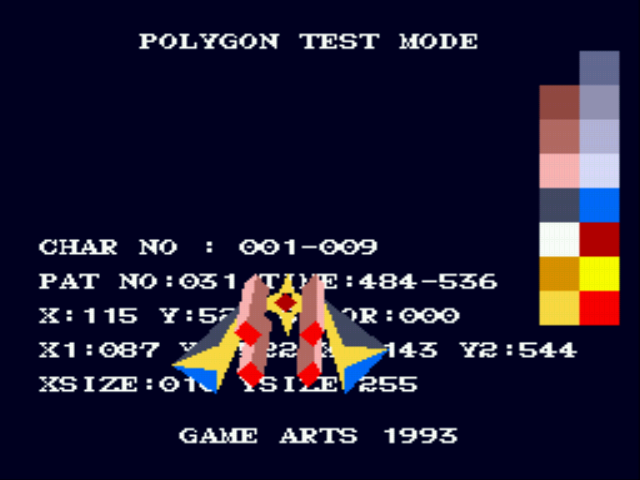
Fabien seems to be unaware of this, by the way.
This is also why the game play is so bland. The number of 3d objects and their complexity was severely constrained and did not allow for varied or more sophisticated game elements.
If you've never seen Overdrive 2 by Titan (a demo scene group), it's unbelievable what the MegaDrive can do stock.
https://www.youtube.com/watch?v=gWVmPtr9O0g
I'm reasonably familiar with the hardware, I've written some games from scratch and I still have absolutely no idea how they did most of it.
This was submitted by a bot :D I subscribe to Fabien's RSS and he must have changed something in the server because I got this post on my RSS reader (again, as it's an old post), and here it is submitted to HN (again)
I manage my RSS by hand (I should really fix this) and update it when I am ready to publish something.
Someone emailed me to tell I had a typo in the URL of the Silpheed article. This must have unlocked the bot maybe?
https://youtu.be/IehwV2K60r8?is=WWZU3R1PMAQksHhj
How they fit the Sonic 3D intro onto a sega mega drive _cartridge_!
Summary:
It's low resolution at only 256 x 80, stretched vertically to the screen size.
It's only 16 colors so only 4 bits/pixel.
That comes to 10kb per frame.
A variant of Huffman coding gets it to 3.52kb per frame.
It's at 15 fps and is 12.5 seconds in length.
15 x 12.5 x 3.52kb = 660kb, which fits in a 4mb cartridge.
There is dithering to give the appearance of more colors, and it's done in vertical stripes rather than checkerboards because that compresses better. Then at runtime, every other scanline is offset by 1 pixel, and in opposite directions every other frame, so the dithering blurs back together to give the appearance of many more colors.
I think the article is sorta wrong about the sound setup, the Mega Drive I does have a sound input on the expansion port, and mixes it into its sound output. Otherwise stuff like RF cables wouldn't get Mega CD based audio (and you can do silly stuff like a Mega Drive II, which doesn't have a headphone port, with a Mega CD I).
I was going to say the patch cable setup was just a passive aid to take the Mega Drive I's minijack stereo output (the big DIN AV connector on the rear only does mono) to a more serious two RCA jack setup. But looking at a schematic to check, it does do more stuff, and apparently connecting the patch cable will reroute stuff so the sound mixing is done on the Mega CD side, not the Mega Drive side (early Mega Drive revisions are somewhat infamous for showing that Sega hadn’t quite mastered the dark arts of analogue sound circuitry).
(I would double check some of this, but my Mega Drive / Mega CD setup isn't to hand, and the CD drive is broken anyway, although I understand the JP/PAL piano tune on the logo screen is all from the Mega CD side?).
So the problem with the Model 1 that the mixing cable is trying to solve is that the expansion port on that model has audio input pins, but no audio output pins. Now strictly speaking, this is sufficient if you just want to use the MD1's headphone jack (stereo) or A/V out (mono), but in addition to the analog audio circuitry not being amazing (though honestly the MD1 is much better than the MD2 here in general) it also imposes a fairly aggressive low-pass filter. This is rather undesirable for 44.1 kHz CDDA. As you note, the mixing cable allows the RCA outputs to be mixed on the CD hardware side which works around this issue.
On the MD2, they added audio output pins to the expansion port in addition to the existing audio input pins. This allows them to achieve the same effect with no mixing cable.
The Sega CD manual says that the RCA jacks are for connecting the Sega CD to a stereo system or stereo TV. I guess they found that doing the sound mixing on the Sega CD made the output cleaner which would have been useful for people wanting to use it as a CD player instead of just for games. The mixing cable is necessary to use the RCA jacks on the Genesis 1 because the system does not have a sound OUTPUT on the expansion connector, only a sound INPUT. The Genesis 2 repurposed a couple of previously unused expansion pins as sound outputs, which let the model 2 Sega CD do the audio mixing without needing a patch cable.
> I think the article is sorta wrong about the sound setup, the Mega Drive I does have a sound input on the expansion port, and mixes it into its sound output.
The Megadrive has a stereo sound input on the cartridge port too, for a total of 3 stereo sound sources (the YM2612, the MegaCD, the cartridge) plus one mono source (the SN76489 PSG).
As far as I know no original release ever used the cartridge input, but nowadays it is supported by many flashcarts to emulate the MegaCD or to provide CD quality audio tracks (MSU-MD and MD+ romhacks), and it has been used by some recent games.
The 32X used the cartridge audio input for its PWM audio channels. For one example of how this worked, Knuckles' Chaotix used the extra channels for the percussion in its music: https://www.youtube.com/watch?v=L6BSQVK9gSc
I always though that the audio mix happened in the 32X itself, much like the video mix, but I just checked the schematics and you are right (page 7 of https://segaretro.org/File:Genesis32XUSManual.pdf)
I have a Japanese 32X and a copy of Knuckles Chaotix, but I have yet to play it so I didn't notice the sound xD
Using the ASIC meant for bitmap rotation and font rendering in an almost MPEG like fashion. Super clever.
> That was a departure from how I normally work since I did not write a single line of code. I will likely write something about my A.I framework (and opensource it) next month.
If the author is around, super curious how they got to enjoy their workflow here in a side project, working with AI. This kind of situation, to me, is often where the joy is gone.
I have a writeup I want to publish about it.
- I felt like Tony Stark inverting Möbius strip to solve time-space navigation with AI.
- Any idea or gut feeling I had, I could verify very fast.
- I had to write a mini Genesis emulator to test the pipeline and it was very pleasant to direct the LLM to write it for me (with clean code and architecture).
Excited to read if you ever get to publish! In particular 1. made me even more curious.
I do get most of my AI value on prototyping [small codebase] & summarizing.
Personally, I find LLMs really fun to work with, and the more capable they are the more fun it will get. It's one hell of a force multiplier.
It is fun in a totally different way than programming is. The "fun" or "joy" isn't coming from the sense of accomplishment of writing code or building software per se. Now it feels like it is just the joy of being able to prototype or debug or reverse engineer literally anything at a pace way beyond what you could've ever hoped to before. Have you ever dreamed of developing some software, but realized it was simply too big of a scope for one person? It might not be, anymore, even if you don't go full vibecoder.
The only real problem I ever had with this was the quality of the code. Sometimes it doesn't matter, like for pure prototypes or even reverse engineering, but sometimes it does. My heart sank a bit when I tried Fable to find that it was much better at long tasks and more ambitious in general, but I still didn't like the code much more than Opus 4.7 or 4.8. However, I'm pretty pleased with the code quality of GPT 5.6 Sol. This is a silly thing to care about but I love that by default it doesn't print code comments like a CVS receipt printer adding all kinds of pointless crap that is either apparent from context or irrelevant outside of the conversation you were having. Generally I've also found it to be super good at debugging, usually able to zero in on the actual problem with surprisingly little effort, even with not much context; I wish my debugging foo was that good. I gave Codex a spare machine to test something with real hardware and it has done a fantastic job making use of it.
Then of course there's the problem that I really don't like OpenAI or Anthropic very much. But it seems the news is good there too: even if we assume open weight Chinese models are at least less than 12 months behind on coding performance, then by next year we should have quite a lot of options for how to go about things. Evidence suggests 12 months is probably an over-estimation, and even now I use GLM 5.2 quite a lot at work since it is simply good enough. So... we're getting there too.
Obviously it's a little scary to think the world may need fewer programmers when you are one, and this is maybe not the way that I wanted programming to become accessible and democratized, but beggars can't be choosers. If the future is me being able to run an army of virtual programmers on a GPU cluster, I am interested in seeing what cool shit can be done with it. And when the hype and doom cycle finally ends, I hope everyone else will realize how fucking cool it is, too.
Cool article, but Silpheed is a genuinely awful game. Just warning if you are tempted to play it after this lol
The DOS version has a special place in my heart. I memorized the opening text and thought it was an eerie and cool bit of original poetry, before learning much later that it was a quote from Shakespeare's _Julius Caesar_. I still remember my preferred weapon loadout.
Yeah, it doesn't hold up by today's standards, but it was stunning in its day.
Somewhat enjoyed the (less-visually-impressive) PC version way back in the day, there weren't many good shoot-em-ups on a 286 PC that could barely scroll the screen, but Silpheed played fairly well on it, and IIRC it was one of the few games that supported the non-standard sound card on my parents IBM PS/1. Actually think it might have been bundled with that PS/1
> one of the few games that supported the non-standard sound card on my parents IBM PS/1. Actually think it might have been bundled with that PS/1
It was.
https://pixelatedarcade.com/tech_attributes/overview/ibm-ps-...
Sounds like a great candidate to watch a LongPlay instead!
I've replayed it hundreds of times. It's pretty fun. I got to the final boss but didn't win.
Agreed, the original is awful too.
I mean, the gameplay isn't amazing. But I wouldn't call it awful. I've played games that are a lot worse... many of which are less fun while also being much less visually appealing. IIRC the sound design for silpheed is good too?
The sound design is amazing! Having the squadron announcing incoming threats on comms in full CD quality was also a unique and fresh experience. I’m sure Wing Commander and others did it earlier on PC, but for a console game it was very immersive. Seeing gigantic lasers take out huge ships and hearing the panic from the other pilots is fun, even if it plays out the same way every time.
7 of the audio tracks are CDDA audio as well. I seem to recall playing those in my discman at the time.
It’s a shmup, they can’t all be Ikaruga.
> I’ve played games that are a lot worse…
These things aren’t mutually exclusive. This can be an awful game (which it is) and not be the worst game ever made. And as with anything, it has its strong points too, just that as a complete package, it can’t be called a good game.
If your scale has only good and awful, you miss nuance.
I don't think the same adjective should be used to describe both both Trolls on Treasure Island and Silpheed. :P
Just thought I'd chime in! Started on the IIgs, loved the graphics, music and artwork from the manual. I even use the hand drawn sketch of the 'dogfighter' as my twitter pic.
I had this game as a kid. Although it looked good, the gameplay left a lot to be desired.
Anyway, another great article from Fabien.
Delete the si parameter from your YouTube link. It identifies your YouTube account to Google.
Fixed link: https://youtu.be/GBS332N6wig?t=1749
The Apple IIGS version was great!
Am I the only one who's no longer impressed by demonstrations that one turning machine can emulate another?
Now do snatcher