▲ 71 points
back
96 comments
Cars have become absurd. We have an older car, and I occasionally look at what we could replace it with, and everything is huge and expensive. Literally, the only car I have been interested in is from BYD and will never be available in my country.
Mitsubishi just discontinued the car line that I drive [0]. The Mirage was great. I can drive from NYC to Boston on ~10 gallon. The only downsides were: No arm wrest, no sunglasses holder, and the media console won't turn on if you leave the car in the hot sun for a while.
I'm hoping to make my next car an electric car but all of the US ones are massive.
> I can drive from NYC to Boston on ~10 gallon.
NYC to Boston is only ~220 miles. You can drive literally any car there for 10 gallons.
Or did you mean there and back?
The Mitsubishi Mirage Cyborg ZR was a hell of a car.
One of the higher output 1.6 litre 4 cylinder engines there were(175hp). Taking that to its 8200 rpm redline was glorious.
But this isn't the car you're talking about.
Consider something other than a car.
Last year I purchased an electric scooter to complement my car. I ran into mechanical trouble with my car, and it wasn't worth repairing. Instead of replacing it with another car, I have ended up complementing the shortcomings of the electric scooter with an acoustic bicycle. In particular, the bike is better for carrying cargo (I can put things on the bike or even in a trailer instead of just a backpack; I have even moved furniture with my trailer!), and better at dealing with weather (I never have to worry about the battery getting cold or wet, and I also have studded tires for ice).
If I knew I were getting rid of my car, I probably would have gotten an e-bike instead of an e-scooter. Having both has been quite nice though and they complement each other to be better than just having an e-bike. Depending on your cargo carrying / passenger needs, a cargo e-bike or a regular e-bike may be a much cheaper way to replace your car, and may be much more practical than you expect!
We already barely drive and the car is largely just for groceries and other shopping. We can almost get away without having a car but it was be a bit frustrating and neither of us enjoy biking.
From what I've ridden in the newer models it seems like internal cabin space remains the same or is genuinely getting smaller, but crumple zones keep increasing in size. There has to be some kind of ever increasing safety bar that keeps rising every year and this is the malicious compliance they're getting in response.
In 2100 every car will have a total of 1 person of internal space, span the size of a city block and will be made entirely of cotton balls to achieve a 4 star safety rating. For the 5 star rating you also have to make sure the driver is immortal so they can't die of old age.
There is no malicious compliance, just compliance. Who would they be malicious to? There is enough competition, it would only hurt their bottom line
BYD also have some humongus cars. I have the BYD Tang and it's too big for some parking spaces.
Get a Honda Civic Type R
The philosophy that most resonates with me is Colin Chapman's "simplify, then add lightness”, so I really hate everything about what cars have become (even ignoring the spyware part, for a moment).
I want to buy a car that is like the 1988 CRX HF but with almost 40 years of engine and materials engineering advancement. That car with primitive mid-80s fuel injection could do 49 MPG and weight was about 1800lbs.
I am certain with modern engine control technology and judicious use of carbon fiber (without making it excessively expensive) Honda should be able to build a 2026 CRX HF that is 1700lb and get maybe 80 MPG. I wish they would. I wish governments would allow them to build it.
How about Yaris hybrid? It’s quite small, great performance, and very reliable.
The new Audi Q9 is absurd - https://www.topgear.com/car-news/suvs/gargantuan-new-audi-q9...
What’s even more absurd is the Chinese vehicles in the same class have better tech and prices. German auto manufacturing is cooked unless they manage to legally block the Chinese in their primary markets.
Sheesh!
> 5.31m long, 2.21m wide and 1.81m tall
vs. the Humvee, according to Wikipedia:
- 4.57m long, 2.15m wide and 1.83m tall
Eh. Old American sedans were often longer. A '77 Ford LTD was almost 5.5M in length, while this is only 5.3.
I guess I do agree those were insane monsters of vehicles. I couldn't imagine driving one of those today in urban areas.
And yet still in the standard "Jeep Grand Cherokee melted in the sun" shape. I wouldn't mind so much if the popular land yachts of decades past like the 1957 Cadillac Eldorado were revived, but today's most common passenger vehicles are still being made in the same boring sad-beige-mom shapes.
The wild thing for me is that we just recently bought an XC90 and an American friend asked me how we're managing with three kids in a "compact SUV". That car is about as large as cars get over here for the most part.
Weird, XC90 wouldn't normally be considered a compact SUV here in the US
In the USA the X5 is a Mid-sized SUV. Very weird. The X7 is just... too large.
We need a pigouvian tax based on vehicle weight to address the increased deaths due to noise pollution, collisions, and increased wear to roads.
And credits or rebates for vehicles with improved safety features?
I assume the 18-tonne lorries that move most of the world’s goods would be exempt, too, or would you pass that cost on to consumers? Just make everything a bit more expensive for everyone.
weight is the easiest measure. wear&tear on road, mpg, damage in accident all scale with weight
Deaths from noise pollution?
And this is in EU, not even America where cars have always been tanks.
I do think we will see fewer on the road though. In my city more and more streets are being pedestrianised. And unlimited public transport is only 24€ and amazing quality. Most of the people who still drive are rich foreigners that don't know any better. And also still view them as a status symbol.
Outside cities public transport isn't great though but it would be amazing if we would see car ownership decline by say 50% by 2040. Even electric cars aren't exactly good for the environment and cities become a lot more livable without cars.
The Germans will be pissed but they'll have to find new things to sell :)
A rising trend in the EU has been new buyers going for SUVs. People, especially those with families, have been buying them as sort of an insurance against accidents. You're far less likely to die in an SUV than in a sedan. Although that does mean that you become a much bigger risk for those who drive sedans.
And the windows keep getting smaller, the beltlines higher, the seats more cramped, though I don't have statistics to back up any of that.
As much as I like to hate on larger cars. In reality, I use my SUV (3 row, Subaru Ascent) all the time for camping and outdoor activities (80% of weekends or so). I just took out the middle seats to build a full-size bed platform (75x45” or so).
My wife also drives a smaller Forester that we realize could have been an EV or hybrid. Although in CA, electricity is so expensive that it’s not much improvement over gas especially if you spend more on the car itself. Really, just a same model year but more fuel efficient sedan or one of those old 100-mile range EV cars is what you have to “downgrade” too.
Of course, it’s silly seeing all the oversized, sparkling clean massive trucks and SUVs on my commute while I’m driving my heavily scratched glorified minivan (since that’s what SUVs are now days).
There's little to no incentive to buy human sized cars usually. Parking costs the same, tolls can cost the same, insurance I have no idea but I don't think size matters, and perhaps more. All of these should be more expensive, much more expensive, for bigger and heavier cars.
Perhaps in the United States, but in a number of European countries, weight is a primary factor in determining annual road tax costs, which can reach into the thousands of Euros. If they keep making cars bigger, they will inevitably become heavier.
Meanwhile the size of residential parking slots usually stays the same for decades after being built. I had "fun" of living in an apartment complex built in the 60's, one could only barely fit modern cars to the designated spots.
we're slowly moving towards a world where people can't afford homes so they'll just be living out of their cars. guarantee that some car manufacturers are already considering/getting ready for this.
Towards? You need to see how many people are doing vanlife, not by choice.
If only that wasn't illegal.
Good then that all vehicles over 6m length and 2.05m wide are not allowed to park in my city. It's good most pickups have custom wide tires, as it makes them too wide.
Australia has a similar issue, in part because we import a lot of US domestic vehicles and advertising, and in part because the ato has tax exemptions that only apply to overbuilt utes[1].
[1]: https://www.drive.com.au/caradvice/ute-tax-breaks-exemptions...
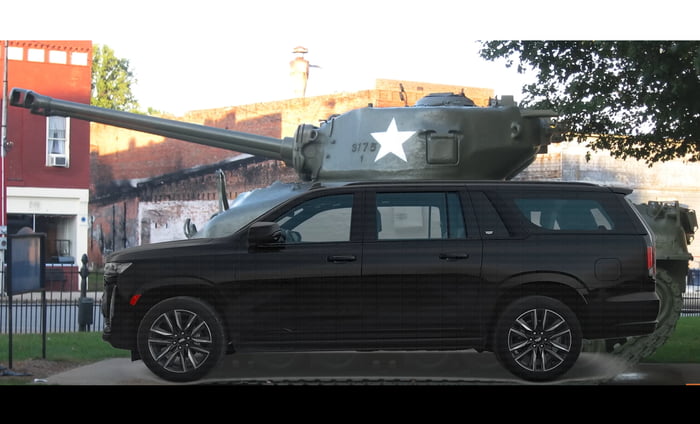
I hate this because my parking space, both at the company and at home, are not getting any wider or taller. I chose to purchase my EV6 over the Equinox EV, despite the Equinox being significantly cheaper, mainly because latter was too big (and also worse driving experience).
Cafe standards.
That’s part of the picture, but the US also has a considerable “my vehicle is an extension of myself” or “my vehicle is a major pillar of my identity” thing going on. That’s how we ended up with so many pavement princess trucks and SUVs shoehorned in where a minivan or hatchback would’ve been a better fit.
The height of hoods is at least in part because of pedestrian safety standards. I believe these originated in Europe, but I could be wrong.
A Tacoma is now the size of an F-150, they used to be the size of a Ford Ranger. It's ridiculous.
The people are getting bigger.
Like the bellies, bigger is better