▲ 167 points
back
37 comments
I used and developed software for RISC OS for many years and it was there I cut my teeth as an open source developer.
I wrote the very popular !Director application which let you customize your Desktop and add lots of nifty shortcuts. It could be expanded with BASIC plugins to do just about anything! It was distributed by the Arcade BBS to start with then Acorn User magazine put it on the floppy disk that came with the magazine.
Amazingly Director was written entirely in ARM assembler (with the help of lots of macros). I used to really enjoy writing ARM assembler and used to grit my teeth whenever I had to read the assembly output of the C compiler! I remember writing quicksort in ARM assembler as part of this (to sort menu entries) which was a lot of fun.
I still have a RiscPC under my desk, but I don't think I've turned it on for nearly 15 years :-(
32bit ARM remains my absolute favorite instruction set. And yeah, C compiler output was criminal! I wrote products entirely in the BASIC assembler. What a time to grow up!
I have a feeling I used that, either on my A3010 or my Risc PC. Thank you!
I went down a rabbit hole a few summers ago and I ended up writing a calculator from scratch in assembly for RISC OS. Interesting experience having GUI routines at the syscall level
I have a RiscPC in the shed and a half-repaired A3000. I don't fire them up them often, but both have !Director launching on boot; it is a wonderful program. Thanks!
As someone that grew up using Acorn Archimedes it's hard to express to those that were never involved just how difficult what has been going on here is or how surprising it is they have stuck at it. The overwhelming majority of us had left long before 2000 (even before 1995 really), and it's not as if there were ever that many compared to the Amiga or ST universes.
There was at least one program for the Acorn which is unique --- Cerilica's Truism --- it was a DTP application which actually simulated mixing inks and what inks would look like on various paper substrates (no need for the "C" variants of PANTONE spot colours).
I think maybe the famous surviving Risc OS application might be Sibelius music notation program.
It’s owned by Avid now but it started as the work of two brothers on an Acorn Archimedes under Risc OS.
Obligatory posting of Tantacrul's hilariously vicious kicking of Sibelius[0]
"This really is one of the great examples of breaking all UI design principles and every UX design principle too. It's like a design bull in a musical china shop."
https://www.youtube.com/watch?v=dKx1wnXClcI
[0] They may have fixed things in the intervening 8 years, I'm not a composer, I don't know.
Sibelious crashed sibelious crashed SIBELIOUS CRASHED
The black bars can stretch. They can stretch really high.
That was pretty great, Many times when someone does not like something they are unable to unable to articulate why. That video is a master class in how to critique a thing.
I couldn't compose my way out of a wet bag, but I wonder if at some level of complexity the job would be better served by a markup language? https://lilypond.org I know for complex documents, I start to really despise the word processor, Much better for my sanity to just write in the markup language in the first place, But that may just be me.
It's impressive how fast it boots up on a Pi. I've tried all the OSs for the Pi and RISCOS is way faster than all the alternatives.
The real value of a niche platform like RISC OS isn't measured by market share, but by how much of its design DNA survives elsewhere.
I've always been curious whether choices in Mac OS X might have been (unintentionally) influenced by RISC OS. I believe there were a disproportionate number of Brits on the HI team at Apple.
The stand-outs to me are the use of blue folder icons and the Dock.
https://www.retro-kit.co.uk/user/custom/Acorn/3rdParty/Retro...
There was persistent noise even back in the 90s that the icon bar was inspiration for the Windows task bar in Win95. Quite the basis for it, or if it was nonsense, no idea. (HN has previously surfaced some serious Acorn related historical surprises, so someone here may actually know).
What has been quite surprising over the years is how violently many people raised with Open/Save dialogs hate the Risc OS filer and approach to saving and loading files.
Open and save dialogs are insane. Let's make a whole other finder that's completely different to the main one we use to navigate files.
The RISC OS approach is like a million times better. The only thing I would add is a context menu to create a new file of whatever kind at this location, like The "New" menu in windows.
> Let's make a whole other finder that's completely different to the main one we use to navigate files.
In my retrospective for the original Mac's 40th anniversary, I explained the technical limitations that forced this design:
https://www.theregister.com/on-prem/2024/01/29/the-real-sign...
Paul Fellows absolutely claims that. From https://astrospeakers.org/provider/paul-fellows :
> He worked on the first generation of home computers and lead the design of the RiscOS operating system for the ARM processor, including inventing the apps and icon bar user interface that has since spread to phones and computers across the world
Many.
A decade & a half ago, I put the original project team lead in touch with the London user group, which resulted in this talk:
https://www.rougol.jellybaby.net/meetings/2012/PaulFellows/
A decade later, I moderated a virtual interview with him and the surviving core team members:
https://www.theregister.com/software/2022/06/23/how-risc-os-...
One of the core team got head-hunted to NeXT in the USA. He took his Archimedes running RISC OS with him. Reportedly, he demonstrated it to his colleagues, and presto, the following beta of NeXTstep had this new "Dock" that was much like the Acorn RISC OS "icon bar".
Well, a reminder of the origin story of RiscOS: https://binarydinosaurs.co.uk/Museum/Acorn/fellows.php
Paul Fellows later went on to be the CTO of AlertMe, which became the basis of British Gas' Hive service, and then Lowes' Iris product line.
If you want to know what it's like to program for RISC OS:
RISC OS is a really interesting and significant OS, one whose importance is largely missed by American readers.
GUI computers conquered the mass market in the mid-to-late 1980s; by the 1990s, Microsoft caught up, and the x86 PC nearly wiped out everyone else. Only Apple survived.
But in the late 1980s, the pre-Cambrian explosion, there were 4 main players:
• Apple, first with the Lisa, then the Macintosh, running related in-house OSes
• Commodore, with the Amiga, running an in-house OS built using some parts from academia
• Atari, with the ST, running an OS from former CP/M giants Digital Research
• Acorn, who stuck with 6502 longer than anyone, then did the mother of all 2nd acts with the most successful RISC CPU of all time, which outsells x86 100:1 and powers the Mac I'm typing this on.
They did it by taking their original 8-bit OS, modernising it for a 32-bit CPU, and putting an astounding GUI on it which influenced NeXT, Microsoft, Apple, Android, Linux and everything since.
People often wonder what if the original MacOS was open source, or if Microsoft open-sourced 16-bit Windows, or IBM open-sourced OS/2. Amiga and ST fans wanted FOSS versions so badly, they rewrote the entire things from scratch.
Well, here is the worked example.
Acorn's OS is still around, still maintained, still runs on modern hardware made and sold cheaply today. It can talk IPv6, has modern web browsers and email and chat and media and all that stuff that people said Linux and BSD needed for decades, and it always had them.
And it's FOSS.
The original ARM operating system
I guess technically that'd be Arthur rather than RISC OS.
My high school had a particularly well connected compsci teacher who managed to get his hands on one of the first Archimedes to be sold (using his own money it must be said ...). At that stage it shipped with Arthur because, or so we were told, the "actual" OS was still in development. As it turned out, that OS was eventually cancelled and instead Arthur was upgraded (in practice ... replaced by) RISC OS.
I still have fond memories of playing the demo that would become Zarch (aka "Virus" on the Amiga/ST/Spectrum/etc.).
Yep, I think of Arthur as a sortof Beta for RiscOS
I had an Archimedes A305 which launched with Arthur, when I upgraded to Risc OS (which arrived on ROMs, if I remember correctly, you ordered the ROMs and then your local dealer would fit them onto the motherboard) it wasn't really _that_ different, everything I'd written continued to work, etc. Like it was a major upgrade but fundamentally the same "thing".
I had that same model, except I fitted the chips myself. The first time I’d really ever looked inside a computer and very exciting for me age 11. The old Arthur ROMs were a prize possession for quite some time afterwards.
> At that stage it shipped with Arthur because, or so we were told, the "actual" OS was still in development.
I think this was ARX[0], which was overambitious. Arthur apparently stands for A Risc by THURsday[1]
EDIT: a detailed article[2], linked from lproven's article[3], about the history of ARX / Arthur / RiscOS.
[0] https://en.wikipedia.org/wiki/ARX_(operating_system)
[1] https://www.theregister.com/software/2022/06/23/how-risc-os-...
[2] https://www.rougol.jellybaby.net/meetings/2012/PaulFellows/
Oh, thank you!
I could come back to the "modernising RISC OS" piece and update, as things are now actually happening. Although I was pessimistic for its prospects, it's becoming reality.
I know of 2 main efforts...
* Merlin, an all-new OS in Rust, aiming for a very simplified modern design and backwards compatibility.
* The RISC OS Open team is rewriting it in C.
I also know of an effort involving running an Arm64 hypervisor and then running the current 32-bit RISC OS kernel in a whole-machine VM. I lack any tech details about it so far, though.
> I guess technically that'd be Arthur rather than RISC OS.
RISC OS was Arthur version 2.0: they renamed it with a more internationally-market-friendly name.
Arthur 1.2 I believe.
I think we're getting pretty close to the point where hardware manufacturers can find a niche use case for these OS's - I put ReactOS and Haiku in this set - and build custom hardware just for these OS's.
I mean, I'm pretty sure there is a market for OS's that have not, yet, been encumbered with AI/Ads/spyware/etc.
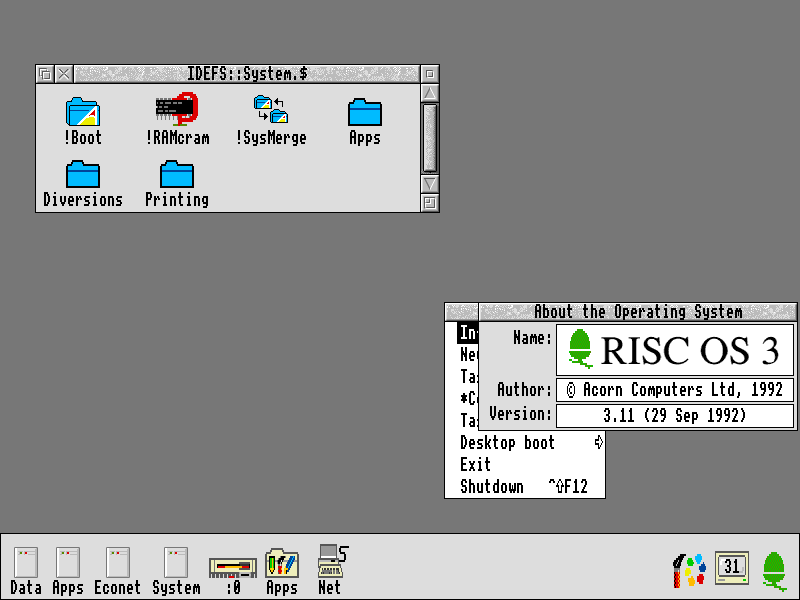
Twenty years, but apparently no screenshots. How can they be serious about making a graphical operating system with no screenshots anywhere on their web site?
I think the assumption is that if you're interested in the source or contributing, you already know what it looks like.
There are loads of galleries and walkthroughs out there.
Here's v3.11 from 1992:
https://guidebookgallery.org/screenshots/riscos311
Here's the more modern 3.7 from 1996:
https://guidebookgallery.org/screenshots/riscos37
An annotated walkthrough the GUI:
Look at that subpixel antialiased text in 3.7.
So, so far ahead of it's time.
First OS with built-in scalable font rendering as standard.
First OS with full-window dragging as standard (instead of an outline).
First OS with a taskbar/dock as standard.
there are plenty of screenshots in the user guide:
https://www.riscosopen.org/zipfiles/platform/common/UserGuid...