▲ 86 points
back
90 comments
I’m assuming the data for Europe is largely correct, but a lot of the per country data doesn’t pass the smell test to me. Afghanistan (35 days), Libya (45), Yemen (46), etc. what percentage of workers there are getting that many paid days off?
Edit - the original source even had the audacity to label Yemen with a “smiley face” since it has the most paid days for the region.
I dont want to derail the conversation about the article but what's with two separate accounts posting within 5 minutes of each other both going off about America inventing transistors?
I wonder how much vacation time the people who invented the transistor took each year.
Edit: up to three mentions of transistors now. Bizarre
That is surprising, unlike the expected USA bad rhetoric
What is going on in the US is nothing short of shameful.
https://www.bls.gov/charts/employee-benefits/paid-leave-sick...
Could be better for sure, but a graph showing the US as having 0 days of paid days off because the federal government doesn't mandate anything is misleading at best. Average US worker after 1 year of employment earns 7 sick days and 11 vacation days. And likely has some state and federal holidays off as well, and could very well qualify for state required PTO and sick time. But that doesn't get clicks and attention.
More data, if one is curious:
> earns 7 sick days
Including sick days makes the calculation worse, not better. Sick days typically don't exist in Europe. If you're sick, you obviously just don't go to work. What's the point of infecting the whole office?
On average, workers in Europe take about 2 to 3 weeks off each year due to sickness in addition to their vacation. In fact, if you're sick during vacation, that doesn't count as vacation time, at least in some European countries.
> employment earns 7 sick days
ugh, "sick days", what an absurd concept. If you are too unwell to work, you don't go to work , of course, and get paid while at home, until you're healed. Not 7 days, not 2 days, just the amount of days required. putting a number on that. ugh
and 11 vacation days. Wauw. After a decades of working in Europe you can get a good amount of holidays. in 2025 I had 49 day of which 20 are that minimum you start out with. Every overtime and outside business hour call also gets recovered, that's an extra 3 days so we've passed 50.
but what else is new, in the 80 and 90s workers in US were boasting about doing 80hrs of work each week... like wtf :). They live to work, I prefer to work to live life.
I wouldn't take into account sick days, because this article doesn't also.
I think an interesting point here is there is no substantial difference between allocated vacation days if you work for the government or a private employer. One would think the government would set a good example.
11? And that's good?
"Earning sick leave" is some dystopian bullshit. If you are sick, don't go into work. You don't need to earn it.
I've never worked at a job that didn't offer some form of PTO, only exception is when you are doing contract work and not a full time employee, you simply take time off when the rest of the company does for no pay during those windows of time.
The US has generally higher wages than Europe and lower taxation rates. Those paid days off are not free.
You're assuming that's due to more days off? I have my doubts. I think the US could offer more paid days off, and it would retain its higher wages and lower taxation rates.
You talk as if you believe low taxation rates are good for low earners.
Switzerland has all that and paid days off on par with the rest of Europe.
I think we're slightly below average with 20 vacation days per year as the legal minimum (compared to 25 on average in the EU?).
Still significantly higher than the US, and with notably higher income/GDP per capita, so indeed it doesn't seem to be some linear tradeoff.
And the US has the lower life expectancy.
Now, now. That is also related to our completely shitty, overpriced medical care!
> higher wages than Europe and lower taxation rates.
ah yes live to work. Not work to live right?
> lower taxation rates
eh.. many western countries have comparable taxation rates. That's not true.
Regardless it would be nice to have the choice to work 75% the hours for 75% pay. Not many jobs offer that, though.
Everything in the US is built around maximum value extraction for corporate profits, and I believe this is just another cog in that system.
This comment needs to be pinned.
The areas with the highest wages are disproportionately more expensive, and the personal risks forced on both workers and the unemployed are far dangerous. (Esp lack of healthcare.)
What do you mean by "lack of healthcare" exactly? Are you under the impression that it's hard to get healthcare in the US? Or that the average healthcare experience is extraordinarily expensive?
Why does it say 0 for the US? You have Thanksgiving, Christmas, 4th of July and more? Are they unpaid days off?
Depends on the company. The US maintains no requirements, federal holidays are a suggestion, not a mandate.
A few states inside the US upgrade federal holidays to state holidays to required paid time off. Most don't.
In the US paid holidays are a corporate "tradition" more than a regulated common good.
Even US federal employee holidays vary between agencies and branches of government.
Exactly. I work in retail and we have ONE guaranteed day off each year: Christmas Day. (And a lot of retail employees don't have even this!) And until recently, I never got holiday pay either.
I think they're technically not federally mandated. Businesses can be open on Christmas at their discretion and require workers to come in.
It depends on the job and is not mandated to be paid, or even given off.
Holidays are on top of vacations so they shouldn't be counted .
The rest of the world seems to believe that if the government doesn't mandate it, it doesn't happen.
well, then what happens when the company decides to revoke your pto? where do you put that into the statistics?
Because it gets more attention if they ignore reality and treat a lack of a federal mandate as meaningful information.
All I wanted from this article was a table with the list of countries and the amounts of paid days off, but the chart labels only 16 countries.
The referenced source includes an image with all of the values: https://www.moorepay.co.uk/app/uploads/2025/07/01_Which-Coun...
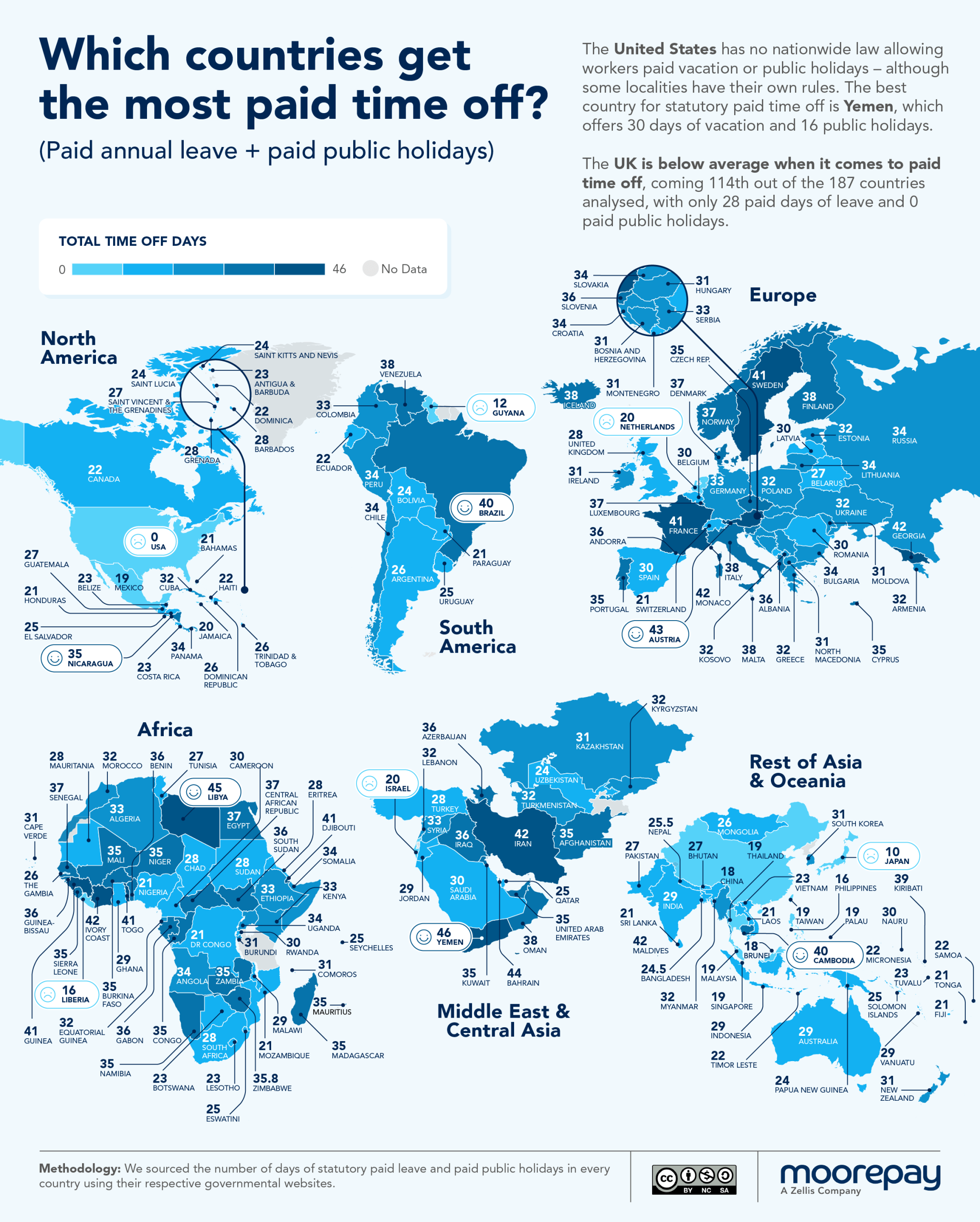
Of course, nobody really gets paid for days off, anywhere, ever. Salaries are prorated, people are paid for the days they actually work.
Are you talking about in Europe?
Because at my company, in the US, I am not required to take any time off. I can bank any amount I want and spend it when I prefer. And it explicitly is treated as a paid day of work.
Of course not, but there is a strong default option effect.
And more often then not an employee _has to_ take the exact amount of vacation that's mandated in their country.
I guess thinking from first principles probably the ideal is neither government mandating days off nor their behind terribly hard to come by.
Better imo would be - if I personally accomplished something meaningful and valuable and 'earned' time, then I am strongly incentivized to take time. Also it taking time will help my health and wellness meaningfully then I should also be incentivized to do so.
But that seems impossible to setup if we aren't all our own business owning entrepreneurs.
From the first principles, I suspect it’s an attitude thing, management-to-individual-contributors relationships. If management treats ICs as equals and tries to form a healthy human-centric culture, you get unlimited PTO. If the management treats ICs as tools to do the work and tries to squeeze maximum performance per dollar out of that biomass, you get sweatshops with zero time off. Incidentally things correlate with ICs replaceability - the more replaceable an individual is, the less reasons to care (see a work-performer as a human with needs and problems and ) business owners have. Plus, the wellbeing of the business is a likely factor - the more breathing space it gets, the more it could afford (unless greed and lack of long-term planning kills everything) to be less financially optimal short-term for long-term prosperity.
Regulations are means of pushing the bottom line back at scale. They should be unnecessary in ideal humane society, but that’s not a thing. I wonder whether there’s a way to shift the culture somehow… but there seems to be no political will for that, because it’s certainly not any popular agenda point.
As I understand it the UK holiday requirement includes bank holidays.
I was a bit surprised.
The country that does not, invented more or less every modern technology (transistors, ICs, wifi, microwaves, cellular). Mayhaps there is something to it.
You didn't invent microwaves. Well, your lot invented the klystron. Know what a klystron is? No? Well there you are.
But I bet you know what the cavity magnetron - invented in Scotland - is. You probably used one today already.
Cellular phones were invented in the UK and Finland. The US didn't even have them until the first couple of generations were obsolete here.
Transistors were invented in Germany, although they were made practical in the US, I'll them that.
Most of those things were invented by a company granted a government monopoly on communications and not allowed to directly profit off of any of those advances.
AT&T threw money at smart people and said, "Do stuff. Then we'll see if we can use it"
No one does that anymore.