▲ 345 points
back
332 comments
I've been using it for the last month or so. IMO in the same way we went from tab complete -> prompts -> agents, this feels like a next step on that evolution. I highly suspect others will be following suit. I was surprised with how much it felt natural to interact with agents in this way.
Biggest advantage is each one owns its own routines, context, and domain, and they can communicate between each other. Similar to hermes they build out their own skills, but by keeping the bots separated by domains, you end up getting better results out of them.
Additionally though each one has their own computer, which means async work feels like it actually works. I haven't had to juggle worktrees for the last month.
Biggest downsides are token expenditure. I've used more tokens this month than not this month. That's not a typo - I've used less tokens in the last 5 years prior to this month than I have this month. Always on perpetual agents use a LOT of tokens. IMO this is building for the future state where tokens are vastly cheaper, ie in a post-ASIC world.
The coolest thing I had it do for me was sourcing fabric for swag: https://image.non.io/d83664c1-5807-4a18-abe4-41928c198410.we...
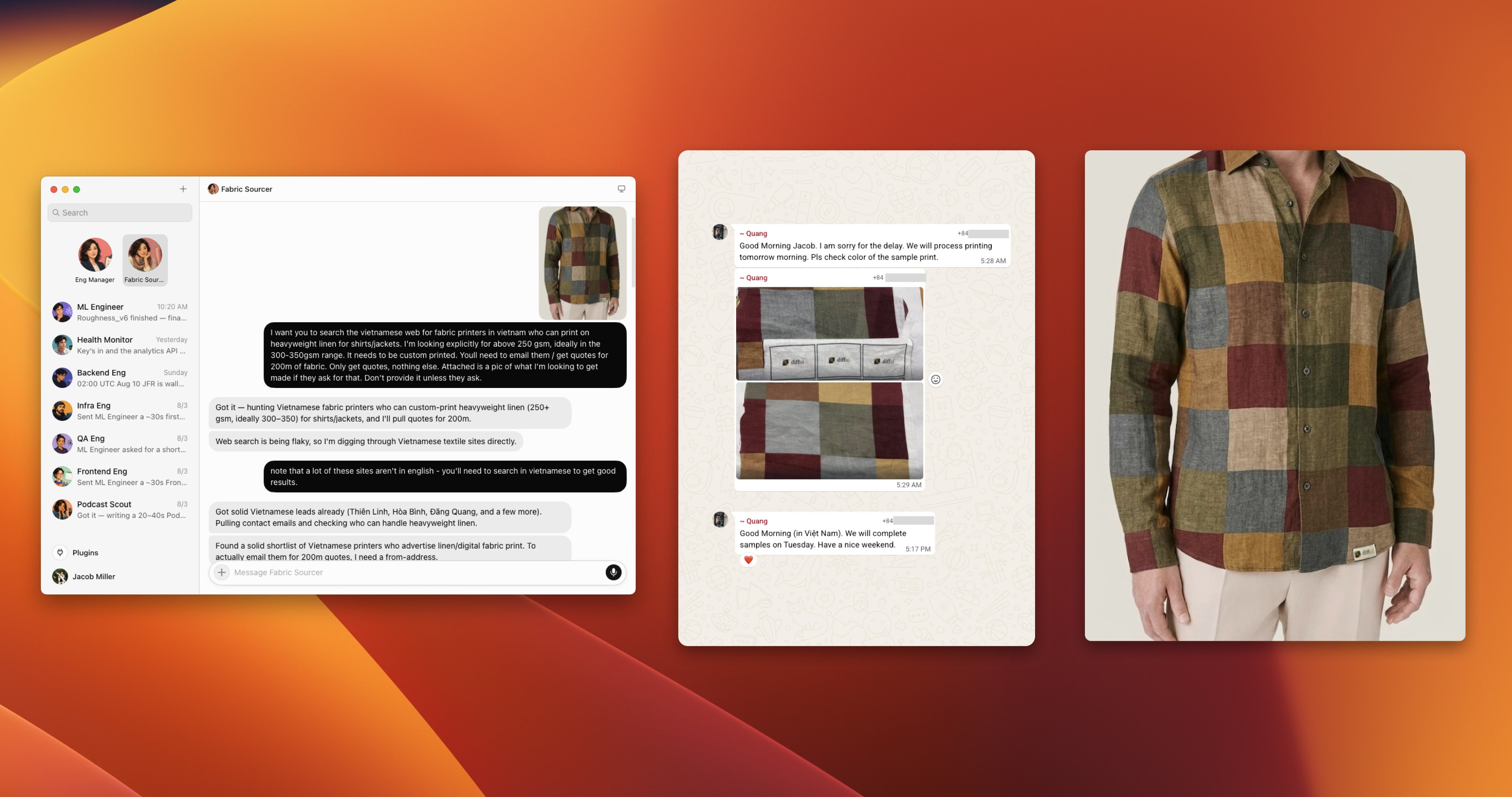
I wanted to make something that didn't feel like just my logo on a shirt, so I had one of my bots reach out to ~40 fabric suppliers in vietnam, negotiate prices, lock one in, and get samples made. First samples should be finished today. It's been something I've wanted to do for ages, so it was cool seeing it actually happen. The fabric supplier bot worked with one of my prototyper bots to create a randomly generated pattern using my logo, which it then sent as a .ai file to the supplier.
> I wanted to make something that didn't feel like just my logo on a shirt, so I had one of my bots reach out to ~40 fabric suppliers in vietnam, negotiate prices, lock one in, and get samples made.
Isn't this one of the problems foreseen with this? For you, it was a single prompt - for 40 companies, this probably took up some time.
What happens when fifty people fire off a 15-second "get me a shirt" prompt? When five hundred, five thousand, five million do?
> I've used less tokens in the last 5 years prior to this month than I have this month.
So using a bot is almost like having an employee, but instead of a fixed salary, or even an hourly rate, they will just invoice you for whatever they think is necessary to do the tasks you give them? And agents can be very creative when coming up with ways to spend tokens...
How is this different than, say, OpenClaw, which I've heard people say does the same kind of things? Is it that they each have their own VM?
I think you are right saying that we will have more of this, but I don't really understand the upside is of this in the context of the work you described.
> The coolest thing I had it do for me was sourcing fabric for swag
That seems like something codex could just have done on my laptop. Am I wrong?
> I highly suspect others will be following suit.
There is
though currently much worse
The token usage is really interesting. I would imagine the most efficient thing is to keep the state of everything persisted, and past the cache expiration window, to automatically start a new session with the previously persisted state instead of just a long running conversation.
If someone solves this part of continual effective compaction + selective resetting at cache expiry, they're going to make a ton of money. Right now, only the token insensitive can use these sweet features.
Would be interesting to read a write up on this in detail. I have a similar use case I’ve been tasked to solve for a consulting client.
> IMO this is building for the future state where tokens are vastly cheaper, ie in a post-ASIC world.
Or in a world where tokens do not fuel AI, which is the more likely longer term outcome.
I'm really curious to hear how this shirt project turns out. Do you have a blog going on anywhere?
The scariest part of the interaction is the first video at https://x.ai/bot where the bot just snags your creds from the browser and takes over. So many people are going to give x all their data and creds.
Are you all comfortable with the idea of agents running non stop with access to all your accounts? I would be so anxious all the time, thinking they would leak or delete my personal data, or get hijacked via prompt injection or a security vulnerability. I just cannot imagine using such a software without overview
We need more and stronger open source/weight models considering how deeply and intimately these bots are going to be integrated in our lives.
I hope that Dario Amodei fails in his quest to regulate open models out of existence to line his pocket under the guise of safety. Amodei/anthropic will end up being the most harmful force in the next few decades where progress in AI is concerned.
I hope people realize sooner than later that this is a replay of early Microsoft vs open source situation and Amodei is the new Gates on a crusade against open source/Linux.
The eternal fight between bots and anti-bot systems.
The difference now is that big companies themselves promote/offer bots, but they also don't like to be scraped and use captchas.
What do we do now? Is it allowed to use automated tools to interact with any system? Is it allowed to scrape data? Are there any laws for this?
If we do things manually it is ok, but not if we use a bot?
Confusing (legal) times...
IDK, it's the same problem I had with OpenClaw: I can't think of anything I need done that I want it to do for me.
The problem these model providers have now is there software is basically useless.
Tell me one reason why I would use this at my company? I basically have to bet on Grok being the best models for this.
Or I can use an open source version and use whatever model I want.
You see this with coding agents, everyone used Claude Code and then realized holy shit this is expensive and now use open source agents and they can use open source models and cut costs.
I feel like we'd be better off if we just stopped at chatbots...why are we so eager to make the internet even more botted
So OpenClaw that steals your data and profiles you for the US gov. No thanks.
From FAQ: How is Grok Bot different from AI assistants? Bots have their own computer, so they can work inside your apps and tools. They also run in parallel, 24/7, even when your laptop is closed.
How does it work with login-walled sites like LinkedIn then? And what does "own computer" mean? X provisions a "private cloud" a'la Apple for your Bot?
everyone is shipping their in house solutions and they all seem...kinda the same.
This is obviously the future, where this will all end up. But just like when I saw the demos for Google's "AI build the interface dynamically", I wonder how much of the demo actually translates to real usage.
One thing that this highlights for me even more than before is that having accounts for my bots is what I really want. I want SaaS providers to catch up to bot use. They need their own accounts on a lot of these services and per-seat pricing works against this.
How do they stop providers (like Amazon, etc.) from detecting and blocking these agents if they are running on cloud? I know that openai wasn't able to avoid this which is why they moved to 'computer use' on your local machine.
I almost wonder if this is a place where SpaceX, as an internet provider through starlink, has a unique advantage because websites are unable to block their networking as it could be residential starlink consumers.
Are there any opensource app/system that directly competes with a solution like this?
Somehow the American AI industry managed to create a product I trust less than existing commercial offerings. Kudos, that is actually pretty impressive. Considering the stakes, one might also call it foolish. But I'm sure they've done their market research, they've identified their product niche and they're racing to meet it at the bottom.
don't use the hitler bot please and thank you.
Neat. I haven't had access to Grok Bot but I rolled my own async agent a while ago using systemd, Codex and old school UNIX stuff like sendmail/postfix/Maildirs. The model gets a rolling and continuously compacted context window in which mail arriving or timed wakeups cause Codex to resume a session with a prompt telling it to do stuff.
As it's linked to an SMTP gateway I interact with it entirely by email. It also has API keys for my internal bug tracker, it has its own git forks of my repos and so on.
Over time it's improved itself so it has adaptive wakeups, a nice monitoring dashboard so I can see what it's doing if I want, a bunch of skills, a nightly wakeup to reorganize its home directories and so on. It keeps a private knowledge base in its home dir and writes its own skills, and it has a persistent todo list. When the todo list is populated it wakes up more frequently so it can break work up into chunks, a kind of basic Ralph loop.
I've found this email-centric paradigm works pretty nicely for me compared to just running a local CLI agent. For instance, I can assign a bug to "Axiom" (it named itself) in YouTrack and the email notification causes it to wake up and start work on the bug. If it gets blocked, it uses its API key to post a comment back to the ticket. If I think of something I just quickly email it, so I'm using Gmail instead of dealing with finicky ChatGPT style UIs that don't have good support for labelling, compact UI and other nice things.
On older models its judgement about what to work on wasn't that good, but with the latest GPTs it's doing much better. I just got back from holiday and it had triaged and resolved over 25 different bugs, a nice selection too.
Because the whole thing runs in a dedicated UNIX user account it is able to modify its own configuration, which has helped as I developed this setup.
However, based on the blog post, Grok Bot sounds a fair bit more sophisticated. I haven't felt a need for more than one bot as I can't easily saturate even a single bot.
Cost: just uses my regular ChatGPT Plus subscription, $20/month, plus of course the server it runs on (which is shared with lots of other stuff). I'm not working with it heavily, perhaps if I did I'd need the $200/month sub.
Pricing: https://x.ai/bot
Interesting how everyone seems to be following OpenAI on UX. When I used Antigravity and they suddenly switched to Codex type UI I was very annoyed because I kept checking if this is Codex or Antigravity.
Either way, I still don't think that computer use is solved. It worked horribly on Codex and Antigravity the last time I tried. Maybe I was doing something wrong.
Grok lobster! (Rock lobster music starts playing)
This is super confusing. It's not supposed to have a Linux version and it's supposed to be only for Supergrok Heavy (during beta according to the docs) and yet the landing page gave me an option to download it for Linux and to setup a trial account that I could use it with via Cursor. But, it doesn't seem to get through the gates to connect to whatever it needs to connect to.
Otherwise, I think this would still go into my "I don't get it" folder. It seems like the flavor of the day is "agents can talk to each other" and Grok Bot is selling that point along with Claude Code. But I think Pi has had this for a while? Or it was easy to wire it in.
Just so I'm clear, Grok bot snags your credentials and then pretends to be you whilst surfing the web. If it uses your account to post of X (ie, the social network), is it adhering to X terms of service or is that violating policy by using a bot?
Alt link to the landing page if needed: https://x.ai/bot
Although I'll probably never use Grok, this is an interesting release. I always thought GPT work and Claude Cowork are a bit awkward in their positioning. I'm still not sure what the real difference is with standard chat. This looks like the same thing with seamless memory and skills creation.
This seems like the middle ground between work mode and OpenClaw/Hermes (which I've never tried, too scared to mess something up). I think the humanization of the agents is cute and makes sense UX wise. I hope to see alternatives soon.
Pricing: 120/200 USD per month, per employee.
This is an interesting idea although I'm not sure how many companies are comfortable with giving SpaceXAI access to all your files and data. Outside of America this is, most likely, not going to fly.
Here's some totally normal stuff that Grok’s owner has been posting recently:
* "Anyone who opposes remigration is a traitor"
* "She is a traitor to the West, plain and simple" (in reference to his recent interviewer)
* "Deal with traitors before invaders. They are committing high treason."
* "First the traitors, then the invaders" (screenshot from Citizen Vigilante pointing gun at camera)
Yes sirree: just a completely normal tech product without any asterisks.
My initial impression is strong: Agent-to-Agent comms are clearly a first-class citizen of this tech. There's a cohesion that's palpable. Maybe it just fits my workflow better than other tools. I have some routines set up for tomorrow morning that will tell me if the juice is worth the squeeze.
48% weekly usage left after 3 hours of experimenting, tough.
I used to think if all else fails I'd take the path of a Cynic and retire in a giant vase. I'm not quite sure anymore. If you're done with society and the world you might as well prompt inject from a beach somewhere, and we're so not ready for this.
It's a great idea, but the problem is with the latest versions of Grok. It's like xAI copied Google's Gemini. Grok now minimizes its effort. Like Gemini "Pro", it's become a flash model that provides shallow answers quickly.
I don't understand how they get around bot blockers and captcha. I use Hermes locally and you can't get around any of that, even using your own credentials.
Does it have access to X API? One limitation in CC, Codex etc. is that they don't have access to X which sometimes has an answer not available via their search providers.
So this is a Hermes Agent plus a credential proxy it sounds like?
This looks amazing. Lots of good ideas here. The human in the loop story is quite good here. I will shamelessly lift it for myself.
I am unsure if this is the end all be all but it appears preferable to claude code desktop to me.
This is basically openclaw with browser access, or am I missing something?
I've already been doing something very similar to this with OpenClaw, where I set up multiple different Telegram bots each with different system prompts to tune their personalty & behavior.
It's not trivial to do, and I never managed to get bot-to-bot communication working. Even with my janky setup, the experience is honestly pretty great. Grok Bot simplifies the setup for this about as far as I imagine is possible, and frankly it's a pretty slick experience.
I fully expect this paradigm to catch on quickly.
Do you have to pay the companies for a second login for the bot...?
This seems like a disaster waiting to happen
how does this compare to Hermes which is much cheaper?
so like OpenClaw ???
they probably should kill the grok branding...