▲ 121 points
back
52 comments
My first experience with a computer as a child was putting a floppy disk labelled "King's Quest" into an IBM PC XT when my dad wasn't around. And now I'm on this forum.
Where might you be today if it had been Space Quest instead?
I guess it worked out in the end.
I have a framed copy on my office wall of this story from the NY Times, August 13, 1981: https://www.nytimes.com/1981/08/13/business/business-digest-...
In about 1990, my Dad gifted me an old XT. By that point it was almost ancient, no modern software would work on it, but I could do some BASIC programming, and learn DOS and a few PC magazines still had PC software on 5.25" cover disks, so I got some of those going. My mates by this point had Amiga 500s and Atari STs and the other rare PC owner I found was using 386s and dreaming of a 486 (the Pentium was still years away).
A few years later the PSU blew, a mate and I isolated it to a capacitor that burned out, we tried replacing it but it didn't work. I left it to one side and I decided I'd get back to it one day and restore it with more time and knowledge - or get a professional (I'm a software guy), to fix it.
I returned from University one break to find it missing. My step-father had known it was broken and decided it was rubbish. He'd put the whole thing - base unit, monitor, keyboard, all of it, into a wheelie bin for the council to take with the household rubbish collection.
I felt sorry for the rubbish collectors - that thing was heavy. I'm surprised it didn't break the bin, TBH.
And of course, I still haven't forgiven him. Love the guy, but man...
Anyway, when I have the time and space for a small retro computing museum, I'll be getting one of those in the collection. Iconic, beautiful, and close to my heart. And also - I can't understate this enough - really, really heavy and not something you should dispose of with household rubbish.
I was still using my XT clone (with Hercules graphics) in 1990, mostly for WordPerfect and to play SimCity. I also remember getting simcga from a friend in 1991 and using that to play some 80s CGA games. Finally upgraded to a 386SX in 1992.
I had a 386DX with Hercules Graphics around 1993. Love how high resolution it could get in monochrome. Wrote a font renderer that could scale fonts to any size. Did not have any games, but rewrote a few old VIC-20 games into Pascal.
Ah jeez, that makes me feel old. It’s particularly impactful as my dad worked in the computer industry at the time of the transition and the firm he worked for were a little late to the game. They limped on for years but ultimately failed.
My first pc ran CP/M
Yep. I had a Northstar Advantage and was able to get all the various MicroSoft Language distributions for it.
80 column text and dual floppies. Woot!
I love the keyboard casually hanging off the desk like it’s not 20lbs!
It's a weirdly unnecessary AI version of this image (https://flashbak.com/wp-content/uploads/2014/11/PA-6797798.j...). It should be a green-screen monitor, and the woman staring at the printer...
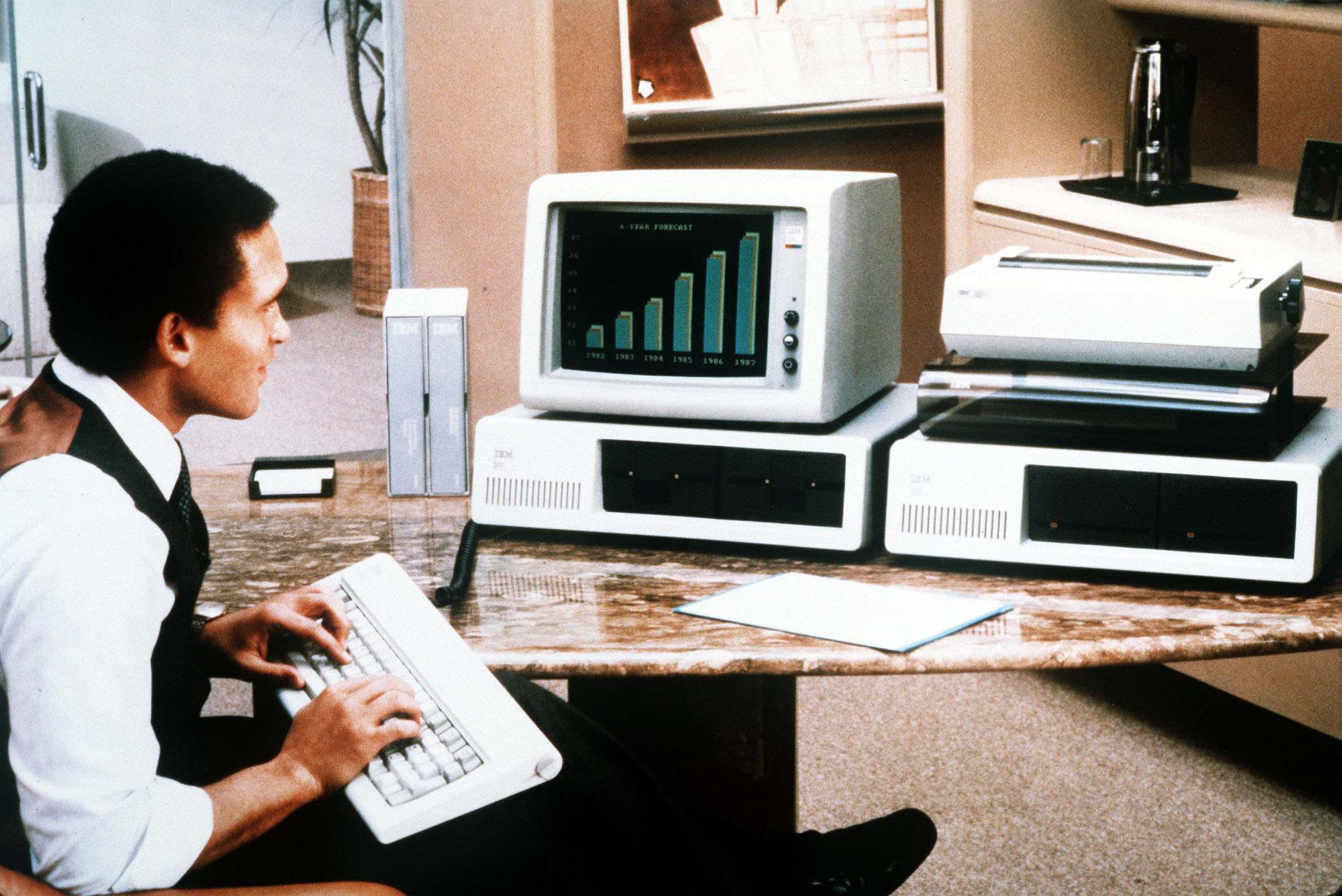
Author here. The photo is from an IBM product guide for Fall 1983 to Winter 1984, page 18: https://archive.org/details/ibm-the-guide-fall-83-winter-84/... Technically, I cannot absolutely guarantee that whoever scanned and digitised the guide didn't 'mess' with it, but nothing seems suspect to me. Certainly, IBM didn't have access to generative AI in the 1980s. It's probably just the same set being used by different people, with at most being airbrushed and composited, but not AI. Whilst the person staring at the printer is quite amusing (partly why I included it, to be honest), you may notice similar oddities in contemporary IBM marketing in general, arguably including the photo you linked as well.
Furthermore, the monitor in the photo you linked is also not green-screen (ie, the IBM 5151 Monochrome Display). It has three dials instead of two, and you can make out the red-green-blue colouring just underneath the silver "IBM" badge, indicating it is at least a 5153 Colour Display. You can also just about make out the bar chart having other colours, too.
https://sharktastica.co.uk/image?id=yysMQjg1
Admiring the keyboard layout they went with. I love that Ctrl is placed in my preferred location. That’s prime real estate that modern keyboards waste on Capslock. Unfortunately, Capslock still exists awkwardly adjacent to the space bar.
That cord storage pocket is pretty nice as well.
I became an Intel Field Application (FAE) engineer in 1988, just 7 years after the PC. At my first internal tech conference in Phoenix I was told that the reason IBM used the 8088 over the Motorola 6502 they were also looking at was because the local Intel FAE lent them an 8088 emulator. These things were a pin-for pin replacement for the chip and were the hardware equivalent of a software debugger, with single-stepping, register inspection, breakpoints etc. Having one would have made development of the motherboard that much easier and quicker. This seemed to be common knowledge in the FAE community, but never mentioned by IBM or Intel higher ups. Who knows which version is true, but perhaps a design decision based on the serendipitous fact that the FAE had a loan stock emulator in the trunk of his car when he visited the IBM team was not the story that either company wanted written.
I am not a huge fan of the IBM PC. For one, it was a mediocre design. Most important, it caused a mass extinction in the small computer space so that, even today, the majority of desktop computers out there are distant descendants of the original 5150. They probably have a complete 5150 inside them, just for compatibility with ancient software.
What the IBM PC provided was a standard on which competition was unleashed and massive investments went into improving a common platform. Which is how all the closed proprietary alternatives got overwhelmed. Without it, we would have many weak walled gardens incompatible with each other, like we have on the smartphone market.
Listen to Linus Torvalds when he says that the PC is so easy compared to the nightmare of all those incompatible arm SOCs.
I dream of a smartphone PC.
> What the IBM PC provided was a standard on which competition was unleashed
Entirely accidental. What really started this was the reverse engineering of the BIOS. This allowed any company to enter the market with a PC-compatible computer. IBM tried, but clean-room proved to be an effective defense.
> Without it, we would have many weak walled gardens
Kind of. There were Apple II clones with varyingly clever schemes around copying the original ROMs, and it provided slots so many manufacturers could provide hardware for the machines. Microsoft was one of them, with a Z-80 card that allowed the II to run CP/M software. Atari had a serial bus that allowed external expansion - less popular than the II, but still allowed other manufacturers to expand it. And let's not forget the ubiquitous S-100 bus, with hundreds of different companies making hardware for. In 1983 you could assemble a computer around your choice of processor, graphics (or not), IO, mass-storage, and so on.
> incompatible with each other
Kind of. Prior to MS-DOS, CP/M was the de-facto 8-bit standard for business computers. It had a multi-user version called MP/M, and versions for processors other than the 8080/85 and Z-80. In the higher end, Unix-compatible small computers started to appear - the TRS-80 model II could get a 68000 board, for instance.
> There were Apple II clones with varyingly clever schemes around copying the original ROMs, and it provided slots so many manufacturers could provide hardware for the machines.
It looks like the vast majority of clones used a (near bit-by-bit) copy of the original ROMs. I've only heard of one company using licensed ROMs and one company using reverse engineered ROMs in the American market.
> And let's not forget the ubiquitous S-100 bus, with hundreds of different companies making hardware for. In 1983 you could assemble a computer around your choice of processor, graphics (or not), IO, mass-storage, and so on.
These machines, in conjunction with CP/M, were the closest thing to what the IBM compatible would become, in terms of it being an open platform. Unfortunately, they were also notorious for being incompatible with each other. As you noted, they didn't have to use even remotely similar processors. Heck, you couldn't even exchange disks between many variants (the format was incompatible).
> Entirely accidental. What really started this was the reverse engineering of the BIOS.
Not really. IBM didn't intend the clones, but the effort to create clones was intentional. Not only did you have the outright rip-offs and famously cleanroom reverse engineered ROMs, but you had many companies making machines with various levels of compatibility while trying be legal. Once the PS/2 arrived, IBM's attempt to regain control of the platform, there was a concerted effort by their competitors to ensure they (rather than IBM) defined the standard.
The biggest and most catastrophic effect of the PC was to delay mainstream multi-user systems and graphic UIs by five to ten years. The standardisation was a game changer, but both the hardware and OS were brain damaged compared to what could easily have been possible.
Atari ultimately won. USB was designed by the same people who did Atari's serial bus using lessons learned, and thus is a direct descendant. Meanwhile most competes don't have slots, though high end will have a few.
There was an industry standard before IBM PC, based on Z80 S100 and CP/M
It was a mediocre design, but it came with superb documentation for every bit of hardware and software in it, including the source code for its BIOS and all the hardware details of the peripheral and expansion interfaces.
I wish this had remained true for its descendants.
"…but it came with superb documentation for every bit of hardware and software in it,…"
Very true, I still have my XT and AT manuals and use them as illustrations of how documentation should be done. Back then, good documentation included both operational and service manuals including maintenance and circuit diagrams (and as you say IBM even included BIOS source code).
IBM documentation up until at least that point had always been suburb across its product range. For example I have the original copy of this IBM typewriter manual even though I've no longer the machine because the manual is so very excellent:
https://archive.org/details/bitsavers_ibmtypewriricTypewrite...
Manufacturers considered their products and manuals proprietary and protected them with patents and copyrights but they were not secret as is so often the case nowadays. Right to Repair wasn't even a concept back then, had anyone suggested such a notion they'd be laughed at, as it was automatically assumed. What counts as documentation nowadays is an utter disgrace.
IBM was not alone, companies such as HP, Tektronix, Racal (and many others) also produced truly excellent documentation—especially so their maintenance and repair manuals. Equipment performance could often be judged on the quality of the manuals alone.
Most are paying less than a fifth of the cost for a PC nowadays, inflation adjusted, compared to 1981.
Those paying equivalent prices or higher for a mid spec computer do get much higher quality documentation, such as high end Toughbooks.
Some of it did. They are still mediocre ;-)
time to boot up some Lode Runner.
And to think that back then, those weak computers took up entire floors of institutes, with ponds just for cooling them...
Apple II home computers and TRS-80 are 48.
I learned BASIC in 1981 on the TRS-80 Model I with 4k RAM (later upgraded to a massive 16k), and it wasn't long before someone showed me EDTASM [1], and I was hooked. My parents couldn't believe me when I asked them to buy "How to Program the Z80" by Rodnay Zaks [2]. They were shocked, it was the first time I asked them to buy a technical book. I was so excited I couldn't sleep for days. I was in High School, and I would carry the book around and read, use the lookup tables, and write Z80 assembly in my spiral-bound 8.5"x11" notebook.
One three-day weekend, I slept about 4 hours while I was disassembling the BASIC ROM to find nuggets I could call in my Z80 programs, and also to learn so much more about the video, the cassette interface, interrupts, etc. My notebook looked like something a madman had scribbled on the walls of an asylum to everyone around me, but to me it was perfectly organized, and I used it to reference things I would use later in my programs. I got to the point where I could read the hex dumps and "see" the op codes in my mind; people would look over my shoulder while I was debugging, and I'd be explaining what the code was doing, but I hadn't disassembled it yet. I didn't even realize I was doing that until one of my classmates pointed it out: "Hey, disassemble that. I'm not following you, how the heck do you see that?"
And all of this because my science teacher had that TRS-80 Model I sitting in the corner of his classroom gathering dust; nobody knew what it was, I didn't either, but I had to figure it out. I've always had this bug, I don't believe in magic, I want to know how everything works, it's been an insatiable thing all my life, that first machine set me on a course of learning for the rest of my life.
Thanks, Mr. Kruzan, you changed my life. I'll never forget you. Oh, and thanks to all the people who created the Z80, the TRS-80 Model I, and paved the path for me to learn computers and never stop learning.
We are truly building on the shoulders of giants; every generation, more giants. It's humbling to look back and think about it forty-five years later...
I learned BASIC in 1985 on an Apple II, and 6502 machine language in 1987, while in high school. I was able to publish a 6502 machine language program on a national computer magazine that year. Back then we printed the hex code of the program on paper, along with some explanation, then mailed it to the magazine. The magazine stuff manually typed in those hex code on the computer, and if they thought it worked well, they'd just publish hex code of the program and the explanation. Interested readers would then just typed the hex code into their computer to try it out.
The publication validated that programming was something I liked and was good at, which became the main factor I chose computer major in college.
Great story, I am wondering if nowadays this kind of being hooked on in any kind of technology is possible. Kids have ipad style computers or smartphones which are not really hackable. There are things like Scratch, which provide kind of easy access to programming, but that's not the same thing (or maybe I am just old and miss the old times with Atari ST and IBM PC clone with 486DX processor).
For me it was the Commodore 64 from a few years later (1982, I think?) - that's what got me into computers. Back then, to me and my nerdy friends, the C64 felt sorta like a 'rebel computer'; we weren't doing Lotus 1-2-3 or anything practical at all. We were just tinkering, mostly war dialing and pirating games. The C64 was cheap enough that broke-ass kids like me could afford to do the same shit the Apple II and TRS-80s were doing.
Yeah. Thank you Mr. Pierson for lending me the TRS80 Basic manual, even though I wasn't enrolled in the class that used them...
It is one of those things, yes they are old but they also aren't that old considering the impact personal computers have had on everything.
I wonder what the average CS grad thinks of these days when they hear the company name "IBM".
Red Hat Enterprise Linux
That is the certificate I earned upon completing community college. Their Linux curriculum was originally designed around Debian, but when IBM acquired RHEL, redesigned to offer this foot-in-the-door.
IBM still seems to do alright in the legacy mainframe/mini market. It is quite strange how the AS/400 and zOS stuff all goes without notice of ordinary IT guys like me, as if it didn't exist, but still powers a lot of machine rooms that aren't AI data centers.
System z machines come with special AI processor modules these days, so it's clear IBM wants a piece of that pie also.
They come with very fast inference in the core processors as well. Telum is a very impressive family of chips. Their cache architecture is pure madness.
When you need to do fraud detection with extremely low latencies, this is the way to go.
A lot of old mission-critical banking or commercial software systems have been running on those machines for decades. Before the AI age, it'd seem impossible to migrate those programs off. Now with the AI help, there might be a glimpse of hope.
Honestly, a lot of it was not that hard to port if you really wanted, it's just that the ROI of replacing the entire stack including physical machines was not necessarily good. The parts where ROI was good got replaced already.
Might be something like "IBM? What's that?"
It's been said that when Microsoft started to grow - say, in the mid-80s, Bill Gates' biggest fear was that it would turn into IBM.
> Bill Gates' biggest fear was that it would turn into IBM.
Good news, it did not. It is worse.
Quality was always a challenge for Microsoft.
I would assume every good one would know IBM mainframes still run the world. And POWER processors are the second coolest ones (second to the mainframe ones).
"I guess we'll need to learn how to program those quantum computers in the end"...
"I haven't heard of that LLM model, how is it?"