▲ 966 points
back
491 comments
Here's a image->html test. Gemini has always swung above its weight class for vision work, so I'm always eager to try it with this.
Original images: https://image.non.io/neonRamenDesigns.webp
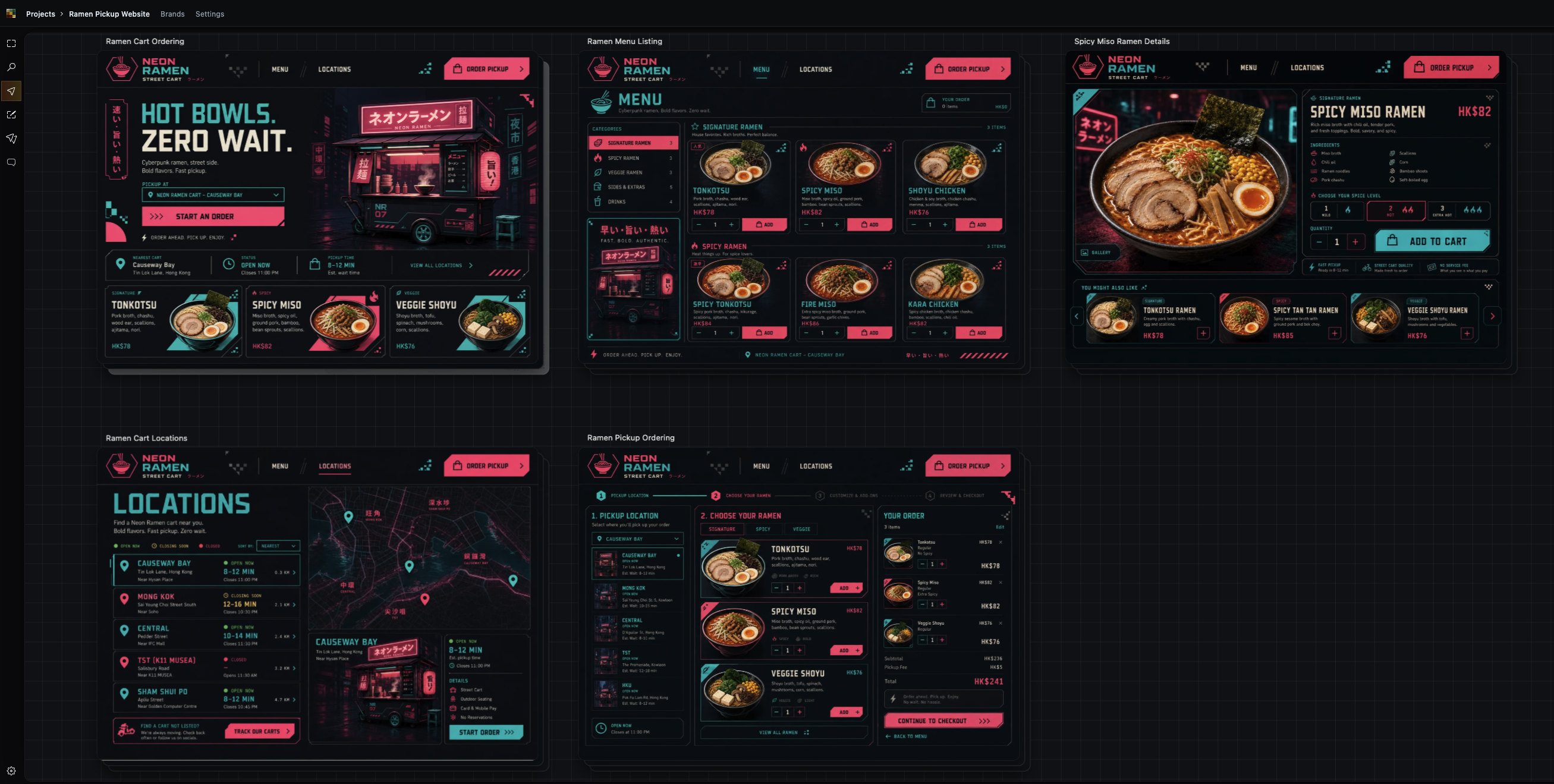
Gemini 3.7 build: https://html.non.io/neonRamenGemini3.7
Opus 5 build for comparison: https://html.non.io/neonRamen
Opus is still best in class for this, but it's worth noting how well Gemini 3.7 does vs a more comparable LLM price wise, which is Grok 4.6: https://html.non.io/neonRamenGrok4.6 . I thought Gemini would blow Grok out of the water (it generally has in the past), but Grok has really caught up.
Other thoughts: I really think Google has fallen behind here. Even as a high speed offering (this build took ~7min, which is pretty good!), it wont be able to claim dominance for long with cerebras announcing the Sol preview today: https://www.cerebras.ai/blog/accelerating-gpt-5-6-sol-ultraf... .
It's not a bad model by any means, but I just don't know what situation I'd reach for 3.7 Flash first for. Google really needs a differentiator, especially given how hard it is to get an API key from them. They can't be high friction and non-pareto.
These look exactly like all of the low budget bodega signs near me. They also look like a bunch of cheap ads for parties that I keep seeing. The sameness of style is uncanny.
(I don't have the Bodega signs, but I'm thinking of shit like this, from a quick google: https://linkstub.com/en/wet-wild-foam-party)
I think both outputs are really good. I don't see a lot of differences. So what exactly should be looking at and notice that one model did worse or better than the other one.
EDIT: OKAY I see it's mostly the "image" generation, not so much the HTML... Noticeable in the food photos and the foodtruck/cart photo
There is some irony being a developer and reading along the lines of: "oh look at the comparison between these models executing a task for a few cents on a job i'd be charging 1k minimum"
How are you doing this with Opus. Clearly I’m missing something. I always turn to ChatGPT when I need images because Opus typically refuses. I’ve tried Claude Code and Claude online in the past. I’m pretty sure neither created images for me and I thought this was because Anthropic was focused on code.
I guess I need to try harder. :)
FYI Gemini's version is less broken than Opus' in Safari...
One of my favorite image tests with AI models is schematic analysis...I build and repair tube amps for a living, and use AI for such work a LOT.
so far, IMHO, the best has been opus and fable\mythos.
What’s the prompt you used for this?
Edit: oh wow, diffui looks nice!
I'm curious how much the harness plays into this. I'm somewhat surprised by the gemini and grok results, they seem to have strongly deviated from the original images. I'm thinking maybe the harness has a big effect? It's possible to proxy in different models to claude code, if you're curious you might find it interesting to test!
The "introductory pricing" for this 3.7 Flash model is really weird.
It's scheduled to double in price on December 31, 2026, but who would anticipate still using this model five months from now? Especially since 3.6 Flash came out just three weeks ago!
My first effort with default thinking level produced an ambitious pelican, let down by a flawed bicycle: https://tools.simonwillison.net/markdown-svg-renderer#url=ht...
Then I ran it on high, medium and low thinking levels (oddly minimal is no longer an option, which WAS an option for 3.5 and 3.6) and got a pretty excellent pelican for the first two:
https://tools.simonwillison.net/markdown-svg-renderer.html#u...
UPDATE: That was in Safari, but as pointed out in the replies here the pelicans do NOT render well in Firefox or Chrome! Best guess is that's because of this invalid filter in the SVG:
<filter id="shadow" x="-10%" y="-10%" width="130%" height="130%"></filter>
Ever since the insane discount with GPT-5.6 Luna, not much excites me anymore. I mean just look at the benchmarks, even though Gemini 3.7 Flash performs well on the DeepSWE 1.1, Luna (Max) still performs way better. I personally have stuck to Luna (Xhigh) because its been more than enough and does not bloat up the context window too fast with reasoning tokens.
> Starting January 1, 2027, $1.50/1M input tokens and $7.50/1M output tokens will apply.
Compare this to Luna which is at $0.2/1M input ($0.02 cached) and $1.2/1M output.
They need to release benchmarks against Luna/Terra. Luna is much cheaper which feels like it undercuts the need for Flash.
I've always considered the Flash series of models to be for low-cost, high-volume, mostly text-based use cases (e.g. summarization, parsing, formatting), emphasis on low-cost.
[edit: ah, benchmarks here: https://blog.google/innovation-and-ai/models-and-research/ge...
more of a Terra than Luna competitor which is an interesting positioning. I feel like differentiation at the mid-tier of models is pretty difficult.]
Actual announcement: https://blog.google/innovation-and-ai/models-and-research/ge...
So it's better than 3.6 Flash, at half the price. I've been pretty excited about Gemini models recently, they just feel so fast after spending most of the day at work waiting for Opus 5.
https://artificialanalysis.ai/models/gemini-3-7-flash
The selling point for gemini continues to be speed and particularly end-to-end response time.
The Gemini Flash models makes perfect sense to me coming from a company like Google. Google AI Mode for search is a product I really find useful. It makes sense that Google focused on smaller, faster yet smart enough models that wouldn't break your bank on inference. It plays well into their product ecosystem.
Google AI Mode consistently gets me consistently good results and good speeds. It really changes what "googling" is for me.
Gemini Flash is one of the best "good-enough" models. I use this type of model daily, for automation and quick development iteration loops.
Unfortunately, it's often not strong enough for heavy refactoring and long running development loops.
The multimodal abilities are great, but if you deal with text only, what is the benefit of using this over DS V4 Flash/Pro? 13-26x cheaper with comparable intelligence, and available across many different inference providers.
I fail to see the usecase where DS V4 Pro is not enough, but Flash 3.7 is - except multimodal.
Luna is similar, and also 8x cheaper. Source: artificialanalysis
The only benefit I can see is the speed, that looks to be outstanding, probably thanks to their TPUs.
> What's new in Gemini 3.7 Flash [0]
> Coding and agentic tasks: Significantly higher quality on real-world software engineering and agentic benchmarks, improving issue resolution and reducing failed agent loops.
> Web development and stronger design parity: Generates higher-fidelity desktop and web application code directly from design mocks, with strong gains in design adherence and in auditing existing codebases against mocks to verify 1:1 design parity.
> Promotional pricing: Gemini 3.7 Flash will be available at an introductory price of $0.75/1M input tokens and $3.75/1M output tokens. We’re also applying this new rate to 3.6 Flash. Introductory pricing expires on December 31, 2026; after, $1.50/1M input tokens and $7.50/1M output tokens will apply.
Still no sign of 3.5 Pro. Will have to test it, low expectations given every other model from the Gemini 3 lineage, but one can hope. Just struggle to understand the promotional pricing being temporary for four months. Given this industry, I'd be hard pressed if 3.7 Flash was still in use by end of year, so why not make it the official pricing?
I just subbed to Gemini a week ago and have been using antigravity and 3.6 flash. The speed is absolutely a differentiator compared to Claude.
This is genuinely a competitive model, considering it beats Claude Sonnet 5 on almost all benchmarks and is more than half its price. Seems like Google is back in the game, though not leading the frontier anymore.
I don't get it, Google could heavily subsidy their Gemini models to make it more attractive, but they prefer to not do it. I don't know one soul who is using Gemini models to code.
Even OpenAI who doesn't have money or capacity is offering their Luna model at $1.2 per 1M/out.
Has anyone noticed that antigravity has been working really well for the last few weeks. Now with this model it should be working much better. Hope the Google AI Pro Subscription can be used to do some real agentic coding now.
> 3.7 Flash is available through the end of the year at an introductory price of $0.75/1M input tokens and $3.75/1M output tokens.
> Introductory pricing expires on December 31, 2026. Starting January 1, 2027, $1.50/1M input tokens and $7.50/1M output tokens will apply.
Was excited to try it, since I've been use 3.6 Flash in the last few days to make simply experiments/prototypes. My loop is writing a prompt, maybe adding a screenshot of the closest to what I want I have so far, then based on the result I modify/extend the prompt, maybe use another screenshot.
Well, I think I'll stick to 3.6 for now. Based in a very scientific sample size of exactly one attempt each: https://imgur.com/a/fDOkBDm
Both got the same prompt and example screenshot. I mean, they both suck but that's normal this early in, but the 3.6 version (first screenshot) actually changes the displayed threads depending on selected categories, and the messages of whatever selected thread, as obviously described in the prompt. You might say it more or less does what it should. Both versions have an ugly flash/jerk in the category pane when selecting/deselecting a category, so that's a wash.
The 3.7 version doesn't work at all, i.e. it always shows all threads, and no messages for any of them. I can post new messages in threads but they don't show up, and it doesn't even increase the message counter for the thread. I guess it's a matter of taste but I don't like the look either, while 3.6 actually is in the spirit of the screenshot I added the prompt, using 11k of CSS versus 3.7's 16k. The code is also less, and the backend split into 3 files (instead of just 2 as 3.7 did it), so assuming it sucks in either case, it'll be easier to read and massage.
edit: geez, 3.6 even properly fades/disables the "new message" button when no thread is selected, 3.7 didn't bother which is smart since everything else is broken anyway. Maybe it's better at really complex things, but for simple things, what I'm experimenting with, I already saw enough.
They compare it to 5.6 Terra, however https://cognition.com/frontiercode puts Terra at about 1/2 the price
Also have to compare to the recent Grok 4.6 release, which appears to straight up be better AND cheaper
Hard to understand why anyone would choose 3.7 Flash under these conditions.. is Deepmind still a frontier lab?
On a related note, I see all these quantitative benchmarks and the models getting really good at them over time. One thing I've been wondering: if the GPT series of models performs so well quantitatively, why do I still kind of hate using them relative to Claude? There’s a missing “vibes” or “taste” benchmark I think.
Maybe this is just my experience, but have people had trouble with 3.6 Flash just... getting things it has seen in its context correct? I don't know if it's been insanely benchmaxxed or what, but it'll pull information from websites and immediately get it wrong the token after. Or for example (this is something that happened like yesterday) I asked it to compare the uses of A and B in a language I was learning, and the way I typed it was "Please compare how these two are compared differently: A VS B", and then... it proceeded to compare "VS" and "B". I'm not kidding.
Personally whenever I use Gemini I've just been using 3.1 Pro because I've had insane trouble with them getting things incorrect like this. Hopefully they'll fix it soon / they've fixed it with 3.7 Flash.
Does Google believe people want fast models because they have some sort of evidence of that preference? Or are they no longer capable of delivering a Pro model?
I was going to cancel my gemini membership today ..... still going ahead. In my experience, gemini 3.1 pro, 3.5, 3.6 flash constantly lie too much about completing their tasks whereas sol (even though equally dumb) never claims something has been done when it hasn't been.
This is a solid release (at the intro pricing, the other pricing is dumb). I do think its a missed opportunity to really blow things out of the water and have this be another 1/2 off, but clearly they don't have the inference efficiency for it. Speed is good, the knowledge in google's models is solid for those usecases, price is reasonable (after 3.5/3.6 major missteps).
The intelligence index vs cost pareto frontier is crazy now, its basically a flat line with 9 people all at or right at the edge of the frontier along various parts of the graphs. Insanely competitive right now.
It's on Google AI Studio, which I use for free when I'm not on computers I control.
It did fine on my usual benchmark about configuring old Sparc hardware, maybe output slightly faster than before. Even included something new to check in the firmware.
3.7 Flash gets 56 on AA up from 52 for 3.6 Flash. But it seems like this is at the cost of more output tokens per task: 3.6 Flash is 26k, 3.7 Flash is 37k. Due to 3.7 Flash's 2x slashed pricing it's still cheaper per task.
Funnily enough, I just ran a task on AI Studio with 3.6 yesterday and got 3.7 to do a similar one today; so it serves as an interesting and quick comparisons between the old and the new (usually, if enough time passes between your use of one model and the next, you'll have a sourer view of it than its actual competence suggests).
It hallucinated in both cases despite being given an API key and building a lot of pipes to access data using this. It was a simple "oh shit" fix moment for the model, but weird how eager it was to hallucinate despite the process being designed for it to be data-driven.
We should move past the idea that benchmarks alone tell us whether a model is getting better. I would've had the same experience a year or two ago with 1.5, and the solution would've been similar (keep prompting). I've been investing time into making system prompts and input prompts more meticulous, but the fundamental "it will make shit up" problem still remains, even though it shouldn't when the job involves calling tools.
I know this sounds like I'm expecting superpowers of it (I'm not), but my point is just that these incremental benchmark gains may not reflect user experience.
And I'm over here on SiliconFlow using Stepfun AI Step-3.5-Flash at $0.10/M input and $0.30/M output tokens (262K context window) for complex market analysis work in rust utilizing vectorized instruction sets. It provides me with amazing results.
I honestly wonder how long this calliope can keep playing before it crashes to the ground.
(I have no business relationship to anything mentioned here except as a regular retail customer who went bargain-hunting)
Have you tried the new DeepSeek Pro v4, Qwen 3.8, Gemini 3.7 Flash, and Grok 4.6? Do they make sense for any use cases?
I'm currently using omp with Kimi K3 as the planner and DeepSeek v4 Flash 0731 as the implementer, or CC + Fable for planning and Opus 4.8 for implementation. For API(not coding), I just use DeepSeek v4 flash 0731 and MiMo.
I'm pretty happy where I am, but I'm wondering if these new models provide some new kind of advantage
I want to like Gemini models but my problem thus far has been a lack of coding chops. They still make mistakes, importantly, without correcting them for things like hallucinated API calls or code that doesn't run but they never bothered building or running. I know a lot of this can be fixed with workflows but it still feels like a failing.
GPT-5.6 or Claude models haven't delivered to me non-running code in ages.
Whenever I have Gemini in the flow, it's fast, but mistake riddled. I have low confidence in the output.
I've had some success with Opus driving Gemini models. It's pointless for GPT family since Sol is cheap enough or can drive terra/luna for arguably better performance, same speed, and better outcome.
As for all of the talk in this thread about modalities. Every SOTA model takes screenshots and verifies work now. Grok-4.6 does this, Luna does it, etc. They can also all work _from_ a screen shot or mockup provided.
I don't think it's a major selling point when every model can do it well and reasonably fast.
That said, eagerly awaiting "pro" and improvements to antigravity.
For those looking for the full benchmark figures and technical overview, Google's primary announcement post is here: https://blog.google/innovation-and-ai/models-and-research/ge...
>3.7 Flash is available through the end of the year at an introductory price
1 of $0.75/1M input tokens and $3.75/1M output tokens. This price combined with the enhanced model performance enables developers and customers to scale production-ready agents cost effectively.
Introductory pricing until December 2026 implies no significant Gemini Flash developments until the next year.
Given my codex have limited usage and I get a idea to build a on device clipboard translator with menubar when read a article find some words not seens before
So i launched agy and find seems it have a 3.7 flash i thought its latest,until i see this article i know it's just released
after serveral rounds prompt(the initial prd prompt is by chatgpt), it use 2.9k user message token and 42.5k reponse tokens with gemini 3.7 flash(low) after i check the status, i got a working on device translator, its cool
the model seems also p and retty fast and the generated app looks good and easy to use
but agy cli is a bit unintuitve and i also check the guy that release the latest agy, seems the guy does not commit much ? or perhaps agy does not open source and only use github as a issue feedback channel
> * For 3.6 and 3.7 Flash, introductory price expires on December 31, 2026. Starting January 1, 2027, $1.50/1M input tokens and $7.50/1M output tokens will apply.
this is hilarious. it is not 2025 any more, by Jan 2027 there will be at least 3 newer generation of models (from other provider) released already. nobody would use flash 3.7 at that time.
sure we used to cling to gemini models in the past, demanding 2.5 models to continue to serve, but since google betrayed us with those price hike, people already spent their time making their production pipeline less dependent on google since then.
heck, even now I'm not sure I even care if they cut the pricing even lower. there are too many models with cheaper price and similar performance now.
i just wish google cloud ux was remotely as good as their models. they made some progress with their studio, but then in a true google fashion, product names keep changing (Gemini, Anti-gravity, Vertex, Google AI,...) as well as confusion and complexity for something as simple as registering agy cli with a Google cloud project.
today i wanted to link agy to a google cloud project, for that i had to enable 5 different APIs in google cloud UI, then create a subscription for Gemini Enterprise (whatever that is), then link it to a project, then assign it to a user. and after all that, agy couldn't find the subscription.
the best part: i couldn't cancel the subscription. so i just paid $35 for one month and left it.
I have had such good, consistent success with Gemini 3.6 Flash (usually on medium setting) that I forget about it. It is just this reliable, effective assistant that I use for managing and organizing information, brainstorming, and of course coding.
I honestly don't know what I would want more/better than what I was already getting... so I'm curious if I will see any improvements with 3.7.
So at this point new models seem to only care about one task, software development. This really was not the original pitch of ai and I do not see how it justifies the insane spend or valuations it has produced.
Reposting my comment from the other thread https://news.ycombinator.com/item?id=49288847
They compare it to 5.6 Terra, however https://cognition.com/frontiercode puts Terra at about 1/2 the price
Also have to compare to the recent Grok 4.6 release, which appears to straight up be better AND cheaper
Hard to understand why anyone would choose 3.7 Flash under these conditions.. is Deepmind still a frontier lab?
Testing it in Pi.dev and liking the speed a lot! Huge improvements from past gemini models regarding tool calls and agentic capabilities
I'm finding Gemini 3.7 speaks a lot more academically. Its explanations are not clear and intuitive by default.
Maybe this has to do with all the RLVR it went through, where reasoning through difficult academic/coding problems caused it to think and speak a certain way.
The benchmarks looks great but it doesn't feel as legible, so maybe it's more meant to be an agentic model rather than an everyday model whose outputs are read by humans?
Hard to believe nowadays but Gemini Flash 3 was $0.25 / 1M input and $1.50 / 1M output when it was released.
We run a platform that serves models from many of the frontier players to power conversations and workflows. Gemini flash-2.5 was a game changer for us when it came out. Cheap, fast, and reliable.
We are now considering dropping support for the model family all together. All of their models require significant scrubbing of errant thinking blocks, inner monologues, and it's consuming more engineering resources than it's worth.