▲ 107 points
back
58 comments
So as I understand it, the author is suggesting that NetFlix produce a bunch of low-rent pilots (or half seasons or so) throw them against their wall of subscribers with a bit of recommendation-targeted magic, see what sticks, then spend the money to produce the "grown up" versions.
At first glance, that isn't a terrible idea, but even if it were their eventual strategy, I still think it makes sense to spend big bucks on top shelf series to start. For one thing, they weren't totally "blind": If you believe their spin, they spent a lot of time analyzing their audience to target exactly the kinds of shows they should make, and they have a lot more data to go on than, say, AMC had seven years ago. For another, if they wanted their subscribers to take them seriously as an HBO-like content producer, it helps to actually produce some HBO-level content right out of the gate. Once subscribers trust that you can make Emmy-worthy shows, they're more likely to tolerate your ultra-targeted but cut-rate test-batch series.
Even so, I'm not sure how the suggested strategy is supposed to play out: Say they made 100 cheap shows instead of 5 expensive ones. In order to be more interesting to any particular audience to overcome the fact that they aren't (yet) Hollywood-quality, one would think they'd have to appeal deeply to a narrow audience (I'd give a science fiction show about a generational ship a chance no matter how cheaply it was produced, for example). But now your show is in a trap: It's too focused, and will have a hard time gaining an audience even when the production values go up (and how do you "scale" to more expensive actors?) Time travel geeks loved the movie "Primer", which cost about the same as a small car to produce, but a million-dollar-an-episode show based on the concept has roughly 0 chance of making its money back.
Author here. I don't disagree with you, especially in the second paragraph. To some degree I think it was smart for Netflix to make a big splash this early on. But the perception that they're "paying for quality" is a bit suspect, given that Hollywood itself -- ostensibly "paying for quality" in its entire process -- has a 98% failure rate on developing projects. Quality talent doesn't always yield a quality product in the creative business. Even the best writers, directors, producers, and actors have their failures. I have no reason to suspect Netflix was any smarter in its approach to developing House of Cards than networks would have been -- though I could be wrong (and hope I am).
At the end of the day, the $100M for HoC was a big bet. It was a signaling tactic, a marketing tactic, and a bet on top-tier talent. But it was a bet, nonetheless, and an expensive one. That it seems to have paid off (to an extent? jury is still out) shouldn't fool us into 20/20 hindsight bias. It could just easily have busted.
"So as I understand it, the author is suggesting that NetFlix produce a bunch of low-rent pilots (or half seasons or so) throw them against their wall of subscribers with a bit of recommendation-targeted magic, see what sticks, then spend the money to produce the "grown up" versions."
Not necessarily, and I should clarify here. I think pilots can be shot for a lot less than they are, and I think audiences are proving themselves quite receptive to previews and other short-form "pilot" systems as proofs of concept. A lot of movie trailers are increasingly being made before the movies even start shooting ("teaser" trailers). I think there are ways Netflix can take the guesswork out of the development process, even if production is still an expensive endeavor.
You have to pay for a quality product, but the system right now also pays heavily for the risk in the pre-production process. That process can probably be de-risked considerably.
I would not recommend testing 100 half-baked concepts to see what sticks. But I do think Netflix could test or tease concepts in development to determine which ones to develop, and/or how to present new shows to the right early adopters.
Something I probably wasn't as clear about as I could have been: half the battle in finding a hit is developing an audience, not just a show. Netflix has better audience-development capabilities at all stage of the production equation. It doesn't need to guess quite as much as networks do.
Maybe -- to your point -- Netflix's audience-segmenting capabilities give it the ability to play the big bets game more than networks can. But historically, people have been shockingly bad at predicting what will actually hit and what will miss. Star Wars was laughed out of every major movie studio in town, for instance, and at the script level, it sure didn't look like "quality" to the eyes of the execs reading it. On the other end of the spectrum, a show like Firefly -- which fans (including myself) consider one of the most brilliant things ever made, has repeatedly failed to gain mass appeal beyond its limited niche, despite many attempts at re-marketing home video, a feature film, etc. The operative lesson here is that "quality," as an objective concept, is hard to parse and hard to pin down. "Quality" is more of a function with a lot of variables, and many of the biggest variables are on the production side and the audience side -- not the development side.
Tldr: People are over-investing in development, when they could be investing more heavily in production -- whether at greater scale, or in greater depth per project.
The business model of Netflix is entirely different from broadcast TV. Netflix makes 0 additional marginal dollars from an existing subscriber watching an extra hour of video. What they care about is producing something "must see" for a particular niche that would convert a non-member into a paying member.
That means a rabid fan base and buzz is far more important than broad popularity. That's why shows like Arrested Development and Orange is the New Black have been so good for them, because they have an in built audience they can bring reliably.
I'd argue the opposite from you which is that Netflix is worse than traditional TV at developing audiences. For someone to adopt a new show on Netflix, they have to be interested in the show AND a subscriber of Netflix or so interested in the show it would compel them to subscribe to Netflix vs just switching over to the right channel at the right time to check it out.
Instead, Netflix's strength is in supporting a pre-existing audience.
"Netflix makes 0 additional marginal dollars from an existing subscriber watching an extra hour of video. What they care about is producing something "must see" for a particular niche that would convert a non-member into a paying member."
Netflix makes 0 marginal dollars on a hit show, but for Netflix, this isn't about the marginal dollar. This isn't even about adding more subscribers per se. This is an attempt to preserve subscribers in the face of a rapidly diminishing content library.
As I mentioned in the article, a lot of the networks and movie studios are raising their rates on Netflix, or pulling their libraries altogether. In the long run, Netflix risks becoming a "dumb pipes" commodity business, no more special or different from Amazon, iTunes, and all the rest, if it doesn't have something exclusive to keep viewers interested.
That's why they're betting the farm on original content. HoC won't appeal to everyone, but it signals to Hollywood and to tastemakers that Netflix is a serious buyer, and that it's in town to buy a lot more where that came from. Hollywood has a strong signaling / social proof system in place, and moves like this are often great ways to break the ice and establish credibility in a town that will shut up and listen to money. :)
"That means a rabid fan base and buzz is far more important than broad popularity. That's why shows like Arrested Development and Orange is the New Black have been so good for them, because they have an in built audience they can bring reliably."
Correct, and I don't see us in any disagreement here. This is what I mean about Netflix's home-field advantage in "audience development." Netflix knows its niches better than networks know theirs, and furthermore, it can afford to be in the niche game, because it's not dependent on mass advertisers. This is a significant advantage Netflix can draw upon.
I'm a perfect illustration with HoC. I dropped off Netflix Watch Instantly when they split it off as a separate item. I'd vaguely mulled hopping back on--Amazon on-demand really didn't have enough selection--but I wasn't a huge on-demand user so I never quite pulled the trigger. HoC got me to pull the trigger. And I'm still not a particularly heavy on-demand user but I'm not about to stress over whether I'm getting my money's worth now that I'm back on the service.
Yeah, I'd say Netflix has close to zero audience building ability, especially with the decision to release entire seasons at once. Building and audience 1) takes time, 2) benefits from shared experience and anticipation and 3) needs consistent promotion.
I want to believe you're on to something here, but how do you "tease" a show like "Mad Men" at low cost? The best tease for that show would be something like the incredible "Carousel" pitch from the end of Season 1[1], and indeed, a link to that from reddit was how I finally decided to check the show out a couple of years in. But that arose organically, after a ton of money had been spent on script, casting, production...
I'm not saying I have a fantastic answer, and I want to admit that. (I'd be a lot more successful right now if I did!)
I made some edits to my reply, and I think the answer I can best come up with is this: spend less money on development, and reallocate more of that money to production (either of more series in general, or on fewer and better series, or on licensing of exclusives from shows on other channels). Money in production seems to have better ROI, while money in development is a spin of the wheel.
Another thought: a lot of great shows get canned from the networks simply because advertisers don't grok them, or networks bungle the marketing and scheduling of them. Perhaps Netflix can get into the business of picking up these wasted opportunities? That seems to have been the operating logic behind its investment in Arrested Development, and I don't see why that model wouldn't work for other shows like it.
Small anecdote from personal experience: when I worked in development at NBC, we invested a ton of money into a high-profile Aaron Sorkin dramedy about life at a TV network. It was a fantastic script, by a confirmed creative genius with a track record ten miles long. As bets went, it was about as much of a sure thing as anybody had seen. That same year we spent a much smaller sum on a quirky workplace comedy about life at a network.
Of the two shows: Studio 60 lasted all of a season. 30 Rock ran for seven. As great a show as 30 Rock became, it wasn't all that great from the get go. A lot of the magic happened in production, with the hiring of a fantastic writing staff and the time to let the whole thing gel and find audience fit. I'm not sure what the operative lesson is from that experience. But it did teach me quite a bit about how you can't tell quality when you supposedly see it. Especially early on. :)
I didn't hate Studio 60 as much as others but, yeah, it should have been better.
>As great a show as 30 Rock became, it wasn't all that great from the get go. A lot of the magic happened in production, with the hiring of a fantastic writing staff and the time to let the whole thing gel and find audience fit.
I'm generally not very receptive to arguments along the lines of "OK, this show isn't great now but you owe it to the universe to give it six months" but I also don't really disagree. I confess to also liking 30 Rock but never quite putting it in the must see bucket. (In all fairness, I've really sort of gotten away from sitcoms period.) Certainly, I imagine we'd all like to see good shows get the opportunity to work out kinks rather than putting all the burden on one pilot.
I'm curious. Are there good examples of a really "knock them dead" pilot that didn't translate into a halfway decent show. Smith might be one possible candidate although I liked the show as a whole more than people in general apparently did.
[EDIT] Related question. For a relatively big budget show, how expensive is making a pilot relative to non-pilot development costs?
Your argument applies even more to something like Breaking Bad or even the venerable Babylon 5. The strength of those offerings was the build-up over many seasons.
Ugh, and please let's not judge Star Trek TNG on its first season. Yikes!
I'm not sure Hollywood is even ostensibly paying for quality though.
I'm not trying to be smartass, just that having been around the industry there's a lot of companies below the top tier that are quite direct about their intent to just make something that sells for more than it costs.
The big players generally try to pay for quality, especially in scripted TV. That's because there's such a huge spotlight on everything, especially from critics and advertisers.
That doesn't mean crap doesn't get through the system, though. Some networks (cough VH1 cough) and production companies seem to specialize in churning out low-effort crap with a high expected return. That's a legitimate business model, I guess, but it doesn't seem to be the prevailing logic at broadcast networks or premium cable companies.
The operative problem is that quality is very hard to ascertain. A lot of our perceptions of "quality" are drawn from hindsight -- and from the heuristic bias of looking only at the winners, thinking their wins were obvious and preordained.
How much data are networks making these decisions with and are they the right data?
Just saying "focus group" doesn't really provide much insight on the level and utility of feedback networks receive.
How big of an opportunity do you feel there is for more/better data?
They've got general consumer research from firms like Nielsen, which doesn't really give you all that much insight into how a script will pan out. They've also got focus groups, and I mean that literally: network TV is one of the last great holdouts in abandoning the focus group. Focus groups are methodologically flawed for all sorts of reasons, and they're notorious for mis-predicting hit shows and movies. But they're still a staple.
But more to the point, the real magic isn't in the data networks may or may not be able to use ahead of time. It's in the data they should capture from the shows: how they're trending, how they're being talked about, what channels people use to discover them, conversion rates from various channels, marketing efficiencies in various channels, cohorts among viewers based on spending patterns, sentiment, word-of-mouth likelihood, etc.
My overall thesis is that less time and money should be spent on (80-90% useless) development research, and more money should be spent on analytical marketing post-launch. I think TV networks can learn a great deal from video game publishers, for example: similar business model, similar hit dependency, similarly huge budgets -- but a complete mastery of distribution and marketing channels.
Nielsen ratings, of course, get looked at and scrutinized daily. But those are lagging indicators, they're approximations, and they're not actionable. And changes made to shows can't be directly attributable in the following ratings.
A strong counterargument to this logic -- and I feel I should give it its due say -- is that overanalysis will lead to design by numbers. And that's a very real danger. But I think the greater present danger is on not being analytical enough. We've got a long way to go before we're designing shows by numbers. That'll be a bridge too far, but the bridge isn't even in eyeshot yet.
"I'd give a science fiction show about a generational ship a chance no matter how cheaply it was produced, for example"
Thanks, that's extremely useful market data, albeit only one data point.
(I'm a microbudget show producer, so I'm very interested to hear this sort of thing.)
The low-rent-show model is almost exactly what Amazon ended up going with, and to be frank, the shows are crap. Nobody joined Prime for those. Netflix apparently knows they have to have solid shows with name-brand talent for anyone to care.
I'd give a science fiction show about a generational ship a chance no matter how cheaply it was produced, for example
Something like The Starlost?
I'm really impressed - and curious - about Priceonomics' ability to come up with such well-researched and well-written (getting both right isn't always easy) posts on such a wide plethora of topics.
Especially because the authors don't seem to be their staff (I could be wrong here). What motivates the writers to come up with content that must surely take a lot of time to research & write?
First, nice story!
Question for the author (or anyone else really)... What about what Amazon is doing at studios.amazon.com? That seems like a new way to build programming.
Amazon's approach is very interesting, and I'm paying pretty close attention to them.
I tend to be somewhat skeptical of open-submission systems, or of voting systems, because they suffer from the same prediction problems that Hollywood's development model does. Plus, they're more prone to GIGO problems (Hollywood actually does a pretty good job filtering crap out before it goes into the system).
Amazon might be focusing on the wrong thing (development) rather than the right things (production, support, distribution exclusivity). At least in the short term. If I were them, I'd probably use my significant capital reserves, buyer power, and Hollywood's resentment of Netflix to my advantage. I'd cut exclusive deals on proven or undervalued material that's already been produced (and could be scaled up, or reinstated, or spun off).
Personally, I think the smartest thing Amazon is doing is tying Amazon Prime to free VOD streaming. A la carte content purchases are probably going away in the long run, and Prime is a great transition vehicle into more subscription-based services to compete with, say, Netflix.
Why do you think a la carte content purchases are going away?
For reasons of consumer convenience and marginal purchase costs. Right now, I believe the reason iTunes is so competitive with Netflix has less to do with a la carte's strength as a model, and more to do with Apple's strength as a platform and ecosystem. I would not be shocked to see more subscription-type offerings from Apple, especially with the whole migration toward iCloud.
Here is where I'll put on my Purely Speculative Futurist hat, and I'll wade out a little bit into the choppy waters of broad generalizations. But I think that a la carte purchases, especially for entertainment products, are in many ways a relic of physical media. That's the way you had to buy physical media, for the most part. But it's a relic that cloud technologies and streaming services are obviating the need for. From a consumer standpoint, I experience zero marginal cost to watch an episode of Breaking Bad on Netflix (whereas I very much experience the feeling of paying $2.99 for it on iTunes).
Netflix is in a tough spot because it has lost a lot of great content, as well as competitive windows against services like iTunes. iTunes is (currently) a much better place to get the new stuff while it's new, and that's a big liability for Netflix or other subscription services. All other things being equal, subscription is a better value proposition than ownership for many categories of goods. It's also more convenient.
Interestingly, this shows that the economics of TV and the economics of YouTube are actually not that far apart.
Breaking Bad's $400,000 per ad spot, at 10 million viewers, is noted as being remarkably high. That's $40 CPM.
Whilst a lot of people are very cagey about their YouTube earnings, if you do enough asking around the numbers tend toward $2.50 CPM. It's frequently noted that popular shows which are able to sell show-specific advertising make a lot more than that.
Even if you assume that a Breaking Bad-level YouTube success would only get a 4x multiplier to its ad value, that's still $10 CPM - only 4 times less than the on-TV Breaking Bad. I would have expected the difference to be considerably greater.
Maybe the CPMs are so unusually high on TV is because of the fill rates?
I don't actually know the answer to this question:
Can you get 10 million ad views on a youtube ad in a tv-show-length of time?
Also, consider the advantage that AMC has in a dedicated sales team going hard after advertisers on the merits of buying a spot during the breaking bad finale. If youtube worked in a similar way, I bet you would get higher CPM by virtue of better sales people...
Very interesting article.
I've been thinking about the rise of cable channels versus network tv when it comes to the cultural impact of their shows.
They certainly seem to get it right in that respect a lot more often than the networks do, based upon my anecdotal evidence (totally lacking any real data), cable shows like Game of Thrones, Walking Dead, Breaking Bad, American Horror Story, Mad Men, etc
It seems to me (not that I have any real data to back it up with) that the shows people talk about online (and amongst people I meet) are basically all cable shows, from back with the Sopranos to shows airing today like Game of Thrones, Walking Dead, Breaking Bad, Dexter, American Horror Story, Homeland, Mad Men, Boardwalk Empire etc, have a much greater cultural influence than what the networks are offering apart from a juggernaut like American Idol (which seems to be fading away these days aswell) and perhaps something like Big Bang Theory.
I think it's an interesting shift, if there is indeed a shift and not just something I'm making up.
I don't think the HoC $100 million bet was as big as it looks. Execution counts for a lot in this business, and it's very tough to get right, but if you throw enough money at it, and give the right guy enough control, you can do it reliably. It's like pop music. You can't guarantee that your next album will be Thriller, but you can guarantee a big splash if you get everything right and have the cash for it.
It's a question of management bandwidth. If you're at the kind of scale Hollywood's at, there's just not enough to go around. Not enough cash, not enough rockstar executors. James Cameron can only make so many movies.
Netflix simply realized that they can put all their eggs in one basket, then watch it extremely carefully.
You mean like The Lone Ranger starring Johnny Depp and produced by Jerry Bruckheimer which is expected to lose something like $150 million? Big names certainly help. (And IMO Kevin Spacey is what elevates HoC from something fairly pedestrian to something worth going out of one's way to watch.) But this is a biz that's hard to predict winners in and I'm skeptical that viewing data makes a big difference.
No mention of Hulu here or in the article? Hulu has done several of these cheap shows and none of them seem to have caught on in any meaningful way, whereas Netflix's obvious "swing-for-the-fences" attempts seem to have everyone constantly excited.
I'm really impressed - and curious - about Priceonomics' ability to come up with such well-researched and well-written (getting both right isn't always easy) posts on such a wide plethora of topics.
Especially because the authors don't seem to be their staff (I could be wrong here). What motivates the writers to come up with content that must surely take a lot of time to research & write?
As someone who is in the process of trying to get my sitcom to air this was a fascinating read. Thanks for posting.
I'm a little confused by the ending regarding Netflix. I thought Netflix went pilot-less with House of Cards and just paid for a limited exclusive for the whole season. This is pretty different than the described network system.
Hi! Author here.
You raise a good point. Indeed, Netflix went pilot-less, but they still paid network-level prices to make the show. Essentially, they skipped the pilot and went straight to the series order (and 2 full seasons at that). In some ways this was a riskier move than the network model.
My argument is mainly that Netflix has the tools at its disposal to get smarter about this process. To be fair, I believe a lot of that $100M was a signaling tactic -- both in Hollywood and as consumer-facing PR -- almost as much to do with marketing the fact that Netflix has originals as it had to do with investing in them.
But the investments needn't always be that big up front.
Thanks for the article. Regarding "Netflix went pilot-less". BBC had done a "pilot" for them when they produced the Original HoC in 1990 (and they based in on a book by Michael Dobbs).
The point I am trying to make is that, they got a sense of what the show was going to look like, who it will appeal etc because they had carried the BBC HoC for a while in their inventory. I am assuming, that they had some viewership data from this.
The BBC HoC probably provided a nice reassurance, but there is a pretty big chance the US version won't work. I would imagine HoC is even more problematic given the difference in political systems.
does the bar chart (http://s3.amazonaws.com/pix-media/blog/424/ad_cost.png) irritate any one else here? I feel like it's a rather biased data visualization, it seems patently unfair to compare the finale of breaking bad with the average of a network. If anything, it should be contrasted with the finales of each of those network or possibly replaced with a figure representing the average cost of an ad on AMC.
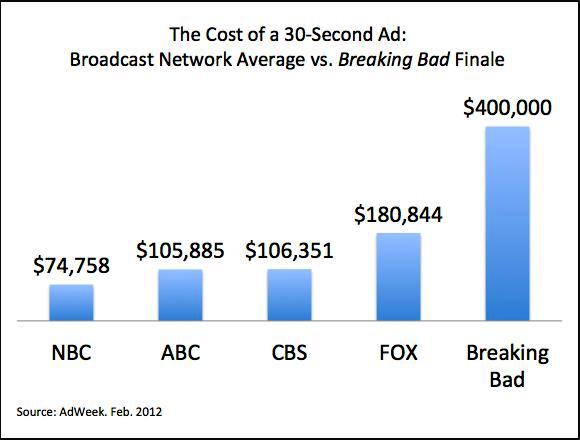
Hi there! Great feedback.
The bar chart isn't perfect, and certainly less so out of context. But I should clarify my intent behind it. The final episode of Breaking Bad pulled in roughly the same numbers that your average primetime hit (or even indexed basket of hits) pulls in every night. So when we're talking about the primetime averages, we're talking about indices with viewership figures roughly comparable to Breaking Bad's final episode. The point was that Breaking Bad was able to put a significant price premium on its finale relative to the nominal size of the audience it drew. It punched above its weight, so to speak. (Finale or otherwise, we're talking about 10 million Breaking Bad viewers vs. 11 million CBS viewers.)
Is the comparison totally fair? In that specific context, in illustration of that specific point, I believe so. Would it be remotely fair if it were used, say, to illustrate a point about Breaking Bad in general vis-a-vis the market? Considerably less so. The point was more about its value to AMC, and less about the show's ostensible superiority to any other network show.
To that point, I like your idea about contrasting Breaking Bad (finale, ordinary episode, etc.) with the average cost of an ad on AMC (though we'd have to control for the skew exerted on that index by Breaking Bad itself). That might be more apples-to-apples in certain respects, and it might have driven the point across a little bit better. Duly noted, and in as much as I am considering a followup, I may want to address that specific concern.
I actually feel like it is misleading. I would expect each bar to represent an item of a similar type. But, in this case, it doesn't.
I am sorry you feel that way, and that was certainly not the intent. I didn't intend for it to be any more misleading than, say, a chart comparing the performance of one company's stock versus an index or set of indices. I tried to explain that this is a unit-vis-a-vis-indices comparison in the text, but the chart could have been clearer in visualizing that point. A bar chart was probably not the best chart to go with.
Anyhow, thanks for the feedback. I very much appreciate it.
I see from the initial image in the post that it contains info about Breaking Bad. So I backed out of reading it until I know if it contains spoilers.
Before I go read it would someone please verify that it's spoiler-free? (beyond the initial image which spoils something about Walt/Skylar's relationship)
.
SPOILERS BELOW
.
I'm partway through season 4 at the point where Skylar makes Walt return the fancy car he just bought for Walt Jr. saying that "someone has to protect the family from the man protecting the family". Jessie is riding shotgun with Mike and Hank is starting to regain interest in the blue meth case.
There are no spoiler tags or any mechanism on HN to prevent reading a post or a part of a post. People who don't want to get spoiled can't parse the page without taking a huge risk even when they have been warned because they have to scan for things they don't want to read.
I suggest you edit your spoiler out and just state the last episode you watched and ask if the article deals with story segments you haven't watched yet.
Seconded. When I saw he posted SPOILERS, I immediately scrolled back up.
To the grandfather: Just post what you wanted, and get rid of the spoilers section. Sheesh. You're not amusing anybody, or adding anything substantial to your original point.
you're safe!
Great.
Thank you.