▲ 48 points
back
9 comments
If you want to play Spacewar on a real PDP-1, the Computer History Museum in Mountain View has a restored PDP-1 with Spacewar on it: http://pdp-1.computerhistory.org/pdp-1/
Steve Russell works at the museum these days, so you might even run into him if your timing is right!
The next best thing (but without Steve Russell himself, sorry) can be found here: http://www.masswerk.at/spacewar (a JS-emulation of a PDP-1 running various versions of Spacewar! – the version closest to the program described in the article is "Spacewar 2B", but the version seen in the photos is probably a bit later and more advanced.)
But of course we ought to visit the CHM, in case we would have a chance to do so.
It's pretty amazing that the display had 1024x1024 and up to 4096x4096 resolution on 5 inch screens in the 60s.
They say the 4096x4096 was for photographic recordings, I wonder if there is any data saved that was displayed at this resolution from the 60s, it seems like each photo would have been huge compared to the size of storage available back then.
It's really hard to say, but some of the high-res scans of DEC promotional material for the Type 30 CRT (1024 x 1024) at bitsavers.org are showing screenshots with a pretty good quality: http://bitsavers.org/pdf/dec/pdp1/JPEGs/
On the other hand the 1024 x 1024 of the standard display was rather a technical resolution, the visual resolution would have been – according to DEC – about the half (since the bleeding phosphor of the activated blips on the screen would overlap and merge). A closeup of the Type 30 CRT displaying an early version of Spacewar! can be seen here: http://www.masswerk.at/spacewar/decus1962/spacewar-decus1962...
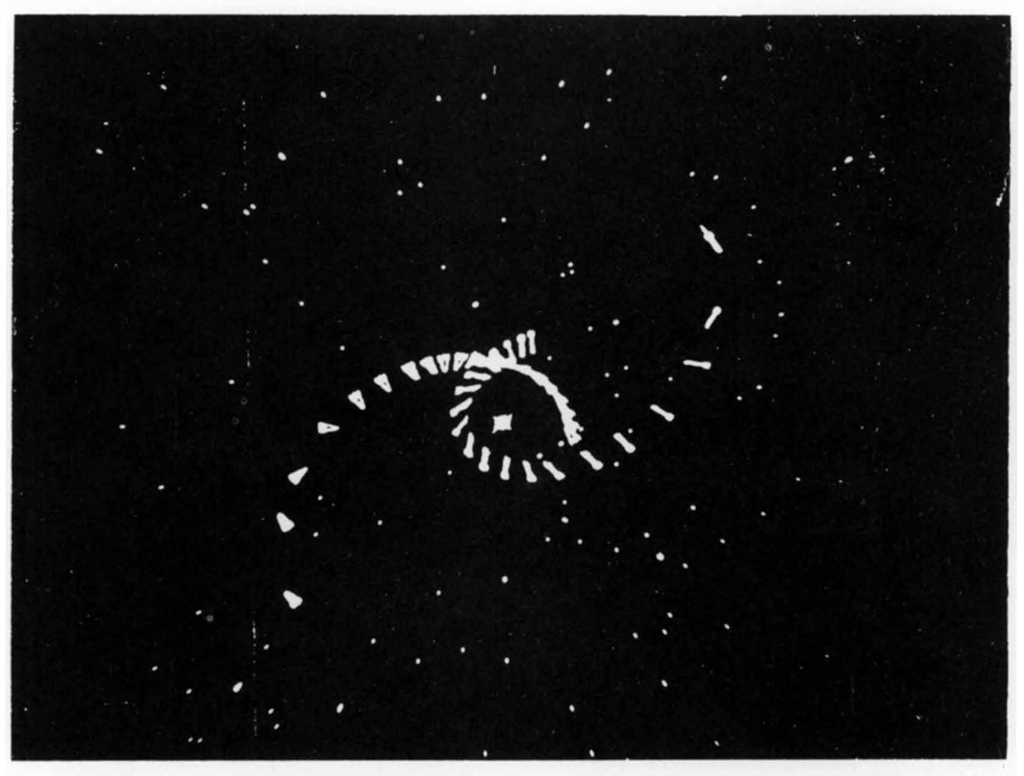
On the storage capacity: Please mind that these weren't bitmap driven displays, all the images had to be composed and refreshed algorithmically. On the up-side, this meant that even a small program could display effective graphics, like Snowflake (see: http://www.youtube.com/watch?v=Y1ioLo2I_5Y) which would only use about 190 instructions or memory locations. Also, consider that these were 18-bit words holding op-codes (6-bit) and addresses (12-bit) in the same instruction word. This was quite more densely packed, like say, in a 8-bit microprocessor computer. For example, I would doubt that (the original) Spacewar! could have been ported to a C64, both for speed and storage, left aside the graphics. (But I could be proven wrong here ... :-))
The screenshots are here (so you don't have to click all 25 images looking for them):
http://bitsavers.trailing-edge.com/pdf/dec/pdp1/JPEGs/Type30...
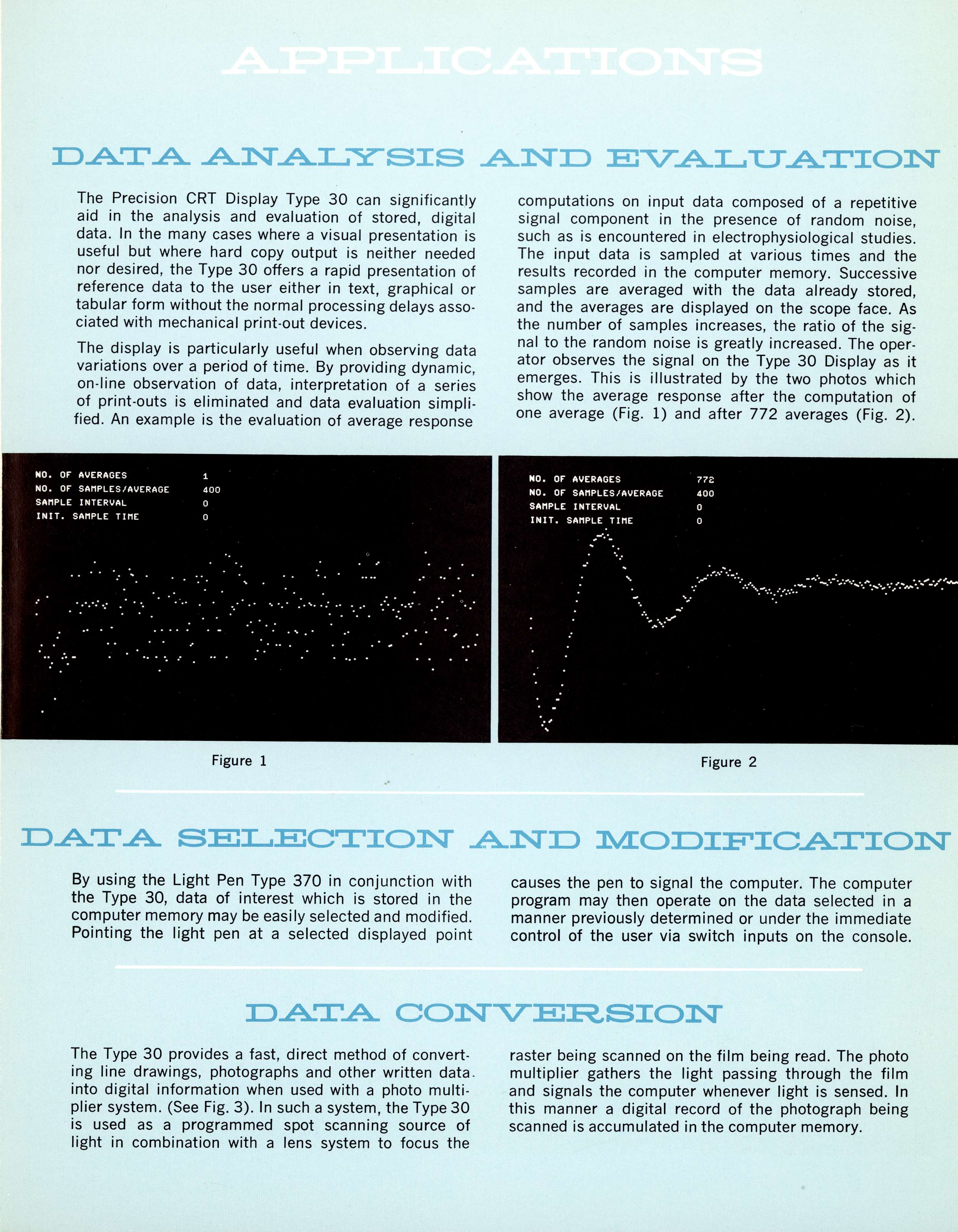
http://bitsavers.trailing-edge.com/pdf/dec/pdp1/JPEGs/Type30...

A display similar to the Type 30 CRT can be seen in action in this video of a Bell-Labs educational film: http://www.youtube.com/watch?v=iwVu2BWLZqA ("The Incredible Machine", 1968).
The video shows later equipment, a PDP-5 and a display that looks like a member of the 330/340-family, but the technology is the same. (Interactive graphics technology like in TX-2 and the PDPs was actually amazing, but apparently got lost over time-sharing ...)
I don't think they saved the photos verbatim -- rather, the idea was to use the CRT to slow-scan the photographs and analyze them by recording the light that transmitted through the film.
I'm old enough that my first experience of 'big computer' graphics in the mid-Eighties was on one of these:
http://www.pdp8.net/tek4010/tek4010.shtml
Tektronix 4010 storage tube display.
It was actually pretty nice, as long as you just wanted to draw a picture.
It's not a raster display. The beam is driven by two voltages for X and Y, so really what those numbers are actually saying is that it had a pair of 12 bit DACs (hardly shabby technology in 1961, but not a 4k monitor either).