▲ 26 points
back
45 comments
An iPhone-sized computer that can wirelessly connect to a monitor and keyboard could itself act as a mouse (with gesture recognition like Apple's Magic Mouse), a touchpad, a chorded keyboard, or any other peripheral that can be emulated with a touchscreen and some hardware buttons on the side. (Volume up/down could act like back/forward on a mouse, for instance.) This would be great for accessing your own data and applications from anywhere, without relying on cloud storage.
I really like this idea. I think you could add in accelerometer support and make the phone function like an actual mouse, physically moving it around the desk like you would a physical mouse.
An accelerometer measures acceleration, not movement. You need some kind of optical sensor (even the camera) to make it usable as a mouse.
The integration of acceleration is velocity, integrate again and you have position.
You have that annoying +C though, so you need an initial velocity. While you can just shove 0 in there, it would still not be 100% accurate, and you'd want it to reset when no acceleration is detected for a period of time.
So while I'm sure you could make it work convincingly, it still wouldn't work as well as a proper rollerball or optical sensor.
An iPad makes even more sense as a combo keyboard/trackpad hybrid, with dynamic multitouch interactions that could be app specific. This is what I dream about.
I was surprised to see no mention of Ubuntu in this article, they did exactly what's being imagined with the phone switchable to full-featured desktop.
The Motorola Atrix did that two year earlier, however, and is mentioned, making a Ubuntu mention redundant.
An Ubuntu mention is warrantied, given that in the very next paragraph the author dismisses Atrix as not having any worthwhile apps running. Ubuntu, on the other hand, is a fully-fledged desktop and can't be dismissed as a toy this way.
The Atrix was a full fledged Linux desktop, which could run virtually any desktop Linux app such as OpenOffice. Heck, the Atrix ran a Ubuntu-based desktop.
Maybe the author just didn't know that, or perhaps they just discount Linux entirely compared to OSX and Windows.
Utterly ridiculous to leave it out considering the waves it made when it was first announced and was raising funding. The author either didn't do any research or wanted to pretend it was his original idea.
What an obnoxious article, the Apple fanboyism is garish.
That's an awful lot of inappropriately bitter hyperbole to expend on what is basically a light "wouldn't it be cool if..." piece on MacWorld's web site, of all places. However, I'm sure you do the same thing when articles on Linux-centric sites fail to mention related Apple technologies, so it's all good.
You want your pocket machine to be a Macintosh; Apple wants your desktop machine to be an iPhone.
(I might just be ten percent more cynical than usual, because, having just opened iBooks for the first time to download the Swift manual, it — without asking — ‘imported’ a raft of other ebooks, destroying my file name and folder structure. My files don't belong to an ‘application’, they belong to me.)
I am very afraid of the day where I can't get a general-purpose computer anymore.
The best pocket machine I've ever had was a Nokia N900. I strongly believe in "if you don't have root, you don't own it".
I'm sure there are people who thought the same of microcode, bootstrap code, or whatever. We all operate at some level of abstraction.
It's an important distinction whether the abstraction is designed to facilitate the user's operation of the hardware or interfere with it.
Define "facilitate" to everyone's satisfaction. By my definition, Apple has done more to facilitate people's use of computer hardware than any other single company.
Apple once thought carrying your life (your Mac OS X home directory) was a good idea when they publicly announced "Home on iPod". They quickly reversed course. I assume the failure rates of the iPod's spinning hard disks were a contributing factor.
I think this could only work if you had great backup with the cloud.
"Your iPod wasn’t designed to be used as a startup drive for long periods of time. When the tiny hard drive inside the device spins for hours on end—as it can if you boot from it—the player heats up enough to make your palms sweat. Since there’s no way for the heat to vent, as it would on a hard drive in your computer, you risk tragedy." - Macworld.
> Apple once thought carrying your life (your Mac OS X home directory) was a good idea when they publicly announced "Home on iPod". They quickly reversed course.
FWIW, this was also the original pitch of the NeXT computer. As a student you'd carry around all of your stuff on a single magneto-optical disk (a predecessor to CD-RW), and stick it into any available NeXT on campus to continue doing work.
When's the last time you saw an iThing with a spinning HD in it? Everything's SSD now. And the computers are going that way too.
Surprisingly, Apple doesn't even offer SSD or their "Fusion Drives" in store. I was at an Apple store last week trying to buy an iMac with a 256 GB SSD and had to have them order one for me.
It is worth going to the store though, they gave me a fair discount for buying it as a business.
Huh. I only get laptops for myself; looking at the online store there's all of one stock Macbook Pro config that offers a HD instead of SSD. Even the default config of the Mac Pro is SSD. All the default iMacs and Minis are HD, though.
We're not in the "SSD only" world yet by any means but there's a definite change from just a few years ago.
There are a lot of 8" Windows 8 Tablets that can already do basically this. No wireless display but you could do a docking station that provides power, HDMI and USB, then use bluetooth mouse and keyboard.
I have a Motorola Razr (Android) that can go into an Ubuntu install when hooked up via HDMI. It's very slow and you can't extend it without root but the idea is neat.
"And who wants a touchscreen desktop, anyway? (Nobody.)"
This is the same kind of tripe that pundits always say. "No one would ever want a touchscreen phone", etc. Its the kind of thing people say until suddenly everyone wants it.
I have little love for Windows 8. Its a horrible kludge of bad interfaces and confused priorities. One of the most frustrating experiences I had in the last 2 years with a new product was doing the initial unboxing and setup of a Surface RT device.
That all being said, there was one time where the entire Windows 8 paradigm made sense. It was on a touchscreen Dell desktop that I played with at the Microsoft store in San Francisco. After just a couple of minutes, several of the normal Win8 annoyances like swiping from the sides to reveal UI panels felt natural sitting at a desk.
I don't think Microsoft's approach is going to be the clear winner. But they may be on to something, and it will take a few generations to figure out what its supposed to be.
Its pretty clear that touchscreen + desktop is a loser. For a phone/pad the screen/keyboard/buttons are all within hands reach, using fine motor skills to manipulate.
The desktop is usually a large landscape screen(s) some distance from the viewer. The keyboard is conveniently located at arms reach in front of the user. Combining them cant be done without losing much from one or the other.
I find touch with the Windows desktop interface to be fine (with my Surface Pro, at least). I mainly use touch for scrolling, cursor positioning and app switching when in desktop mode.
I find it's actually better than using a touchpad or mousing around. I'm primarily a Mac user (and more of a keyboard user than a "mouser"), but having a touchscreen on a laptop or desktop makes a lot of sense to me.
I don't think it would translate well to a desktop. I've got a Cintiq, and it's great for drawing. I can't stand web browsing with it, as my arm gets tired after a few minutes of poking the big screen.
Touch works for phones and tablets because they're already in your hand. Holding your arm up to touch a 20+ inch monitor several feet away gets physically painful within 5 minutes. There's also a difference between the motions you make when drawing (hands spend 90% of the time in the same area, a few sweeping motions to change drawing tools) versus normal computer use where you're scrolling around, clicking buttons, and navigating menus. That's a lot of strain on shoulder sockets when the screen is large.
I think multi touch trackpads are the closest we're going to get until someone has a breakthrough idea.
If you are looking at touch as the primary method of interacting with a desktop, then sure, it doesn't work. As a supplementary method to a keyboard and mouse, however, it can work quite well.
I'd dispute calling a Surface a 'desktop'. A development station wants several screens; a designer wants a mouse and keyboard etc.
I have also tried touch on the 20" Sony all in one, and I thought it was fine.
I am not saying it is suitable for all use cases, but if you are a single screen desktop user, it really isn't a horrible experience at all.. Provided that you look at touch as a supplementary interface as opposed to a primary one.
I used to mock the idea of touch displays with Windows 8 myself. When I actually tried it, I found that my initial assumptions about how bad the experience would be were misguided. Of course, YMMV.
Touchpad + Laptop on the other hand is making some surprising strides.
Touchscreen desktops have been around for years and not many people buy them.
True. But most haven't been done well.
I don't think such a product would do well, personally speaking. But then again, I also think smart-watches are pure idiocy.
"The power is just not there yet."
Hmm, I don't know that I'd be so sure about that. I was running Leopard and Snow Leopard on an MSI hackintosh that had some underpowered (1.6Ghz?) Atom processor in it. It ran OS X just fine, and I created my first iOS app on that machine. I have no idea how that matches up to today's A7 (and we certainly can't go by Ghz), but that MSI is probably 4 or 5 years old by now. I wouldn't be surprised if an A7 ran OS X acceptably well.
But I don't think it's a matter of what an A7 can acceptably run, but rather if Apple sees a compelling reason to do so. Since we're all pulling predictions/hypotheticals out of our nether regions, I'd guess that the closest we'd ever see is an A7-powered Air that gets 24 hours on a battery charge.
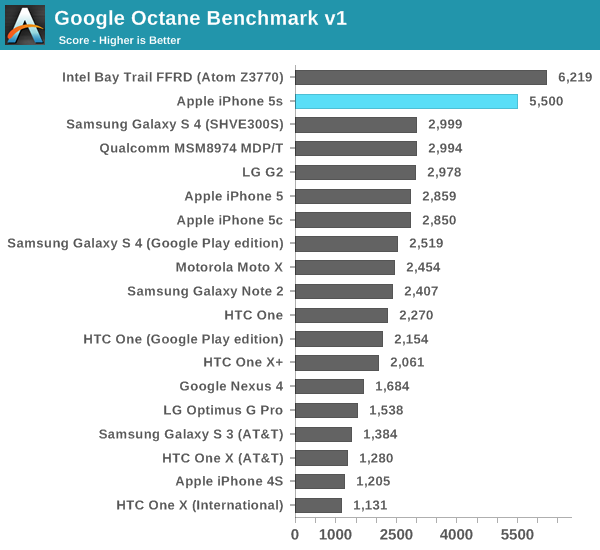
The current Bay Trail Atoms are pretty good. They've got great battery life and while not necessarily as fast as an A7, are probably snappy enough to run a version of OSX that doesn't rely heavily on GPU power for UI effects.
As far as I am aware, the Bay Trail is generally equal to A7, is it not?
For example: http://images.anandtech.com/graphs/graph7335/58179.png
I sort of have this on my old Samsung Galaxy III phone: a HDMI converter for a large monitor and a Java IDE. Anyway, I like the idea of a pocket Mac, even if the market might be small.
Chromebooks in a small form factor, with a full size Chromebook might provide uniform access to data and apps, but I don't like this option as much as the proposed pocket Mac.
Another good alternative coming soon (?) is the mini version of the Surface 3. With a good docking station, it might be a good universal 'one device for everything' especially if it also functioned as a huge cellphone. I have not bought a Windows device for many years, but I am waiting for the specs on the Surface mini before I buy another device.
He pretty much described the Ubuntu Phone concept and um it didn't quite work out for Ubuntu.
Before that, Motorola tried to build a phone that docked into a keyboard tablety kind of thing. I forget what it was called.
It was like ten years ago that I ran KDE on my Sharp Zaurus PDA with WiFi and everything.
The idea of a full blown OS or a dockable phone that delivers a full PC experience is not exactly new. What hasn't been proven is that the demand from consumers is there in droves.
Microsoft Surface is making the best run at this idea so far, and even still it's not selling especially well.
Until you can sell this dockable phone concept to tens of millions of people, I don't think it will ever be much more than a pipe dream.
This reminds me of the ClamBook. Sure, the ClamBook is likely vaporware. But it's also an excellent idea that I would love to have made available. We haven't really had a proper execution of this idea on the market that I've seen.
http://clamcase.com/clambook-android-and-iphone-laptop-dock....
Like: https://www.youtube.com/watch?v=noe3kR8KqJc ? :)
Where is this hypothetical user going to find a keyboard, mouse and airplay display (and maybe a dock)? If all those things already exist, then having a CPU inside one of them is a lot easier than trying to make your phone act like a desktop.
In the end, if you have cloud/continuity/whattnot, what problem does this solve?
Reminds me of the Open Pandora: http://boards.openpandora.org/page/homepage.html
"and I just made it up!"
wow genius. Except all he did was look at the Ubuntu project and Microsoft Surface and substitute a Mac in using his "imagination"
I like the idea.
Pick an app, show it in the nearest monitor or TV, and allow me to switch between touchpad and keyboard with a simple gesture.
Yes, I want to use it as an editor and a terminal for most of my work, plus surfing the web; so type and scroll, type and scroll, that's most of its use as a headless computer while comfortably sitting in a couch ten feet from a display.
Doable.