▲ 130 points
back
74 comments
“Despite the seemingly obvious answer—tomb art discovered in the 19th century depicts laborers pouring water in front of a block-hauling team—debate over how the pyramids were built is almost as ancient as the pyramids themselves.”
In other words, people don't read comments. This is why the best practice is to build self-documenting pyramids.
lol yeah exactly.
its quite obvious looking at what they were doing: http://www.osirisnet.net/tombes/el_bersheh/djehoutyhotep/pho...
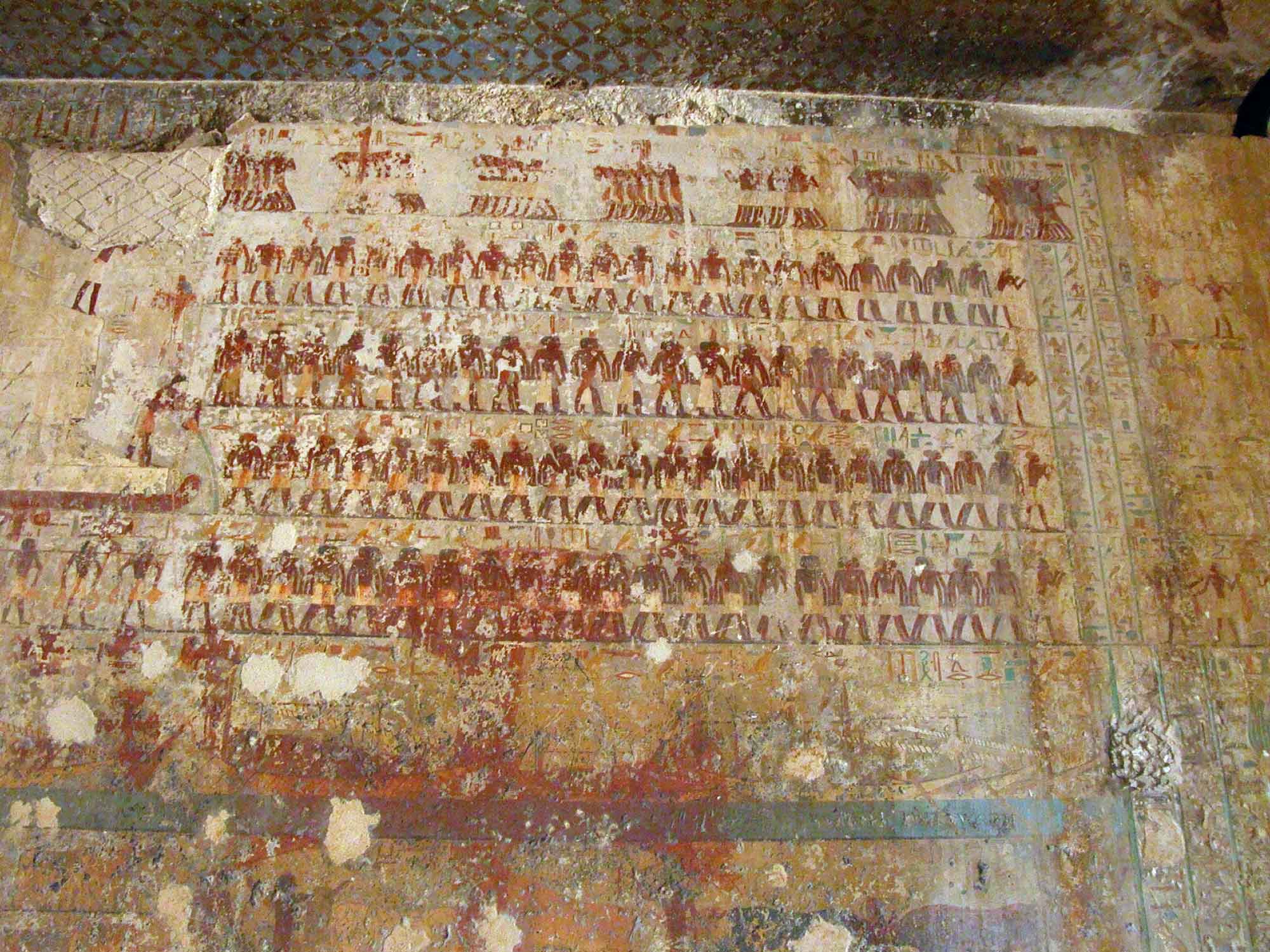
but it is cute that they 'figured it out with science'.
Fourth row down, far left, there is a guy standing on the sled pouring blue stuff in front of the sled, with dozens of others pulling the sled he stands on.
My guess is that the number of people in the picture will turn out to be exactly the right number needed to pull a full sized replica of the sled
And thank you HN - obscure reference to Pyramid tomb art, "oh here is a link to the very image, three minutes later."
Gotta love HN !
Edit I expect water pourer was the cushy number right up until the sled got stuck because you poured wrong - whips were probably involved then.
Clearer schematic rendition of that image: https://en.wikipedia.org/wiki/File:Colosse-dj%C3%A9houtih%C3...

There was an article on this a while back that Egyptologists had interpreted it as depicting something ceremonial- something like breaking champagne bottles across ships' bows.
Having scientific evidence that wetting the sand ahead of the sledges -could- have eased transport is pretty nice evidence that that's what the picture depicts, but without something corroborating its efficacy, it was just a plausible interpretation.
Pyramids: the first successful use of the waterfall method.
And last.
I remember back in the 1970's all these "mystery" TV shows wondering how the South American Indians could fit blocks of stone so precisely that a knife blade could not be inserted into the gap.
Their conclusion, naturally, was that space aliens had done it. (Although this was silly on the face of it, because the rest of the construction was not particularly accurate.)
This nonsense persisted until some archaeologist figured out that such a fit could be obtained in about 30 minutes by banging and rubbing the two rocks together, and demonstrated this on camera.
That was the last I heard of the South American monuments being built by space aliens.
I figure most of the ancient construction puzzles would be head-smackingly obvious if we just saw what they were doing. We often mistake primitive societies for being stupid, when in fact they were remarkably clever in finding solutions within the severe limitations of their technology.
Those TV specials are still being produced: http://www.history.com/shows/ancient-aliens/articles/ancient...
> some archaeologist figured out that such a fit could be obtained in about 30 minutes by banging and rubbing the two rocks together
Remind me how much the rocks weighed?
When I was young Von Daniken's book had just come out and popular culture was awash with this sort of stuff. Remember crystal skulls? "Wow look at those things, how could people from those ancient civilizations possibly have made them?" Simple answer - they didn't, they were all made in modern times.
True, I also wonder why so many people do not rationalize well known techniques that were mainstream longer than anybody can remember.
1. Attach ring through nose of large animal
2. Attach rope to ring
3. Attach animal to large object
4. Pull on the ring in the direction you want large object to go
I love your comment because it's a perfect example of how science (in general) is able to embarrass itself by being unable to hold ambiguity.
We don't know if aliens built the pyramids. We can only say that there is no existent proof that would point us in that direction.
What we do know that the Egyptians didn't bang together 80 ton granite blocks to make them smooth. That's a more ridiculous notion than space aliens (which is saying something).
The article above is also nonsense. We don't know. We have no idea how they constructed the pyramids. And it's OK to say that. Scientists need to learn that it's OK to leave problems unsolved and to say, "We don't know," rather than to grab at the first available explanation and say, "This is it." It embarrasses the entire profession.
This was news back in April: http://www.dailymail.co.uk/sciencetech/article-2617275/The-m...
The important part is that they merely proved that the theory of pulling blocks over wet sand makes sense, but not how the pyramids themselves were built (blocks elevated, aligned, etc.).
I'm not an egyptologist or a physicist. But I've always wondered what happened to the "concrete pyramid" theories. I know that it's only been pushed by Prof. Davidovits but I haven't really heard any proper critiques of it. (I'm not sure if that's because I haven't researched enough or if Davidovits is considered a quack.)
Here's a NYtimes link: http://www.nytimes.com/2008/04/23/world/africa/23iht-pyramid...
And the geopolymer institute: http://www.geopolymer.org/archaeology/pyramids
edit// and the geopolymer papers download page: http://www.geopolymer.org/formulaire/download-articles
They were obviously done with a 3d printer, there's clear evidence of stepping.
I'll show myself out.
I have heard this theory before, and I understand it is made by reputable sources. But it's always baffled me. I would have thought even a freshman geology major could tell the difference between a man-made stone and one cut out of natural earth. But then, I don't know any geology.
The composition is both limestone and also red granite, which are both cut the same way. I'm also not an expert, but the idea of somehow pouring and curing granite doesn't seem to make much sense.
I thought it was making sense when a friend showed it to me, but I'm a neophyte as well and I was also enthusiast before that with the "internal ramp" theory.
"Scientists Have an Answer to How the Pyramids Could Have Been Built" would probably be a better title.
I'd have to agree, it's a slightly misleading title. This part was the most interesting to me: "Notably, few of the many studies were performed by interdisciplinary teams. While both physical scientists and archaeologists have tackled the problem, the divergent sets of skills and interests may have delayed a solution to the mystery."
There needs to be a lot more collaboration between scientists and archeologists/historians on questions like this. Experimental archeology is an interesting subset of this, but my impression is that it's been fairly moribund since the 70s and 80s: http://en.wikipedia.org/wiki/Experimental_archaeology
Ok, we'll use that here.
Do not confuse "an answer" with "the correct answer".
Its pretty similar to how some tsunamis manages to wreak havoc in low lying towns ... a small initial wave inundates the area with a few centimetres of floodwater, paving the way for the following large surge, which encounters little friction due to the existing water.
What, again? It feels like I hear some variation of this about once a quarter now.
Almost exactly: http://iop.uva.nl/news-events/content/2014/00/prl-egyptian-p...
just blogspam from JSTOR.
This paper was originally published in Physical Review Letters in April and covered pretty widely by the press back then.
Debunked. (Although I can only find this in Dutch at the moment.) https://translate.google.com/translate?sl=nl&tl=en&js=y&prev...
Original Dutch: http://www.dayralbarsha.com/node/184
A french architect named Jean-Pierre Houdin has arguably cracked the method by which the pyramids were constructed back in 2007:
http://www.youtube.com/watch?v=YTgxGJfXRQ0
You'd think, that out of all the disciplines of human knowledge, an architect would have been consulted on the puzzle of the pyramids' construction much earlier, but this is surprisingly not the case. I mean, who better to help decipher how something was built then a person who designs structures?
Probably an engineer. After all, architects design buildings but, usually, they have nothing to do with the calculations and construction methods employed to build their design.
Any other information about this Dutch team's model? Are they publishing something? Pictures? Who are they? The article could at least provide more information about them...
http://journals.aps.org/prl/abstract/10.1103/PhysRevLett.112... This is the original article that the APS published in April. Someone posted the PDF here: http://www.slideshare.net/joseluismoreno9235/sliding-frictio...
As an art handler, I've a theory that they placed thick blankets under the blocks and pulled the blankets. You'd be amazed at what a couple of people can pull with a blanket.
> If people from all walks of life can come together to build a monument that stands for 4000 years, then academics from different disciplines can come together to study them.
Something tells me the laborers who built the pyramids weren't working voluntarily...
The source for the idea of the pyramids being built by slaves was most likely Herodotus, who was probably more than a tad biased, being Greek. The evidence I've seen, from articles such as this one from the Deseret News ( http://www.deseretnews.com/article/705357902/New-Egypt-find-... ) and the Scientific American Frontiers show Dead Men's Tales ( http://www.pbs.org/saf/1203/segments/1203-4.htm ) indicate that the people who built the pyramids were most likely volunteers, most of whom showed up, did the equivalent of their national service for a few years, and went home.
Probably the workers were paid rather than enslaved....
'''An inscription on a tomb of a priest judge buried near the pyramid builders city read: “I paid them in beer and bread, and I made them make an oath that they were satisfied.'''
Isn't JSTOR what started the issues for Aaron Swartz?
On topic: I read about that probably being how they moved the materials in second grade.
I had read that they probably used milk instead of water as it would make a better lubricant.
So, they were built with enough stone, time, slaves and... water.
The pyramids were not built by slaves, but by hired workers. The workforce generally consisted of farmers during Inundation periods when their farmland was underwater.
Edit: I swear I wasn't trying to be pedantic Internet one-up guy. It really was meant in an "Oh hey, that's a very common misconception but the real story is actually more interesting" way, sorry :/
This is not news, I saw this in a documentary several years ago.
They had massive whips, Rimmer.
Massive, massive whips.
finally
Seems implausible given the incredibly precise dimensions of each block - dragging them through wet sand would remove a significant amount of surface area..."The accuracy of the pyramid's workmanship is such that the four sides of the base have an average error of only 58 millimetres in length".http://en.wikipedia.org/wiki/Great_Pyramid_of_Giza#History_a...
you konw who else had the answer .... egyptians
you know who else had an answer ... the egyptians