▲ 65 points
back
31 comments
I stumbled across a video on Youtube some time ago which demonstrates sword-and-shield tactics likely used by the vikings, backed up by well thought out and credible explanations. It's a fascinating watch and for me it really brought home the fighting intelligence and elegance of viking warriors: https://www.youtube.com/watch?v=dkhpqAGdZPc
Great video on the bio-mechanics of round shield fighting.
At 33m I wasn't sure I was going to watch it all; turned out it was fascinating.
Thank you for posting this, that was a great half hour video.
I'd never thought of using their shields like that at all.
the article does a lot of discounting 'the vikings where no more "bloodthirsty than other warriors of the period" over and over, and then contradicting it by "pope placed limits on Christian warfare and threatened excommunication for leaders who became unduly aggressive. The Vikings had no such inhibiting force".
they also minimize raids, ransoms, and murders by saying : well there were witnesses left. plenty survived the death camps but that made them no less brutal.
in short? nothing the author writes is quantified. how often did they go to war, raid, etc? how often did the ones 'no more then other warriors of their time' do the same, and how much vs the christian nations, etc.
The Vikings are an example of history written by the losers. The people who lost the battles (literate Christians) wrote the history. The Vikings didn't have nearly that much writing, so they came off very bad in European history.
I would still call it history written by the winners. In the end the Christians had the cultural influence that runs all the way until today.
If the Viking culture had been preserved into modern day I would expect that we would see them in a different light.
A lot of our written history is preserved from the mediterranean civilizations. They have a tendency to describe other civilizations as less developed, primitive fighters. That was almost never really the truth of course.
Some of it lives on in words such as "barbarians", "slaves" etc. that are very pejorative to the people originally referred to.
I'm sure similar words exists in other old civilizations with good written record, such as the Chinese.
History was written by the winners, as Christians WON most of the battles.
Vikings principal weapon was surprise. Their objective was not winning battles but loot and pillage as much as they could before withdrawal.
Their idea was not to invade and conquer populations that were stronger than them if they had time for responding the attack.
If they found resistance they simply changed their objective to some weaker population.
E.g First time Vikings attacked the north coast of what now is Spain they surprised people there. They won in some cases and withdraw. Years later they tried again, but people were prepared and Vikings lost hard.
The same happened on what is now UK coast, first time the surprised and won over the people living there. Next time they lost.
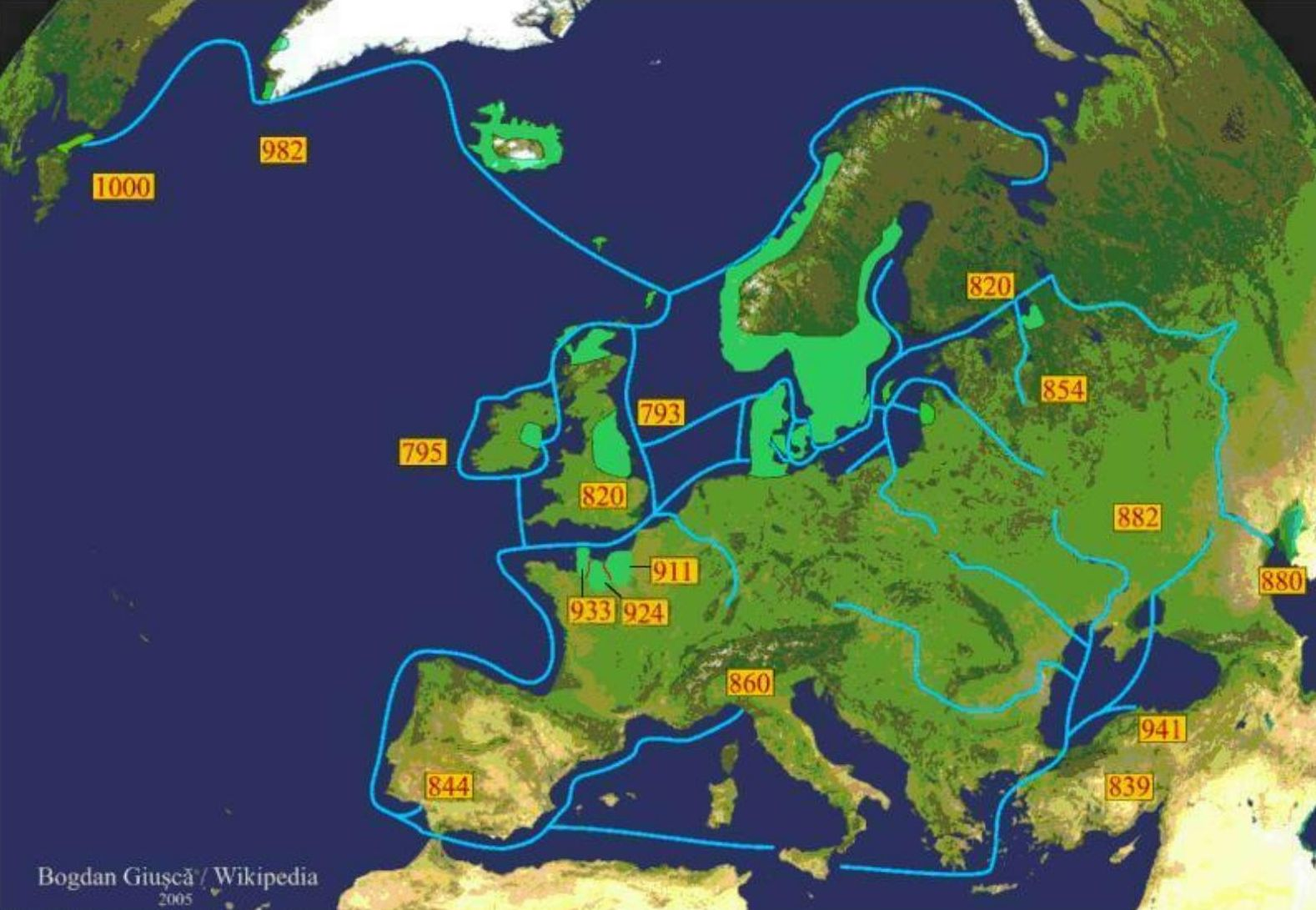
Here [1] is a map outlining Viking expansion / settlemenets.
Note England, coast of Ireland, Normandy, Southern Italy, the Baltics, Russia. Of these, you may argue that South/South-Western England and Southern Italy was Normans, who, while they had substantial viking ancestry were not all of Scandinavian origin, but the idea that they did not invade and conquer and settle is nonsense.
Certainly they did carry out attacks where the intent was just to pillage too, but they went much further.
[1] http://en.wikipedia.org/wiki/Vikings#mediaviewer/File:Viking...

In your own map you see they did not conquer much. The places they settled(vikings) were unpopulated and tremendously cold. They settled there because nobody else wanted to live there.
Those places were very poor, nothing compared with France or Italian, Spanish peninsulas. Places like the South of Spain Sicily or Egypt which food outcome could sustain dozens of times the native population.
Scandinavia could be rich today, but before industrial revolution was very very poor.
The former commentary talking as History written by those who "lost" is non sense. In all the green areas of your map, the Vikings eventually lost.
I know nationalism exist today in Scandinavia, like in the rest of countries. They have quality of life today and could idealize how the past was, but Vikings lived a very hard life at the time, and were not that important.
And yes, Normans were not vikings.
I find it amusing that you keep dragging out Spain, and now Sicily when your earlier comment started with:
> History was written by the winners, as Christians WON most of the battles.
You do realize that Spain, Sicily and Egypt was under Arab during the viking age?
And while you may disagree with including the Normans with vikings, they certainly started out with a large contingent of vikings taking substantial parts of Normandy.
I also don't see how poverty is at all relevant to the discussion.
As for idolizing the viking age, I see more of that from outside of Scandinavia, than within. For starters this idea that the defining aspect of the vikings were raids. The vast majority of Scandinavians during the viking age were farmers and fishermen. And the majority of shipping was trading. Some fringe nationalist segments use viking symbolism, but the vast majority Scandinavian nationalists couldn't care less about the viking age.
Rubbish.
Normans [1] were the direct product of Viking conquest and settlement -- one of many instances in which the Vikings essentially did not lose.
Would you similarly claim that the Varangians [2] were somehow not Vikings? or were "losers"?
And, to go one step further, the Viking settlement on the northern tip of western Newfoundland, L'Anse aux Meadows.
http://upload.wikimedia.org/wikipedia/commons/7/71/Territori...
The Newfoundland base was likely inhabited for only about a decade before being abandoned, but included such features as iron smelting using bog ore near the site.
http://en.wikipedia.org/wiki/L'Anse_aux_Meadows
Each hop was a five to nine day sail for a Viking ship: from Scandinavia to the Faroes; from the Faroes to Iceland; from Iceland to Greenland and then; from Greenland along the coast of Labrador to northern Newfoundland. The Greenland settlements being the permanent populated base to set up the forward base in Newfoundland.
Among the abundant evidence of a much warmer climate at the time, Viking era graves in Greenland are in permafrost. There is no way they dug those in permafrost back then. Digging in cement would be easier.
It is unclear why the Vikings abandoned Newfoundland, though their own accounts suggest that they didn't get along well with the locals.
My own theory is that the only tradable goods the Vikings had that the locals would have wanted were iron items, which the Vikings absolutely wouldn't have wanted to trade (their own accounts say that was strictly forbidden). However, the locals would have been rich in furs, which were extremely valuable in European markets. If you have the element of surprise and superior weapons, along with a rich target, the temptation to raid and steal would have been overwhelming. Raiding and stealing, in turn, would have generated a reaction from the locals, who would have made a sustainable, long term settlement untenable/unprofitable for the Vikings stretched well beyond the limits of a supply line.
After the great human migration out of Africa tens of thousands of years ago, the strands that went to Europe and the strands that went to America finally briefly connected about 1000AD. However, it wasn't for another 500 years that those strands permanently intertwined.
That map can't be completely accurate. It shows parts of Iceland and Greenland as settled that are uninhabitable even today. And "frequent raids" in the Arctic Ocean? No..
Look up the Medieval Warm Period. During the Viking Age, temperatures in the North Atlantic were about 1 C higher than today. Interestingly, the end of Norse settlements in Greenland corresponds pretty closely with the end of this warm period, leading into the Little Ice Age.
Its interesting to compare the accounts of the climate and terrain experienced by Leif Erickson in the Vinland Sagas versus Henry Cabot and French explorers who voyaged to the same regions during the 16th/17th centuries.
"Next time they lost."
I don't think that's quite accurate - a few parts of what is now the UK were colonized by Vikings and their descendants for hundreds of years.
Places like Orkney and Shetland are very proud of their Viking heritage - e.g. the Up Helly Aa festival in Shetland:
http://www.bbc.co.uk/news/uk-scotland-north-east-orkney-shet...
Then, of course, there are that lot of Vikings who settled in what is now France and went on to do quite well for themselves...
Most of England was conquered by vikings at one time or another before the Norman invasion. First Danelaw expanded from 865 onwards. The viking rule over parts of England continued until England was united in 954. But they only stayed away for less than 60 years. In 1013 Denmark conquered England again, lost it in 1014, and reconquered it in 1016.
King Cnut (Canute) the Great then ruled over Denmark, Norway, parts of Sweden, and the vast majority of England, from 1016 to 1035, followed by his sons, and it was first the death of the second of his sons to hold the English crown that brought England, very temporarily, back under English rule in 1066.
The majority of the first couple of centuries of a united England was under the rule of descendants of viking invaders.
Vikings founded Kievan Rus' according to some sources. Ukraine, Belarus, Russia are the modern countries.
The Icelandic sagas is a far more extensive and sophisticated literature than anything produced in Europe at the same time.
Those were apparently written more than a hundred years after "the Viking Age" had ended.
And furthermore they mainly concern themselves with the internal strife of Iceland after the settlement. They're really important historically, mainly because they're pretty much the only thing from that time period that records the customs and affairs of common people and not royalty, but they have almost nothing to do with vikings.
History channel's "Vikings" is actually a quite good remedy for your GoT withdrawals. As a Dane, and even after reading this article, I find the series very accurate, only embellished in obvious places (blood eagle, mushrooms etc).
At the least they got the scandinavian personality traits right.
It's a great show and I love it. But apparently it's historically inaccurate about the "there are no lands to the west" (the norse knew about Britain before the raid on lindisfarne), and apparently Viking society wasn't that totalitarian, and had a bit more of a democratic system
I doubt that hallucinogenic mushrooms were used as a catalyst for berserker rage, but evidence of A. muscaria use among older populations in Siberia and perhaps Lapland exists.
I think it is possible that A. muscaria use happened among the Viking population for religious/ritual use.
Well, obviously the vikings didn't besiege Paris just because they wanted to visit the museums, but they also traded quite a lot, something which is often overlooked. They also made up the Varangian Guard, the reputedly incorruptible bodyguard of the Eastern Roman emperors. There is also little doubt that the Christian sovereigns of this time period (and later) were not shy about the occasional gruesome slaughter against defenseless civilians, so I'd say the point made in the article about their brutality being a feature of the times is pretty accurate.
I can recommend Northlanders [1], by Brian Wood of DMZ fame, on this topic. Fairly well-researched and with good characterization.
Vikings enjoy a huge popularity amongst lay historians and the general populace. We've got a "Vikings" TV series, not a "early Danish kingdoms" series. There's "Viking metal", not "Calmar union metal". Every friggin' fantasy setting has Viking expies, even if the rest is positively Renaissance. When people think of Scandinavian history, it's primarily bearded raiders, not Gustavus Adolphus.
I'd say the only historic stereotype that is more popular are knights, and they share a lot of the same "bad history" characteristics.
So, "bum rap"?
Another reason the Vikings were successful was that in many places they attacked polities that were momentarily weak. They might not have won in Nantes if Charles the Bald hadn't been busy fighting a civil war against other members of his family. Karl der Große's empire was falling apart, and like the Roman Empire had been vulnerable to the raid of Karl's ancestors, so was Karl's empire to the raids of the Vikings.
Don't weep to the Franks, though: in the end, it was just a phase, and they were able to hit the Middle East during a period of weakness just a few centuries later.
TLDR: "Yale lemming tries to make Vikings seem safe and nice."
There's a reason the Byzantine emperor used Varangian guards. It wasn't because they were safe and nice.
Scandinavia at the time (and a few centuries after) was a violent clan society. War, raids etc were what people did instead of playing football and ice hockey. And business.
The trips to (e.g.) England were business, it is documented that boats were recruited from all over Scandinavia.
The "real" Europe at the time had [to a large part] gone on beyond that stage [of clan societies].
What to learn from this is not to be neighbour with violent clan societies. Think old Scandinavia or in the present day -- Afghanistan, Somalia and eastern Iraq.
(Incidentally, Sweden has the world's largest refugee immigration per capita from exactly those places... We will see how that ends up.)
Edit: I guess the down votes are my parallel with modern clan societies? Time will tell, I hope I'm wrong.
The "real" Europe at the time had [to a large part] gone on beyond that stage [of clan societies].
What was the real Europe in (say) 850? The (Eastern) Roman Empire (aka Byzantine Empire), with it's head quarters in modern day Turkey?
I was talking about the destinations "visited" in West Europe by vikings at the time. That was what the quote marks indicated. (It is a bit simplified, Ireland still had partly a tribal society of course.) Sorry I was unclear.
If I should say anything else on the subject, it is that the frustration about all this, like most history, is all the things we will never know.
I read ~ 10 years ago a fascinating theory about berserkers using self suggestion and being influenced by Roman warrior cults (the Roman empire had camps quite close to Denmark a few centuries before the viking age.) It was so frustrating that we almost certainly never will know.