▲ 153 points
back
36 comments
Note how most of them are reading and writing on pitched surfaces, either using a pitched desk or a pitched stand. The near-ubiquity of flat reading and writing surfaces is a recent development afaics: even old mass-manufactured school desks from the early-mid C20 tend to have pitched surfaces. The explanation seems to be that while pitched surfaces are better than flat horizontal surfaces for both reading and writing, flat surfaces are superior for piling crap onto (loose papers, books, telephones, adding machines, typewriters and what have you).
Pitched surfaces were definitely a thing in schools until the middle of the 20th century.
Check out these images from a Bavarian school museum, showing classrooms from 1875 and 1920: http://www.schulmuseum.org/raeume/
That’s not 45°, but still slightly pitched. Also note that bench and table are one massive combined piece of furniture, with two (or more) students sharing one bench. That makes the classroom layout completely inflexible.
I think flat tables (and individual chairs) in schools can also be explained by an increased desire to reconfigure the classroom on the fly, moving tables around to make working in groups easier.
> I think flat tables (and individual chairs) in schools can also be explained by an increased desire to reconfigure the classroom on the fly, moving tables around to make working in groups easier.
Absolutely: it probably mirrors (and likely imitated) the thinking about modular, open-plan offices which came into fashion around the same time too. To an extent it probably also reflects the arrival of Stuff on Your Desk into schoolchildren's lives as well: crafting activities and educational toys in the classroom, but also just more books and more papers than before.
(I'm not holding up C20 pitched school desks as a good example of pitched working surfaces: they were often cheap, sometimes even unstable, unadjustable and cramped, likely designed for someone a foot shorter than the poor eejit who was actually jammed into it. They were more like the sad fag-end http://thumbs.dreamstime.com/x/fag-end-18204918.jpg of a long tradition; I think they may have helped sour many people on the idea of pitched working surfaces.)

The term 'fag end' predates the cigarette by a couple centuries, at least in Europe. In figurative use, I am surprised to see it associated with cigarette butts; it's a very unusual figure, and I would have expected anyone using it to be aware of the (original) meaning.
Interesting! I think nearly all contemporary British English speakers associate it with cigarette butts, though. See http://www.oxforddictionaries.com/definition/english/fag-end and the Collins entry at http://www.thefreedictionary.com/fag+end .
I would be greatly surprised if more than 1% of UK respondants had any idea of the use of "fag end" as anything other than cigarettes and the metaphor.
Before clicking the links I assumed it referred to the end of a faggot (the kind used for kindling).
Sorry, I should have mentioned. For anyone else reading, "fag end" refers to the end of a length of material such as cloth or especially rope. The short end of a rope which is left over from tying a knot is the "fag end". Another similar term is "bitter end", the end of a rope abaft the bitts, that is, the part that remains inboard on a ship.
A useful visual reference can be found here: http://books.google.com.pa/books?id=mrDgmObwGZcC&pg=PA387&lp...
Until fourth grade I had these desks with pitched top that was also the "door": we kept the books and notebooks inside.
I somewhat resent the association with a museum. It was in the seventies!
And yes, the purpose of the flat tables that came afterwards was possibly what you say.
We went to this museum on a class trip in elementary school (late nineties)! That’s why I remembered it.
I do know that these kinds of classrooms did exist in post-war Germany still (mostly because obviously no one was really investing a lot into schools), but most of those were probably gone after the economic upswing and modernisation in the 50s and 60s (though I do not know how long some held on in some small school in some corner of Germany).
(Ha, but you just reminded me of my first proper work desk I got when I started going to elementary school. That thing was pretty fancy, height adjustable, and, of course, the desk could be pitched up effortlessly, set to any angle between 0° and maybe about 50°. I’m not sure how widespread those were and are, though. Plus, I don’t think I ever set it to anything other than flat when actually working. Since my dad is a civil engineer and he actually had a desk he could pitch up to draw – something mostly relevant when he studied in the early eighties, because in his job now he has assistants doing the drawing and they sit in front of a computer – so that’s how I primarily thought of that function, certainly not for reading or writing.)
> I do know that these kinds of classrooms did exist
> in post-war Germany still (mostly because obviously
> no one was really investing a lot into schools)
Actually it's not only not obvious, but the opposite: there was a heavy investment in schools allied-occupied Germany as part of the denazification program. It is weird to look at some textbooks from that period that look like 1950s US books but are in German with typically German scenes (e.g. der Bäker) -- and copyright notices in English with the copyright belonging to the Allied Control Commission.
This was a patchy process; my mother in law who started school shortly after the war, was in a very poor region and her handwriting was still the old Sütterlin style so I think some of her elementary school books were still from the 30s and 40s. But contemporaries of hers who grew up in Berlin have the same handwriting as my wife or our kid.
(Sorry to have strayed from the also-interesting medieval topic.)
"Many of us have seen paintings of monks with quill pens diligently transcribing ancient texts. Their work was placed directly in front and they sat fairly erect, writing on slanted surfaces."
http://ririanproject.com/2013/01/09/what-monks-can-teach-you...
I sat in something very much like this, with the aerodynamic supply bucket under the desk surface, in elementary school in early 1960s Redwood City. The bucket contained papers, pencils, and paste for art period snacks.
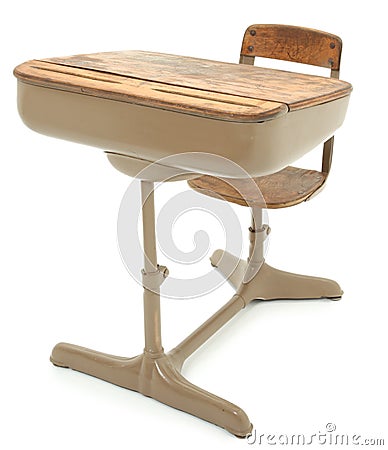
I'm pretty sure I used a desk with a sloping top at school in the late 1980s or early '90s. It looks like it was probably 30 years old though.
Form memory it was ok to write on, great to read on and terrible to put thing on. But it had a self underneath where you kept things (and could hide novels to read during class).
Yes, some old pitched school-desks were definitely hanging around in the '80s, but my impression is that their manufacturing was another casualty of the '60s/'70s. (That seems to be when the two-seating, flat, Formica-surfaced table came in as school furniture: so modular! so modern!)
Pitched surfaces of course survive in some areas. Drafting tables / drawing boards[0] come to mind.
In this (https://medievalbooks.files.wordpress.com/2014/10/bl_royal_1...) photo, you can clearly see the man flaunting his Beats by Dre earbuds over the edge of his desk. You know he didn't just happen to hang those bitches on the most visible part of his gaudily minimalist desk with gravity-defying angles. This guy was clearly a douchebag. The more things change, the more they stay the same.

Yup, Beats "caually" draped over the top of his multi-monitor stand.
What really jumps out at me is that before perspective theory was invented the paintings rather look like Ultima Online.
Omg I need a book wheel!!! I've got so many thick reference books (in a variety of subjects), I would love to be able to have them all open at the same time...
Anthony Grafton (polymathic historian of the book at Princeton) actually built a replica of the book wheel pictured in the original post. Only one of its kind in the world, as far as I know: http://www.princeton.edu/~paw/archive_new/PAW06-07/11-0404/f...
There's a better picture of his wheel (I assume - it looks the same) here: http://www.sil.si.edu/exhibitions/odyssey/images/ramellibook...

Yes, that device looks absolutely amazing. I wonder if anyone ever used two of them side by side like a medieval Memex?
My less elaborate solution to a similar problem is to sneak into a lab when I'm making notes on multiple (paper) references. I just shuffle left and right along a bench with all my books and papers spread out.
Steampunk has never interested me...but monkpunk? Me want bookwheel.
That's not what he's asking for. He wants multiple books open at the same time with easy access and in view, I suppose. Of course, you could have more kindles, like a bunch of the star trek [PADDs](http://en.memory-alpha.org/wiki/PADD) lying around on your desk, but the kindle is too expensive for that at the moment. And even then, when I am doing historical research or writing a conceptual piece on some scientific or technical topic, it is not uncommon to have ten to twenty books, articles, documents or artifacts open at the same time and it never fits on my desk comfortably. So I end up using multiple table-like areas on different heights alongside my desktop: a coffee table to the side of my chair, another chair in the corner, an open closet with shelves just below eye level, and so on.
A document "wheel" or carousel would help a lot.
"but the kindle is.."
Currently cheaper than some of my hard cover textbooks, and I graduated in 2005, so I imagine its worse now.
So that is expensive in a absolute experimental sense but not excessive in the book industry as a whole.
Also carpentry project expenses can add up if you make things fancy, so I can imagine spending about as much on the raw materials as loading a wheel with kindles.
> "but the kindle is.." Currently cheaper than some of my hard cover textbooks, and I graduated in 2005, so I imagine its worse now.
Yes and no. Text books are needlessly expensive and, to be honest, often superficial content-wise. The information contained in them can be easily gotten from the Internet or, if that doesn't work out, from a good library.
But even if I'd want to use 10 text books at the same time, one kindle isn't going to cut it. I think the biggest problem with using digital documents, for me, is that there's no natural geometrical mapping that I can keep in my head the way I can with books, articles, and stuff scattered around my office. I know that the information on concept A is in that corner, for example, and that going deeper into that pile means going in deeper chronologically. And I put documents on related concepts closer to each other. Somehow, these stacks of documents form a concrete representation of the argument I am constructing.
I tried to do the same with digital documents, I've got thousands of them, but tagging them, or putting them in directory trees, and so on, does not give me the same handle on the the information as I understand it at this moment in my mind. It is quite frustratingly, as digital documents are a lot easier to handle otherwise.
Try searching through a book vs. search for a tag within your tagged collection of data. It's a way more logical structure on the digital side.
You're forgetting that unless he plans on stealing the ebooks he still has to pay very nearly the same price for the textbook just now they can make it expire (and don't forget to tack on the price of the kindle).
tl;dr [price of kindle] + [price of textbook] > [price of textbook]
This is not medieval but for those interested in these 'multi-monitor' bookstands, I was immediately reminded of a forefather of the United States, good ole Thomas Jefferson. He had swivel bookstand and here's a PBS woodwright workshop video on how you can make one. http://video.pbs.org/video/2365004559/
It is a fun idea to have one of those book wheels but with laptops loaded instead of books.
A whole server tower filled with kvm racks? http://static3.bigstockphoto.com/thumbs/6/1/1/large2/1160690...

Only one will be at the ergonomically correct height.
Unless your "real project" is making a variable height powered automated chair. Which is an interesting idea.
Given an infinite amount of cheap space (coasties need not apply) something like a teeter-totter with a counterweight to lower static torques to practically nothing...
A motionless chair might result in less sea sickness when combined with a moving rack.
COTS is boring but COTS you can buy half racks and lift tables with multi ton capacity for moving machinery (think like, engine blocks) You'd want some kind of shielding to keep kids and pets out of the works. And you'd need some kind of interlocking to prevent forcing a open laptop thru your lap when lowering.
I was thinking workbenches, and tools, if the wheel can lock into place with a spring loaded foot pedal or something.
Spin the wheel get your SMD rework station, spin the wheel get your RF test equipment, spin the wheel get your connector assembly workbench, spin the wheel get the fastener screwdriver and wrench shelf.
I enjoy unusual carpentry projects and I'm now thinking about making a 3-wheeler for my library room in my house as a big project. Wouldn't that look interesting? I'm getting a dark stained oak and brass fittings feeling about the whole project.
Maybe start on a much smaller scale with a kitchen spice rack at 1/4 scale.
One operational problem is I read recreational books one at a time on kindle app or real space, not 18 books in parallel, and if I do anything academic enough to require actual citations or verifications that's exclusively browser tabs online. I might end up building something really cool that I won't actually use.