▲ 45 points
back
91 comments
Anyone who wants to work freelance or do a startup, rather than work for an employer, and who has any sort of preexisting condition, is definitely helped a lot.
People here are complaining that their insurance got pricier. The reason is that insurers aren't allowed to exclude sick people anymore. If you ever get chronically sick, you'll appreciate this change.
It actually makes health insurance worth a damn now.
Before if you had minor medical stuff insurance was there. But as soon as you got legitimately sick (e.g. cancer) they quite literally went back through every form you ever filled out looking for an error, typo, or omission in order to cut you.
Worse still they actually designed forms to increase the chance of error for exactly this reason. Did you ever wonder why you have to sign it three different times on different pages? That is why.
Plus if you got laid off previously you were in deep trouble since your new employer's insurance company would reject you and you'd struggle to work while sick regardless.
Honestly Obamacare improved things decently. Only short-sighted greedy people are unhappy. Next challenge: Unlink health insurance completely from employment.
Health insurance from your employer is bad for everyone. It reduces consumer choice (e.g. you have the "choice" to either go with the company your employer picked or nothing), and it makes SMBs much less competitive than large corporation.
Startups in particular struggle to offer employees health insurance even if they can afford to offer a competitive income (as they pay disproportionately more for health insurance than a much larger company).
At least an argument can be made for why the "public option" (nationalised health care) is a bad idea, I've heard no good arguments for why unliking employment from health care is. Except "I get really good healthcare right now and I am too lazy to shop around for it."
The only organisation that should be allowed to offer their own health insurance/care is the US military, and that is more for practical reason.
>"Before if you had minor medical stuff insurance was there. But as soon as you got legitimately sick (e.g. cancer) they quite literally went back through every form you ever filled out looking for an error, typo, or omission in order to cut you."
This is pure truth in my experience [1].
Yes, all of it, but it's not just your forms - they'll scour phone calls too. Anything you've communicated can and will be used against you.
Problem is, it's the sort of thing that seems too unlikely or simply too far off until, out of blue, it hits you on the backside of a routine visit. More insidious is the way the scheme necessarily limits the number of people who survive to talk about it.
1: I spent years fighting this on behalf of a terminally-ill family member and I witnessed the lengths a company will go to in order to avoid making payouts first hand while working for an insurance company.
So post-menopausal women are now required to buy a more expensive plan that includes maternity coverage because, "insurers aren't allowed to exclude sick people anymore." Sure...that makes sense.
Or for that matter if you ever spontaneously change genders (statistically speaking), because getting health insurance prior to guaranteed issue was treacherous for women. We were routinely denied family coverage.
If your rates went up, but your previous coverage was never actually put to the test in a serious way you might want to consider the very real possibility that the old plan never would have paid out [1].
"Since insurance companies now won’t be allowed to collect premiums while you’re healthy only to yank coverage when you get sick, they have no choice but to pre-emptively cancel plans that wouldn’t be financially beneficial to actually pay out."
1: http://www.slate.com/articles/business/moneybox/2013/11/obam...
Yep. My employer based insurance was cheap but they dropped me when I got cancer. They wouldn't have covered much anyway I later found out.
I don't know much about the politics or economics of the health insurance industry, but I'm pretty sure if you're posting on HN, you're not part of the group the law was enacted to help. It was never claimed that it would make healthcare cheaper or better for everyone. We have options.
Yes, I'm sure there are some true rags to riches stories around here; but we're talking about right now. I am grateful and lucky to have the background and skills to be able to take for granted that I can afford health insurance. Moreover, since it's not socialized, I'm happy to pay for it. I don't worry about finding bottom dollar on this particular thing.
Wow is this ever wrong. Guaranteed issue is an enormous win for entrepreneurs. When you work for your own tiny company, you obtain insurance on the individual private market. Prior to the ACA and its guaranteed issue rule, insurers routinely denied coverage to family members based on cryptic "DO NOT COVER" condition lists. Coverage denial didn't merely mean the insurer wouldn't cover a particular worrisome condition (which is bad enough) --- it was a blanket denial of any coverage at all.
Young male entrepreneurs didn't run into this problem because they were male, which conveniently dodges more than half of the "DO NOT COVER" list, and because they usually don't yet have families. But cross 30, get married, have a kid, time travel back to 2007 and try to insure your family. You'll see, like I did, how helpful the ACA is for startup founders.
Fair enough. I was responding to commenters that I felt were being glibly dismissive of the ACA. I am a strong supporter of it for a number of reasons.
And if you own or work for a startup, are under 27, and have middle-class-or-richer parents, you obviously benefit as well.
I don't really understand this comment. If you're posting on HN you probably care about startups. And generally, startups don't or can't provide health insurance to their early employees. Which leaves the startup game to the very young and very healthy. The ability for everyone else to have the opportunity to leave their existing job (aka healthcare source) and strike out on their own should surely increase due to this.
I mostly got burned by ACA -- I had $80-120/mo HSA+HDHP which was awesome, and then got forced into $280/mo inferior coverage (a "Bronze" plan) with fewer doctors. (I ended up canceling all coverage a month later, getting a $750k "insurance, temporary" plan for 364 days at $30-60/mo, and ended up having a job with employer care before that expired.)
Now I have employer-provided health care which is "free" but objectively the worst insurance I've ever had (in terms of number of doctors, etc.) HRA rather than HSA, so not very useful there, either.
I hate the idea of employer-provided healthcare. If I had "interesting" medical issues, I'd probably just pay for insurance out of pocket vs. sharing health data with an employer. I'm pretty sure my coverage costs employer more than $300/mo, too.
>> I hate the idea of employer-provided healthcare.
Yup. The most obvious problem is that when you change jobs, you change providers. That alone is undesirable and contributed to the problem of rejections due to pre-existing conditions.
The less talked about aspect is that large companies are self insured. Meaning they cover all the costs and just have an outside company manage the plan. The issue with self insured companies is that on average, working folks are healthier than non-working ones. That means it shifts the higher costs to the non-corporate plans - medicare/medicaid.
Just taking away the incentives for this and having people get their own plan would have gone some way toward a better system.
Similar experience for me. Had insurance I was happy with. Had the plan forcefully cancelled out from under me. Then found less benefits for more money. Now I can't see one of my doctors without paying cash [1]. Nothing affordable about this for me.
http://www.huffingtonpost.com/2014/04/10/obamacare-patients-...
All my reasonable Bronze options in Illinois as HSA/HDHP-qualifying, and they have the same doctor networks as the Silver or Vanadium or whatever plans.
As an European
>in terms of number of doctors
what does that even mean?
Young, healthy people will get screwed by any mandatory government healthcare system, but my view in general is that having strong government oversight of healthcare is just a good thing. With reference to this Guardian article, the US spends $8,362 (Private individuals, Government, and insurance combined) per person. Contrast that to the UK which spends $3480 per person. While I hate paying taxes just as much as the next person, I do think I get very good value for money for my National Health Service.
Universal healthcare is just a good thing.
http://www.theguardian.com/news/datablog/2012/jun/30/healthc...
Please define "screwed". Paying more than you take out does not count, provided older people are paying less than they take out (I hope I don't need to remind you that young people eventually turn into old people).
I mean, it sounds like you're just pointing out that, if health insurance/coverage is mandatory, then you are getting 'screwed' if you don't use the healthcare system. That's like saying I'm getting 'screwed' by public transportation if I own a car.
Eventually young and healthy people turn into old people. Also, you should qualify that with the gender. You maybe be a young and healthy female but you would have been hardpressed to get independent coverage once you hit 'motherhood' age.
you're young and healthy until your first visit to ER without insurance
I'll be the dick. On paper, it's helped me, yes (girl problems that would have run $16K by June just mainly for tests): I met an OOP early (yay! Didn't even know what OOP=out-of-pocket WAS!), so after that I didn't have to pay anything until next year! (Who's heard of such a thing?!)
But the hospitals/docs didn't file right, or didn't get preauths? Basically, providers aren't getting paid; and while AHCA says "ignore bills you've met your OOP!", I'm seeing bills from people I've never seen before because while a doc was "in coverage area", their test readers weren't, and I've actually been served a DEBT WARRANT (by the police!) now. So basically, I'm paying what AHCA said NOT to pay because I don't want to be sued (hire lawyer, get tripped up in legalese, ...it's just cheaper to PAYOLA); plus, I figure radiologists or labs did their job and should get paid (plus their phone calls are scary). I find the entire thing ridiculous, but the debt warrant is scary. NGL.
What is a debt warrant? Isn't this a civil matter?
My rates increased 40 percent for a HDHP+HSA bronze care plan with no preexisting. So, you can say I'm am one of the ones that really got screwed with ACA.
No you didn't. Just that your future risk was finally accurately priced into your premiums (whereas before you would likely have just been dropped if something drastic happened).
So as a freelancer I was paying $140 a month with a $500 deductible.
Now with Obamacare I am paying $260 for the same level of coverage.
How is that helpful to me? I'd love to hear some positive stories, because I'm just paying more and making less in my pocket, while people who don't work are getting health care for free.
About 5 years ago, at age 25, I found out I had a thyroid tumor for the second time in my life. My employer based coverage dropped me citing a surgery I received at 16.
Not only was I employed full time, I was restarting school. I lost everything. Tuition I paid, loan privileges, I had to sell everything, my credit sucks. Until the ACA went into affect I avoided doctors, even for big stuff because I was terrified of getting my family dropped.
I can go to the doctor and many people I know from cancer support groups can get insurance now, I'm not just talking about those who don't work, it was really hard to just get a company that would cover you when you've had cancer multiple times.
I know it sucks for some people but it's helping so many people who really needed the help.
One way to think about it is that you're paying an extra $120/mo for protection against rescission.
Another way to think about it is that you're paying $120/mo for the guarantee that you'll be able to obtain coverage for your spouse and children in the future. That guarantee did not exist at any price prior to ACA.
I'm not sure how to respond to your last point, because people who don't work have always received health care for free. The backstop for health care financing has never been "no health care". The backstop is bankruptcy, which isn't an issue for the unemployed poor.
By extending health care to people who can't afford it, the ACA has probably lowered your costs over the long term. That's because the most expensive possible way to provide coverage is through emergency room visits, which is how the uninsured obtain coverage.
> How is that helpful to me? [...] while people who don't work are getting health care for free.
- Your phrasing of "people who don't work" implies to me that you feel disdain towards them, and that they could work, but are just lazy. (and now they can "freeload" health care too!) If this is not the case, then I would change the phrasing to something like "people that are unemployed."
- "What's in it for me?" isn't always the best measure of the value of something. For example, Bill Gates can afford to pay all his health costs out-of-pocket. Would you agree with him if he said that we should dismantle the entire health insurance industry because he doesn't need it?
- You haven't explained what level of coverage you think that the "non-working" people had before. Do you think that their level of coverage has improved or declined?
> Now with Obamacare I am paying $260 for the same level of coverage. [...] How is that helpful to me?
Insurance companies now have to account for the risk that if you get sick in a chronic/expensive way that they can't find some technicality to drop you. Whether you see this as a benefit or not is probably correlated with your belief that those things "happen to other people."
There's no guarantee, with your old plan, that they would have kept you had you gotten really sick with expensive medical bills. The Slate article above touches on some of this.
Some people are getting subsidized care but the only people getting it for free are those who are eligible to enroll in Medicaid. Not all states have agreed to increase their Medicaid rolls however. Plus, as a Medicaid patient, it is not that easy to find doctors, especially specialists, who are willing to see you. I had a Medicaid patient who had surgery for a wrist fracture a few weeks ago. The orthopedist who operated on her would only agree to see her in follow up in a separate clinic for 'caid patients, and that appointment would be in February. Fortunately we were able to encourage the surgeon to see them sooner. Im guessing that's not the kind of healthcare you want, even if it's free.
...people who don't work are getting health care for free.
From the article:
  Critics of the Affordable Care Act have
  often warned that the program would be unfair
  to the young because it limits the ability of
  insurance companies to charge higher rates to
  older customers, who tend to be sicker. But
  young adults show the largest reductions in
  being uninsured of any age group.
Didn't it really just increase the number of insured people primarily because of broad expansions of medicaid and medicare?
As the map clearly shows, the people who were helped most are all the new people who joined Medicaid when it was expanded.
Compare this map to states that accepted or refused Medicaid expansion: http://i.huffpost.com/gen/1119617/thumbs/o-MEDICAID-EXPANSIO...
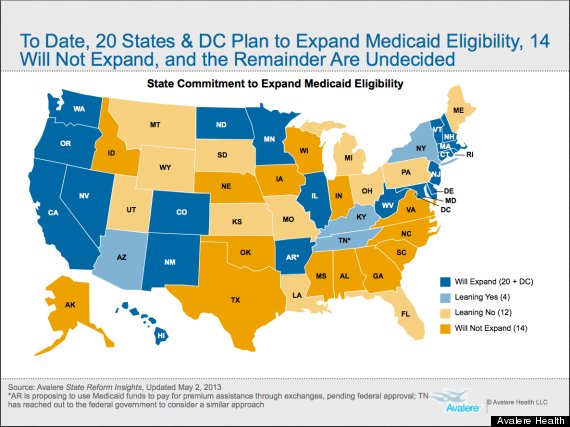
Have any states attempted to take control of medical care and negotiate doctor wages / drug prices? Works reasonably well for Canadian provinces. There's got to be a reason it hasn't been done in the states. What is it?
I'm skeptical of the existing comments in this thread - they strike me as too on message to be four separate individuals with identical concerns.
You think the person with 27,254 comment karma on a 2,304 day old account, with identifying info in his profile is posting anti-ACA comments as part of some conspiracy?
I agree with your observation, but in this case, it makes sense. As someone with a permanent preexisting condition, I am the only person I know that benefited from the ACA. Huge portions of my family and friends were impacted very negatively. Many of them had their rates go up 30-40% and ended up with worse insurance plans.
I am a bit bothered that the NYTimes chose to ignore a wealth of data for a major current societal problem, and just cherry-pick some category that ended up "better" to make a map and article.
My wife and I want to start an astroturfing tracker website. Perhaps we have a few candidates? A ShowHN someday?
Whenever a congressional law passes, just take the opposite view of the Act name and it shall be true. For example, there's nothing affordable about the ACA. My old healthcare plan was eliminated and replaced with a more expansive and less beneficial because of ACA regulations.
Then for people who are forced into ACA plans, they'll have their rates raised conveniently after the Nov 4 midterm elections...
> more expansive and less beneficial
Really? Reporters and politicians have searched for these mysterious slighted people who have had their premiums go up for the exact same plan. You should call the O'Reilley factor, you could be a star!
A lot of people could not buy crippled insurance plans with insanely high deductibles and severe limits on coverage, because those were outlawed by the plan. Also, some people were bumped from subsidized plans to fend on the open market, but that's shitty employers taking advantage of their employees, and not the fault of the ACA.
Finally, with the heavy subsidies to your premiums, the same plan usually cost less under the ACA. You could however talk about the cost of insurance in 5 years when the subsidies start to wear off, but, hey, I imagine the republican leadership has plenty of ideas to help the common folk with that.
So, I was going to make the point that this is only true for the controversial bills (a point worth making -- most laws are tremendously boring), but scrolling through the laws passed by this congress I found an example that makes your point perfectly:
Violence Against Women Reauthorization Act of 2013
It turns out this law doesn't authorize or reauthorize ANY violence against women. It seems to do the exact opposite of what it says -- it is primarily about _punishing_ violence against women.
That is all, continue being outraged. I'm sorry your insurance costs more, that does suck.
I can tell you who it hasn't helped: Me.
Why? I couldn't afford insurance before, and I sure as heck can't now.
For the sake of fairness, it also hasn't hurt me any either.
So basically, before the ACA if I got sick, I was doomed. And now if I get sick, I'm equally doomed. But in the long run, things will supposedly get better. Here's hoping for the best.
Seems like either a poor headline or the wrong metric.
I am insured now, but as someone who was rationally uninsured, I don't think I am better off. While I am only one person, the assumption that insurance necessarily makes someone better off seems a bit spurious.
Are there any metrics on whether the cost of insuring the same person has gone down? Wasn't that meant to be one of the benefits?
Edit: Did some digging and it looks like a more comprehensive review of the stats can be found here: www.nytimes.com/interactive/2014/10/27/us/is-the-affordable-care-act-working.html
As for my own question, it does look like the majority of the markets will see prices increases.
Did you have $20,000 socked away to cover appendicitis? (If you've already had appendicitis, insert any of 100 other relatively common highly tractable medical emergencies you haven't had yet). If not: your policy of rationally forgoing insurance was being financed by everyone else in the market.
(The $20,000 figure comes from my friend, whose teenager had appendicitis a couple years back).
Rationally uninsured? Care to explain your circumstances?
I don't think it was meant to reduce the cost of insuring someone but to reduce the rate of the increases. Remember how fast health insurance premiums were going up in the late Bush and early Obama years?
To answer the headline of the article I did not read... The health insurance companies?
> As for my own question, it does look like the majority of the markets will see prices increases.
Health spending was growing at an average of 7.2% / year from 1990-2008, vs an estimated 3.6% in 2013. Certainly the slowdown is the result of more than just the ACA, but this is the relevant metric one should use when measuring its success at cost containment, not the fact that almost everything gets more expensive from one year to the next.
http://content.healthaffairs.org/content/early/2014/08/27/hl...
>but as someone who was rationally uninsured
It's not rational for anyone to be uninsured. Any healthy person could get in an accident.