▲ 122 points
back
112 comments
I just had a conversation about this last friday with a coworker. We both basically came to the conclusion that the only e-books that work are prose-oriented, not learning-oriented.
With your average novel, you only read from beginning to end, and you only read words. With a textbook, you not only read words, but you read diagrams and figures. You also skip around...you follow footnotes, references, and you also might follow a curricula that was not defined by the author. You will often refer to two or three different hotspots while studying a single chapter...for example, while working on practice problems, you will flip back and forth between the practice problems, the chapter intro, the context for that problem, and possibly a chapter recap.
This user-adoption gap is not one of the underlying medium, but rather of the user interface. Flipping pages one at a time is not sufficient.
There are tons of text features that suck or are absent in ebooks. Even footnotes aren't great, let alone things like facing-page translation—or anything else that relies on two pages being visible side by side at once, which is quite a bit if you're reading much outside of mass-market fiction. Plus, yeah, diagrams, figures, et c.
Poetry often blows in ebook form. A good paper book of poetry has a lot of care put in to precise placement of the text, and it can add a lot to the experience. Ebooks can't do that. Really, any book that benefits from fixed page boundaries has similar problems.
Even one of ebooks' big advantages, full-text search, is worse than using an index unless either 1) you need to search for something that's not in the index, or 2) you're on a device with a full, real keyboard, so not a tablet or eink device.
Ebooks are also very expensive and there's no used market—I'd effectively have to pay ~3x what I did to assemble my physical book collection to replace it with ebooks, provided there were an ebook version for all my dead-trees (not the case). It'd be even worse if most of my books were common paperbacks (the thing ebooks are best at replacing) since you can pick those up for next to nothing if you keep an eye out. 10x the cost to take such a collection digital, I'd imagine.
That seems abundantly obvious to me. I've been a fairly avid fan of Kindles for about 4 years, but I've never even considered reading a textbook, programming book, or reference book in that format. All I have ever read on my Kindles are novels, comedy, popular science, and biographies, all of which are very prose-oriented and linear. One pop econ book I read recently had a lot of endnotes, which was admittedly a bit annoying, but I don't think it would be significantly less annoying than a physical book with a lot of endnotes. Luckily the endnotes were not very crucial to the text.
I have purchased several physical books from Amazon and chuckled seeing them offered for Kindle. The most recent examples were a large and dense musical theory book that's very reference-oriented and has a lot of diagrams, and a book of Bay Area hiking spots that is obviously very map-oriented and meant to be thumbed through. I can't imagine using either on an e-reader.
I wish I knew more details about what sorts of material they were having these young people read, but I suspect it was largely not prose-oriented.
> We both basically came to the conclusion that the only e-books that work are prose-oriented, not learning-oriented.
Completely agreed. E-books are great for linear text, but the moment you have any kind of cross-referencing it falls apart (even footnotes are troublesome; why can't footnotes be display inline?) Most importantly, they lack discovery; it's a lot harder to flip to a random page.
That said, I have started reading a programming Apple iBooks textbook [1] and I find the format great because it's interactive and because [edit: in principle...] you can copy and paste code snippets directly. In this sense, I think it's actually a lot better than its paper counterpart–but perhaps coding books are a niche (and, I'm sure, some would argue that having to re-type code yourself is a worthwhile exercise in its own right).
I agree, if by "eBook" we mean only the specific formats (ePub, PDF, mobi). But I'd argue that you can have all if you make a website instead, and read it on a browser. You can then have multiple tabs, bookmarks, large pages with fast scrolling, etc.
And an epub is just a collection of HTML files anyway, so it shouldn't be difficult to make a website instead. I think what's missing is a "website archive format" supported by all major browsers, so the user can have an offline copy of the "book".
> I just had a conversation about this last friday with a coworker. We both basically came to the conclusion that the only e-books that work are prose-oriented, not learning-oriented.
To me, this is precisely backwards.
I would LOVE to have all my technical library in e-book form where I could easily reference it on a tablet instead of the 4 bookshelves and 42 boxes that it sits in.
I never need my entertainment book on a tablet.
In addition, e-readers are still too slow for me. I can flip a page faster than anything renders. This is STUPID given the vast amounts of processing power we have but continues to hold true.
The only time paper books become easier to use than paper books for me is when the book makes extensive use of really fine print in tables or has extremely long lines of monospace text such as badly written source code.
The resolution of an iPad Mini 3 or iPad Air is sufficient to render all the technical books I use quite adequately.
eInk devices do not have the resolution and screen size required for comfortable technical reading. With "Retina" displays on a decent form factor, magic happens.
I use the iBooks reader almost exclusively since it has very good note-taking and place marking tools.
The only thing iBooks can't handle is position sensitive layout, such as some "art" books which rely on specific typography and layout for conceptual flow. PDF can handle some of this, but if the format is not exactly the same as the iPad screen we're back into "I can tell I'm reading a PDF on an iPad" territory rather than "I'm reading a book".
The Kindle is optimised for flowed text. Of course it is painful for technical books.
Came here to say about the same thing. For regular reading I don't care the medium but will pick ebook most of the time so that I have it everywhere I go and can read a chapter or two in the waiting room on my phone and pick up on my tablet later that night. For text books I have yet to see a good digital interface to them, mainly due to not being able to quickly jump between sections/pages. Maybe an interface where I can "cut" out parts of pages and organize them all on a digital corkboard is closer to what I imagine as "the best" way but still I'd pick book over ebook. The one other thing I will say is that I did get ebooks instead of textbooks a number of times in college because it was cheaper and I was told ahead of time that we either never or rarely use the book (but had to prove we got it or lose points in the class).
With a couple of books I reference often, I've bought the physical version after already having the e-book one. It really makes such a difference.
On the other hand, the convenience of looking for a book online, being able to choose one or a couple, and having it in your e-reader after a few minutes is also something not to discard.
I have to ask: how much of this do you think is because of the digital format, vs how much of it is because the digital format doesn't support certain physical book methods we use?
The two that come to mind are post-it notes and flipping through the book. If, perhaps, I could press and hold my finger one end of a tablet to flip through it, maybe it would make them more suitable. Also, perhaps if bookmarks I made in the book were always visible at the top of the reader, it would also make it more suitable.
It might even be useful to make the application present a 3d view of a real book based upon the orientation of the device. That way I could angle it to find roughly how deep within the book a bookmark is.
I feel the complete opposite for all of the college textbooks I've used (although all of my textbooks are filled with problems rather than readings).
Using a laptop or e-reader to read textbooks is awesome for a couple of reasons. First off, having multiple textbooks doesn't weigh anything, and I can carry them around at all times. Secondly, when doing assignments and the like, I can bookmark the answer section in the back, and flip back and forth between questions and answers arguably faster than I could with a paper book. Finally, the best part of electronic books is the ability to search through it. Every definition in the book is a Ctrl+F away.
So maybe reading books electronically isn't as great when you're doing a lot of actual reading, but in my experience using more math/science textbooks, electronic wins out every time.
I think the biggest problem is we are getting e-books that are just digital representations of physical books. I'm learning music theory right now and it would be great if the book I'm following was an app with animated examples to re-enforce the concepts.
I'm also imagining the time I first saw the animated unit circle gif (years after trig class):
http://i.stack.imgur.com/1oSJw.gif
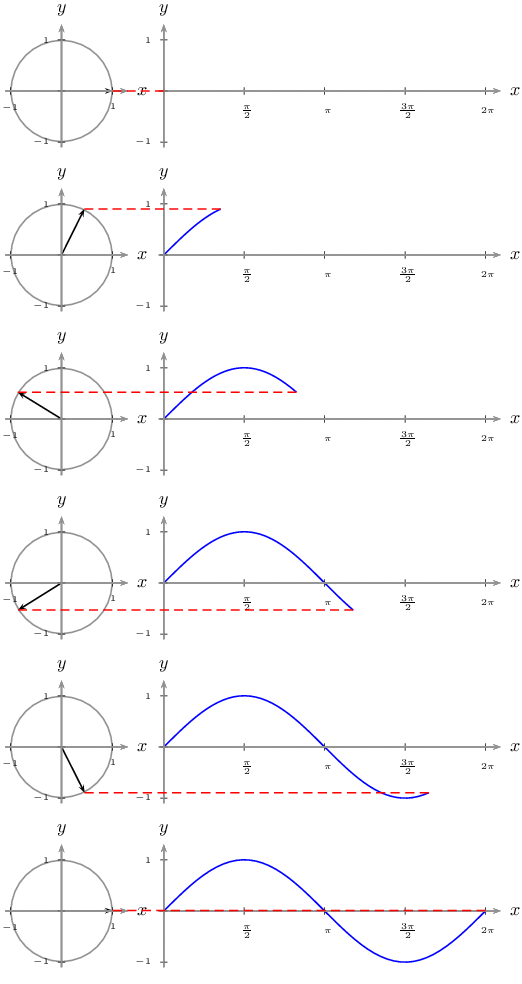
If that was in my "e-textbook", I think some concepts would be easier to explain. I think we are sitting at just the cusp of what "e-books" in school should be. They shouldn't just be for words, but for conceptual learning in a school setting.
"In the United States, e-books are less expensive. Students will say, “I’d like to have the print version, but the electronic version is so much less expensive.” But if you buy a book used, the publisher and the author are not getting any money but they are getting another reader and they’re not cutting another tree. And the cost is less. And if it goes to a third generation the cost is really less."
That's a nice sentiment but there were a bunch of books in college that purposely changed portions from year to year to kill to resale market. Some profs were cool and researched what sections/questions would be so that you could use one of the 3 editions available but others didn't care.
I was happy to get all some of my books in digital form in grad school. Preparing for finals was so much easier.
'they say they get distracted, pulled away to other things.'
This is probably the biggest draw away from e-readers for me and the reason I gave up on them.
For prose, Amazon's Kindle achieved the right form factor, battery life, display combo many iterations ago for me; but I seemingly can't handle having so much information available with a button press. It's just too little effort.
It's one of those oddities of being human, I feel. It seems perfectly possible in theory to learn about a complex field fairly rapidly by simply using Wikipedia and Google, but in practice the discipline required to not wander off-topic I find impossible to manage.
The sort of semi-procrastination that occurs when you're still being productive (because you're still learning), but you realise that you've gone from studying waveforms to ventricular fibrillation.
The thing that's so strange about it to me is that books themselves are alien concepts, there's nothing inherent about them - humans chugged along for millenia without them. Yet somehow, clicking off of an e-book for 'just a few seconds' to look something up seems to function differently to, say, closing one book and opening another.
Reminds me of the Doorway Effect.
We need a comparison of print, pdf and epub. PDF can retain print layout and typography, which makes a big difference in aesthetics. EPUB still needs work from device makers, to honor embedded fonts.
When the flexible eink screen from the 13" Sony Digital Paper goes mainstream with a bluetooth keyboard and Android clones, students can have access to a large yet lightweight device for reading PDF+epub, handwritten annotations and typed notes.
http://goodereader.com/blog/electronic-readers/sony-digital-...
I travel a lot around the world, so I digitalized my entire library, University notes, everything...
I used a Fujitsu ScanSnap(amazing scanner with automatic feeder) to digitalized them using a Wood saw to cut the back of the books. I stored them in boxes in a locker room.
I love it because I control it. I could analyze my documents, I could index them, I could organize them as I want. I could mark them too on my tablet.
Much better than paper.
But most people can't do it(each of my kids going with a USD400 device to school sounds ridiculous to me). A tablet is expensive just for reading, and more expensive if you are going to add an active pen, like I use.
What is quite shocking is that the device I use the most for reading is a new 55 inches LG OLED screen, rotated 90 degrees. I use software that converts black over white "paper" to green on black.
Einks are slow, very bad resolution, monocrome(exchanging resolutions for tones using halftoning), and very small screen.
If only Qualcomm Mirasol or other technologies were cheaper it will be totally different. Not ready yet for the mass market.
>found a near-universal preference for print, especially for serious reading
Is this really any surprise for "serious reading"? Reading a textbook, especially one with lots of graphs, charts, figures, etc., is miserable on an e-reader. I suppose I always assumed that pleasure reading was the most popular use case for an e-reader. Maybe I'm way off.
EDIT: while muddling through this in my brain, I realized that I've been mentally defining e-readers as E-Ink readers.
This finding is not surprising and is a result of shortsightedness by technology companies, IMHO. They placed more importance in video games, multimedia than the simple readability of texts. First, they moved away from antiglare, matte screens. They favor flashy, shiny highly reflect displays, which show shiny videos and images very well, can are subpar compared to matte screens when reading in different lighting conditions. Second, they put less money in developing technologies similar to the Kindle readers, which prioritize reading.
I am sick and tired of reading reviews of devices based on their ability to watch videos and play games. I want to get things done. I want screens that do not reflect. I want screens on which I can read comfortably in different lighting situations. Give me those.
Well, yes, if you force people to use today's college ebooks. I made the mistake of buying ebooks a year ago. The ones I got forced me to use proprietary crap-ware that hardly worked, let alone worked the way I wanted. Eventually, I downloaded illegal PDF copies of the print versions of the books (that I legitimately paid for!) Using simple PDFs and an iPad was a dream come true. I can't imagine anything better for large, technical textbooks. Unfortunately, the legit offerings from text book companies don't even come close.
Honestly, I'm inclined to look sideways at this article. The college text book industry is just too entrenched and future-phobic for me not to believe that special interests funded these findings.
"They run out of battery, they hurt your eyes, they don’t work in the bath."
None of that is practically true.
The Kindle can run out of battery but lets face it it lasts weeks so you just need to remember to charge it occasionally. It is unlikely to die on you like a mobile phone.
I am not sure what they mean by hurt your eyes, but the ability to change the font size and still have convenient paging is brilliant. With a paper book you have to don your 2x non-prescription glasses I guess.
And they do work with the operator in the bath, and the eReader just above the surface. Just keep the window open so it isn't too steamy, and have a table ready for when you want to put the reader down (stop reading once your toes start to wrinkle!).
I'm suprised that no one's mentioned this yet, but I've found that even for linear prose-text, my recall of what I've read is much better with paper books than with ebooks.
My working hypothesis for why this is true is that it's easily the mentally differentiate the paper books I've read: when I try to remember a book, often the first thing that comes up in my mind is the cover art. My mental records of paper books are indexed by a multitude of factors---what the cover looked like, what the paper felt like, approximate size, typeface, etc.---that just aren't there for ebooks
At first I was going to agree with this statement; however, I hate carrying all of my textbooks around, and if I have the e-book of the text that means I saved a lot of money. I do love reading paper books, you cannot replace the feeling of holding a paper book in your hands. It is something that I love about paper books. But I really do love the fact that I can have all 5 of my text books in one device that weighs less than any text book I am currently carrying around.
Last semester I had all E-Books and I was able to bring them all with me at work, and I was also able to read them while sitting in my work truck in the dark. This semester I do not have any E-Books and two of my text books are fairly large. Which really sucks, because I hate having a heavy back pack.
All around I do love having E-Books, on the Kindle I can slide back and forth to different sections, high light the pages and everything I do with paper books. I also take notes on paper as I go along with the E-Book, it really helps me to remember certain parts.
I am saying this at the beginning of the semester though, I might change where I stand but I currently love E-books, except when the battery runs out I hate the thing haha. Who wouldn't love to have 6 major textbooks on one device?
What this doesn't go into is how the students evaluated such a task
> When students were given a choice of various media—including hard copy, cell phone, tablet, e-reader, and laptop
How many have actually compared those devices? And what digital format were they using epub, pdf, HTML, txt ?
I have all those devices to try out the same books on. And I'm a student. I would rate them
1) E-reader - least eye strain, good bookmarking, one more device to carry - I only have one without a backlight
2) Tablet - better pdf support, good bookmarking, backlight is handy, multi function can be a boon and a distraction
3) Hard copy - I still read a lot of paper books - too bulky, I bought a sheet feed scanner just to scan my library and dump it
4) Laptop - at least it's not a phone
5) Phone - too small but I have read whole books using it when I had no option
A few thoughts:
1) Hardware interface: People here are conflating hardware interfaces (e.g., on Kindles) with the data medium (e.g., paper or ebook). For serious knowledge work, such as studying, of course a large screen area (such as dual 22" monitors) and good input (such as a full-sized keyboard) are essential. I think the question is, in that environment, which data medium is better
2) Software interface: How much is an issue of basic interface design. Paper book interfaces have been perfected over centuries; ebook interfaces are still immature. With the right interface, could ebooks exceed paper?
3) Does anyone know if ebook formats combine these capabilities:
* I own the data; it's not licensed to me.
* Open formats, so the book is readable 20 years from now, including the annotations (see below)
* Annotation: I can add notes and associate them with specific locations in the text.
4) An interesting article on ebooks disrupting the college textbook business: http://www.fastcolabs.com/3028855/why-cant-e-books-disrupt-t...
Love digital text. The find command saves me so much time than flipping and skimming.
Books with a lot of charts and graphs, it's a hassle even in print. Figuring out the placement so relavent text and visuals can be displayed on a single page would be better, and it would be easier to experiment with the format digitally.
It took me several years before I made the cognitive switch to preferring eBooks for large, complex, dynamically accessed textbooks over the paper variant. For the first few years I actually couldn't stand trying to read stuff on my laptop versus a nice healthy paper text book (of which I have about 4 boxes that I've incredibly carefully curated down from around 10 boxes). And even attempting to read them on the crappy kindle technology and laggy ipads just sucked beyond belief circa late 2010. It was probably around 2012/2013 that they became my preferred platform on Laptops. Two things probably changed things - SSDs became commonplace, so load times were instant, and, EPUB/CHM readers got a lot betters - allowing quick hotkey movement back/forth. Now, laptops work great - but tablets (in particular, everything I've tried on the iPad), still lags horribly for textbook reading (though they are great for longform prose - I devour books on my iPad - but it's not clear that the iPad is any better for reading fiction books for me than my iPhone - and I suspect the iPhone 6+ is going to replace reading on both in short form for everything except magazines/comics).
Recently, I purchased the Oreilly 5th Edition "Learning Python" and almost laughed. (A) The book is entirely infeasible to bring with you on a trip, (B) I actually had a hard time navigating it, compared to the electronic version which gives me the quickly navigated TOC on the side.
And, the deal breaker - I carry about 30 commonly used textbooks with me on 9 month+ international engagements, all the time in which I'm constantly moving from country to country. It's hard (but I guess possible) to imagine how I might do that with physical textbooks (Just keep shipping them to the hotels I'm next moving to, and hope I'm there long enough to meet up with them).
But I can think of no conceivable scenario in which I could be using these textbooks on the 22 Hour+ flights that I frequently take.
I'm willing to wager I'll never use a physical textbook again.
> There are two big issues. The first was they say they get distracted, pulled away to other things. The second had to do with eye strain and headaches and physical discomfort.
These problems may be common with laptops and tablets, but e-readers fix that. You can't get distracted if the device is only capable of reading books, and e-ink screens offer far less eyestrain than typical LCDs.
Personally, I would say that I prefer reading print books over ebooks, but I vastly prefer reading ebooks on an e-reader over reading them on a different device. I also have almost no shelf space, so being able to store hundreds of books on my device is a great benefit. I get print copies of my favorite books, but in general I use the e-reader for everything else.
I have no experience with e-textbooks, however.
We'll know the solution is near at hand when there's a satisfying way to represent a book like "House of Leaves" (colored words, intentionally blank/sideways/mirrored pages, backwards text, and other typographic mischief) or "Gödel Escher Bach" (diagrams, puzzles embedded in formatting, messages riffing self-referentially on the medium in which they're represented). This is apparently a long way off, given that after all these years, the Kindle hasn't even evolved to the point where it can render a page without what is often sparse and uncomely full justification (to the best of my knowledge).
Found it weird that the only explanation they could come up with for why students still buy ebooks was "saving the environment". How about the sheer weight of all the books you need to carry to last through a 16 hour flight?
The problem with ebooks is the false ownership. I much prefer ebooks, but as opposed to a physical copy, unless I get my hands on the pdf or epub file when I "buy" a book in iBooks I don't actually own that book.
They need an e-ink screen that is big enough to show an A4 PDF. The e-reader (which actually an Android tablet with an e-ink screen) below at [1] is the only one I am aware of, apart from the very expensive Sony legal A4 e-reader.
(I own the smaller version of this e-reader and it is excellent)
[1] https://onyx-boox.com/shop/onyx-boox-m96-universe-97-inch-e-...
I am not a college student anymore, but I can only imagine the time savings of searching for answers and/or keywords in an ebook when writing a paper or finishing a take home test.
As for the ebook vs print argument as a 29 year old, I always order my books on amazon in paperback or hard copy. I stare at a screen all day, and don't want to sit down for an enjoyable read using the same medium. I also always order used copies of books and the prices are often times $.99-$2.00. Far cheaper than a digital copy.
I also prefer print books for in-depth work that requires flipping around between different pages while also working on the computer. There is also something comforting about reading a paper book for fun. My iPad is just not warm and fuzzy.
However, I can't carry my paper books everywhere I go, so I have largely moved to reading by iPad for necessity's sake (I travel quite a bit). Search functionality is awesome for non-fiction how-to books, but my thought process hasn't quite adjusted.
I was surprised I didn't see mention of the reason I buy so many books electronically: Impatience. Getting the book now versus waiting a couple days is a big benefit for me.
I think part of the problem is that there is no full letter/A4 device that isn't heart stoppingly expensive and hard to actually buy.
I might have most of the texts I need to read in digital form but I'm not going to read it on a tiny eReader meant for pulp fiction and my iPad has too many distractions for me to honestly get through dense centent like text books.
"NB: If you’re annotating on a Kindle, on a Kobo, you see—you know how many people thought that word was really important, or maybe everybody else liked this passage. If we sat and thought about it, what we think the author has to say. … Rather, we’re just trying to present ourselves or fit in."
... who thought this feature was a good idea to build??!!
ereaders are a really nice platform but the current problem with ereaders is the lack of tactile feedback, and the difficulty of random seeking.
The first issue is mostly just preference. being able to see how far finished a book you are and the satisfaction of flipping a page is nice, but has little utility.
The second issue is a bigger problem. anything but a linear read from start to finish is difficult on an ereader. the only reasonable use case of ereaders in the current form is reading a novel. anything with a more complicated interaction, such as textbooks where you need to jump back and forth for reference to equations; choose your own adventure books; or books with footnotes or endnotes are severely limited.
I'm not sure if either of these issues can be fully solved, but they will definitely need to be mitigated in the UI for ereaders to have a more sustainable demand.
College books on e-readers aren't amazing yet. This isn't very surprising at all.
Novel style ebooks are a great fit for the Kindle reader. Technical books are not so great. I don't think there is a big push to get technical book reading experiences to be super amazing, even with the iPad being so popular.
It would be interesting to see the comparison done again with a subset of e-textbooks actually designed to take advantage of the platform (and not just be an exported PDF dumped into an azw or epub), like some of the better iBooks examples.
College e-texts are typically "rented", the use terms are terrible. Also, exams in courses I teach are almost always open-book, but I don't allow electronic communication devices, which most tablets qualify as.
The two (huge) advantages of e-books, for me: 1) physical space 2) abundance of available material.
In a perfect world, I'd own physical copies of all books. But as an avid reader, ebooks have been a godsend.
I much prefer printed books, but what I prefer even more than that is the savings of physical space I achieve by having e-books on my iPad instead of print books sitting on a shelf.
This does not surprise me - I print all peer-reviewed journal articles I'm giving anything beyond a cursory glance, and generally prefer print editions of journals.
Not what I expected at all. I would guess that college students would prefer taking notes electronically rather than writing with traditional pen and paper.
Sample size: 300 across four countries.
There are 20 million college students in the US alone.
I don't think that is a large enough sample size.
I've seen a calculation claiming an ebook-reader is better for the environment after 10 books.
smart people, good for them!