▲ 71 points
back
20 comments
As a Canadian who doesn't have much patience to spare for what passes for British royalty these days, it's fascinating to think of a time, just one human lifetime ago, when Canada was a part of an empire ruled by a monarch who actually mattered. There is much fault to be found in Victorian values, but those values and Queen Victoria herself did much to free the British empire from rule by British despots. Victoria's rule, and the values she promulgated, paved the way for the Commonwealth of today. Even though Britain typically acted with rapacious greed in exploiting its colonies, somehow most of them achieved independence peacefully and, in most cases, are today better off than neighboring countries that were not a part of the empire. Victorian values are largely to thank for this implausible bit of history.
I think the best frame of reference is to look at colonisation by British in comparison to other countries. The difference is that the British tended to leave behind a system of governance wbased on English common law, which stretches back a millennia. That also leads to functioning institutions.
So while some see colonisation as exploitation - certainly by the standards of today it is unthinkable - in other cases you can see the bequeathed laws and institutions have made up for that over time, leaving those countries able to stand on their own feet. The peaceful transitions are by design with the promotion of the rule of law and creation of Houses of Parliament and courts and separated church, government and armed forces.
Interestingly the school of thought I have read says that the commonwealth independent model has everything to do with American independence - better to have a stake in something than lose everything.
You're rewriting history (both of you are). Colonialism in Africa was certainly detrimental and exploitative, and not just by standards of today. The "peaceful transitions" you speak of, included borders and methods of government that were set up for the benefit of the colonial powers, the ramifications of which continue to this day. And while independence was achieved peacefully in some cases, colonization itself was a violent process.
http://trace.tennessee.edu/cgi/viewcontent.cgi?article=1182&...
http://exhibitions.nypl.org/africanaage/essay-colonization-o...
Not every case was bad. It was extremely successful in New Zealand with hardly anyone killed (relatively speaking), a peace treaty quickly signed and the quality of life brought up to modern standards, ending 1000 years of murderous tribal warfare. The natives didn't have their own country before it was colonized because they were fractured into tribes. So it was absolutely a good thing to save them from themselves.
"Save them from themselves" is quite possibly the most dangerous mentality to have ever existed on the face of the Earth. The Belgians thought they were saving the Congolese from themselves. Totalitarian states thought they were saving the people from themselves. As soon as you take it upon yourself to decide what is good for someone else, you have decided to become a god with the knowledge of a man. I am quite disappointed to see such ideas supported here.
The Belgians knew they were in it for the money - the main reason it went so wrong there is that they really needed the money now, and so were willing to inflict long-term damage for short-term profit.
Yes, it's very easy to get helping other people wrong, but the answer isn't to give up on doing so entirely.
When you're making the decision yes, I agree it's risky and perhaps arrogant, but with the benefit of hindsight it's clear that it was successful in this case. Not in other cases, sure.
Yes, truly without having first being British colonies, the United States, India and Ireland would have been unable to stand on their own feet and peaceful transitions they were too. Quite right!
I don't think you read my comment. The United States experience was why other transitions were peaceful.
Ireland was not colonised. That was an old fashioned European land war.
India had a relatively peaceful transition, considering what it could have become.
> India had a relatively peaceful transition, considering what it could have become.
You are probably ignoring the Hindu-Muslim riots that took place during partition and the immediate Indo-Pak war after that. These were a result of the british policies.
Oh I read it.
Ireland's was the first colony, it's a matter of record and to this day protestant settlers descendants inhabit the north of the country. [1]
India's transition was not peaceful.
[1] https://encrypted.google.com/search?hl=en&q=the first colony
Are Victorian values to thank for the Opium Wars as well? You can't cherry pick in hindsight to create moral justification for evil.
>what passes for British royalty these days
It's rather ridiculous that democratic country has royalty at all. They should just be private citizens. This, and no constitution. Come on, guys!
We have got a constitution, it's just not written down in one big decisive document and some parts aren't written down at all.
Our civil servants have written more constitutions than anyone else, we are (or were) quite expert at them. We just don't need a constitution to rally behind and so people know what's proper. We never had the vacuum or potential for a vacuum after a revolution like most other countries..
It sounds like a long time ago but there are some surprisingly good pictures of Queen Victoria out there as photography came into its own in the late 1880s. Here's one of her smiling in a carriage:
http://en.wikipedia.org/wiki/Queen_Victoria#mediaviewer/File...

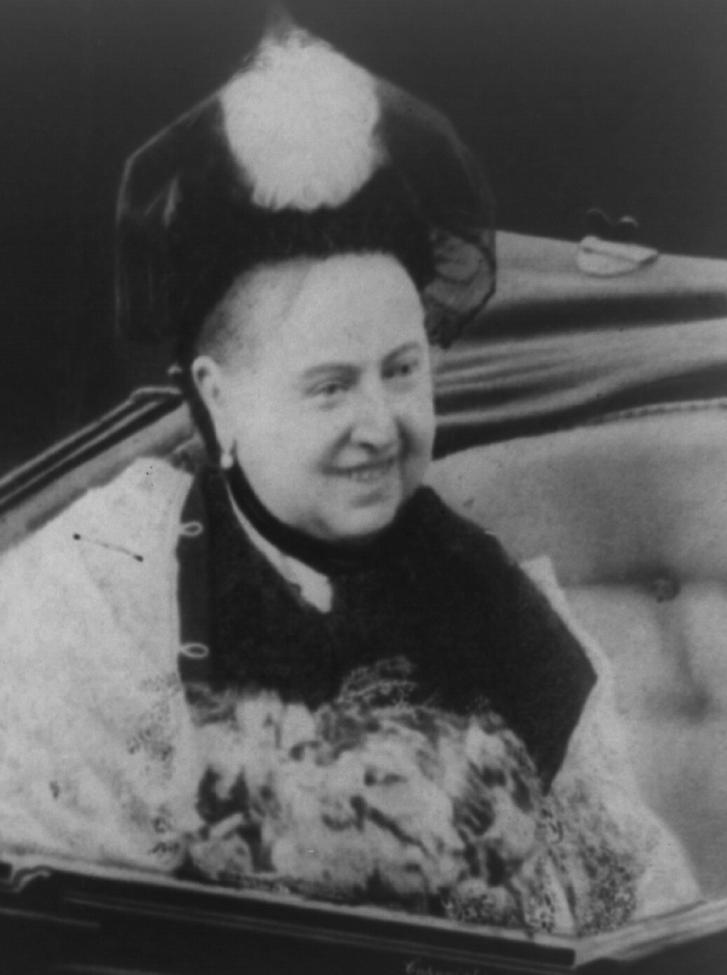
This is a bit like the last widow of a soldier in the American civil war dying in 2008 [1]. History is not as far away as it appears.
True, although she didn't personally live through the civil war. Missed it by 50 years.
My favorite anecdote in this vein is that John Tyler, President from 1841-1845, has two living grandsons (although I think one may have passed on in the last year).
I know some Australian Victorians that would feel different... http://en.wikipedia.org/wiki/Victoria_%28Australia%29