▲ 80 points
back
42 comments
It was amazing what the drivers did with these Group B monsters in the mid 80s, considering how different of a sport rallying was back then. The cars were at best several hundreds of horsepowers more powerful than current wrc cars, with much inferior handling. Most cars, if any, didn't even have power steering back then.
Also the races were much longer taking place over about 5 days compared to the 3 day events nowadays. One event had about 40-50 special stages back then when now there are about 15-25 and most of those are just the same stages repeated. In addition they used to drive both day and night while while getting only a few hours of sleep per night. I'm sure current rally races are still pretty grueling events, but those drivers in the 80s must have been superhuman.
I'm still glad that things have changed. If they hadn't cancelled Group B the fatality count would have just increased. The cars were getting totally out of hand. Some rumors say that some prototype cars already built for the 87 season had close to 1000 horsepowers.
These cars were crazy difficult to drive, they had a "locked" four wheel drive system that is similar to an agricultural tractor so you have to slide the car around slow corners or the engine stalls (spectacular and noisy, but not really fast).
They had an unsynchronized H-shifter gearbox that requires double declutching on downshifts and careful power application given the huge turbo boost. The driver has to be able to use the left and right foot for braking and be able to press all three pedals at once momentarily when downshifting under braking (left foot on the clutch, right foot toe on the brake and blipping the throttle with the outside of the foot, misleadingly called "heel'n'toe").
Here's a really good clip of Walter Röhrl putting an Audi Quattro through its paces: https://www.youtube.com/watch?v=yyVHj3sHVHQ
>> "...and be able to press all three pedals at once..."
Interestingly, the rally heritage of the 80's Audi engineering org was such that even their unmistakably family-friendly models had unusual, competition-inspired features. For example, my '89 200 quattro stationwagon's brake and gas pedals are very close together, precisely to ease heel-and-toe work during technical downshifts. She shares the same manually-lockable type 1 Torsen differential drivetrain with the ur- and sport Quattros, and is powered by a slightly detuned version of the turbocharged inline 5 racecar engine that dominated the rallies so unstoppably. And you can turn off the ABS :D
When you take her around some corners on a dirt road at speed, it's not hard to see why they called quattro "the unfair advantage."
These cars were crazy difficult to drive, they had a "locked" four wheel drive system that is similar to an agricultural tractor so you have to slide the car around slow corners or the engine stalls (spectacular and noisy, but not really fast).
That makes it sound like there are tractors that can do powerslides.
Really slow powerslides. When operating in mud, turning the front wheels won't turn the tractor, so many tractors have separate brakes for the left and right rear wheels. It's kind of amazing how quickly the tractor turns when you stomp just one of those brakes. The resulting effect is like a powerslide in that the front of the tractor "falls behind" the rear.
I learnt to drive on a Massey Ferguson 35. They can be "power-slid". It's just not very spectacular at 10km/h.
Speaking as someone who spent too much time on a farm as a kid, you can do a lot with a tractor.
The only thing you really have to watch out for is popping a wheelie and crushing yourself under it. Imagine my surprise when I found out that real cars aren't like that.
I thought Senna was gifted when I saw that video of him driving the NSX. But this is something else!
Yeah, that is no driving, that is Art...
One thing I really would love to see once is Bellof beating his 956 around Nordschleife with an average of 200 km/h... Sad that there is no real Video of it...
I recall seeing and hearing a group B audi during a road transit stage - the sound of the engine crackling and poping as the driver drove slowly through town was amazing
That 5 cylinder engine makes such amazing sounds. I saw the Finnish rally legend Juha Kankkunen drive his own Sport Quattro S1 in a spectator event in Helsinki last summer. It completely blew my mind. :)
Most cars, if any, didn't even have power steering back then.
And I recall a few years ago listening to Marcus Gronholm - two-time WRC champ himself - asking his team for permission to drop out after his power steering failed.
Turning a non powered steer and turning a non working powered steer are two _very_ different things. When the power steer fails, it gets really heavy.
It also nearly killed the sport. Other manufacturers responded with Group B racing monsters of their own, like the Lancia Delta S4, which were high tech prototypes only thinly disguised as road cars.
The result was exploding costs, exploding popularity (hundreds thousands of people lining the stages without the protection of normal circuit racing) and a series of deadly accidents, eventually leading to the end of the Group B category and a long decline in the sport's popularity.
You make a good point (though including "exploding popularity" in the explanation of how the sport was killed is a bit odd...). But then again, the point of racing is supposedly to improve the breed. I am pretty sure that the technologies from rally cars find their way into production cars more readily than those from say Formula 1. And the Audi Quattro sure kicked off the technology race.
By the way, a colleague of mine owned an Audi Quattro Sport back in the late 90's. It was a very complex car, many components were unique to this model and hand-built. Maintenance was difficult, very expensive and very frequent. He bought a Subaru Impreza WRX "for those 8 months of the year that the Audi spends in the workshop".
> though including "exploding popularity" in the explanation of how the sport was killed is a bit odd...
The issue with rallying is that it used to take place in remote locations with little or no crowds. There are no safety barriers to protect the audience. Additionally, the rally audiences got crazed by deadly dangerous activities like standing in front of the cars until the last second or trying to touch the cars when they zoomed past (there's a story that a mechanic once found a severed finger in the side mirrors of a car).
It became impossible for the race organizers to control the crowds and make the race events somewhat safe. That's why "exploding popularity" was an issue.
Group B was terminated after an accident in 1986 Rally Portugal (?) when a Ford RS-20 car flew off the track and into the audience with dozens of fatalities and serious injuries. This was only a few weeks after the fatalities of driver Henri Toivonen and co-driver Sergio Cresto in the Rally of Corsica. Toivonen's last interview concluded with: "these cars are too fast for the human mind, if you lose concentration, you're dead" [paraphrased from Finnish], then he closed the car door, drove off and was never seen again.
This is how crazy it was: https://www.youtube.com/watch?v=eYIH7ApCxoM
Thanks for this one, and the "heel and toe" explanation in the other comment.
I spent a couple minutes on the Wiki page and this little picture sort of sums up rally racing - they soberly resisted writing "flying" in the label that says "Toivonen driving the Manta 400".
http://en.wikipedia.org/wiki/Henri_Toivonen , http://upload.wikimedia.org/wikipedia/en/6/61/Henri_Toivonen...

What he means with the sport being killed is what happened _after_ Group B was cancelled. Group B was replaced with Group A cars which at that time had much less power thus making the races much less exciting for spectators.
>exploding popularity (hundreds thousands of people lining the stages without the protection of normal circuit racing) and a series of deadly accidents, eventually leading to the end of the Group B category
I know next-to-nothing about rally racing, but that last photo in the article must highlight what you're talking about: a TV cameraman standing about six feet away from a speeding car on a dirt road. Yikes!
Actually more like this: http://www.motormavens.com/emAlbum/albums/Contributors/Patri...
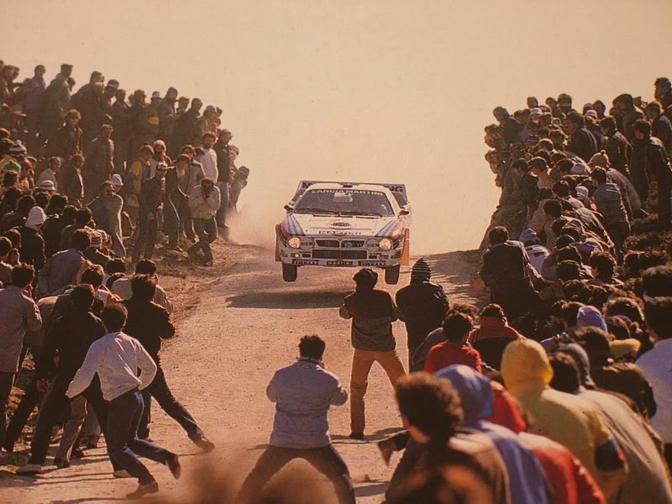
Portuguese rally fans especially were completely insane back then.
O dear. If my calculations are correct, those guys in the street have around eight tenths of a second to get out of the way.
Never tell me the odds
This guy is actually relatively safe, because he is in the "inside" of the turn. The most dangerous places are the "outsides" of turns, where cars out-of-control are more likely to go. I believe that it is a common security measure to place people on the insides rather than the outsides.
They were called "The Killer B's" at the time.
Thank goodness it did. The things drivers can do with rally cars is amazing. By far my favorite sport to watch. I'm sad that it didn't really catch on in the USA. The format is unlike anything that would sell commercially here.
Actually, after the ban of the cars, the manufacturers looked for other races where they could use their monsters. They took them to Dakar, and to the famous Pikes Peak hillclimb race in the USA. Peugeot made a very good movie about it (although it is in a 405T16, which technically never raced group B, the car is basically a 205 T16 with another body shell) - https://www.youtube.com/watch?v=UEuZG37gFdM
I like the part at 3:30 where the driver has to drive with one hand to see anything..
Actually: Comparing that run to this one here [1] from the 'recent' past I'm even more impressed. Seems like the original video was awfully fast - and on a dirt road at that time?
It probably does not catch up there because you'd need a bunch of policemen to prevent spectators from being run over by cars losing control :)
In the days of YouTube celebs and Twitch, I can see a new future for rally spectating.
Just by the title I knew it was Quattro ... such an amazing piece of engineering of the greatest VW generation ever ... that and Golf I&II gt redefined fun in cars.
Some of the success of the Quadro should be attributed to the driver Walter Röhrl (and of course his copilot). Before he changed to the Audi Team, he did win lots of rallyes with an Opel Ascona 400, which was not exactly overpowered compared to the other rallye cars of this time.
The article makes me really sad, but describes the best time in Rally sports. Group B cars made the rallye an event which had as much popularity as the formula 1. It was a time when Racing was 50% raw power and 50% talent, and it is no that it's major racing series, say Group B rally, Group C touring cars or the formula one gave birth to legends like Rohrl, Bellof or Senna. This is an attractivity that is completely lost in modern racing, really, with its small, fuel saving, ecologically correct "cars". Hell, it's racing, not a children's playground. Thank God there's LMP...
> This is an attractivity that is completely lost in modern racing, really, with its small, fuel saving, ecologically correct "cars". Thank God there's LMP...
LMP? You mean the formula where the major constraint is the fuel characteristics of the engine?
Are you referring to the Equivalence of Energy and Equivalence of Technology regulations?
If so that is a much more sane than regulating performance on the amount of oxygen the engine can consume. It's also much more relevant to production cars as well.
To me Balance of Performance is a dirty word, but I am ok with having each technology balanced so each car has roughly the same amount of energy available to it.
Yeah, but it at least gives a feeling of real prototype racing and constant evolution. And they look damn sexy, too.
And when everything fails, I just watch VLN.
I know it is going on a tangential, but it surprised me to learn who the Stig (http://en.m.wikipedia.org/wiki/The_stig) may be named after: http://en.m.wikipedia.org/wiki/Stig_Blomqvist
While the Quattro has gone up in value, so has every other classic car worth buying, especially rare homologation specials. So it's not necessarily the market rediscovering the Quattro (which has never been 'lost') but QE money chasing hard collectibles.
An original Audi Quattro is very hard to find in th US and IMO very collectible.
Am I the first to mention how much I loved the Lancia Delta Integrale? Car of my dreams.
My brother bought a Delta Integrale 1993 EVO in 1997 and kept it for a few years. I had the pleasure to drive it several times. What a beast.
You are Italian, you can't not love Lancia Delta Integrale :D
Chris Harris on the Sport Quattro https://youtu.be/LDCE4FjVHOU?t=8m1s
1985 Pikes Peak Audi Quattro S1 Michèle Mouton
https://www.youtube.com/watch?v=EKKfzR7dX-c