▲ 51 points
back
11 comments
The English in that paper is beautiful. Also it contains a full two paragraphs of personal background on the discoverer. The background seems a lot more humble that we're used to today. "The family moved to Kansas in 1922, where I assisted my father in raising wheat."
Tombaugh came up a lot when doing Famous Kansan reports in school :)

Hmm. Maybe, but probably not. They're talking cranberry while Pluto would be a smallish peppercorn.
Smaller still, given they have Mercury as a mustard seed. Which makes this planet seem utterly huge! Where has it gone?
They could only give rough guesstimates of Pluto's size. They knew its apparent magnitude and orbital distance, and thus its absolute magnitude, but figuring out a body's size from that also requires you to know its albedo - the reflectance of its surface. Turns out Pluto is quite a bit brighter, and thus smaller, than what was originally assumed.
Also, the search for Pluto was motivated by some apparent irregularities in Uranus's orbit, similar to the ones that led to the discovery of Neptune almost a century earlier. Their magnitude imposed a lower bound on the mass of the hypothetized source of disturbance. However, turns out that these anomalies were simply observational errors and Pluto was neither sufficient nor necessary to explain them.
Good estimates on Pluto's size were only possible after Kharon was found in 1978 which allowed us to calculate Pluto's mass.
One small note: these images are kind of weird to me.
It seems they have been artificially sharpened and enlarged
The other pictures NH took of the Jovian system look more natural to me
(or maybe they're really weird features of Pluto that will become clearer one bigger res pictures are taken)
Most images from space probes look a bit weird because they have been taken using science instruments and not typical cameras. They need to be processed in one way or another to make an image out of a data set.
The CCD used in LORRI (Long-Range Reconnaissance Imager) takes 1024 × 1024 pixel monochrome (350 nm to 850 nm wavelength light) images. Currently Pluto is still quite small on that sensor, but rapidly getting larger.
You can see the original (sort of, see below for more information) images here: http://pluto.jhuapl.edu/soc/Pluto-Encounter/
On the image linked in the comment you are responding to, Pluto has been enlarged about four to five times its size (from 120 pixels across to nearly 600), but I don’t think whoever did that used anything more than a bog-standard proportional resampling algorithm, the kind everyone uses when they enlarge photos.
Expect images where no one will feel the need to resample and enlarge them in a couple days.
Oh, and here is the promised section, directly copied from that website, on what kind of processing has been done to those images before posting them to the web:
“The images posted at this website have been processed by ground-based LORRI calibration software, which removes the CCD bias level, corrects for CCD readout smear (LORRI does not have an aperture shutter, which creates smear as the image is transferred from the optically active region of the CCD to the storage region of the CCD), and corrects for pixel-to-pixel sensitivity variations.
“LORRI images typically contain a handful of cosmic ray strikes, which are not removed by the calibration processing. These often appear as single, bright pixels, but sometimes they produce streaks of several bright pixels. They are usually fairly easily distinguished from the images of real astronomical objects (e.g., stars, planets, or satellites).
“LORRI images are recorded on the spacecraft as 12-bit integers with light level values from 0 to 4095. The groundbased calibration processing converts the images to 32-bit double-precision numbers. For display on this web page, the calibrated images are then converted to 8-bit JPEG files (i.e., images with 256 intensity levels) using a linear scaling stretch that maps the minimum intensity in the calibrated image to 0 and the maximum intensity to 255. Thus, the web images do not record the actual CCD signal level; nor do they retain the full dynamic range of the original images. As a result, some images that appear blank on this page actually have important data in them, but this cannot be seen in the automatically-converted 8-bit JPEGs posted here.
“The following ancillary information is provided for each image posted: the date of the observation in coordinated universal time (UTC) at the New Horizons spacecraft, the exposure time of the image in milliseconds, the name of the target, the range to the target in kilometers (i.e., the distance between the New Horizons spacecraft and the target; for example, 12.1M km means 12.1 million kilometers), and the root filename of the image.”
Quoted from http://pluto.jhuapl.edu/soc/Pluto-Encounter/lorri_about.php
Thanks, this is a very good explanation
I had checked the site and really, the LORRI images are still tiny
For example this one http://pluto.jhuapl.edu/soc/Pluto-Encounter/data/pluto/level...
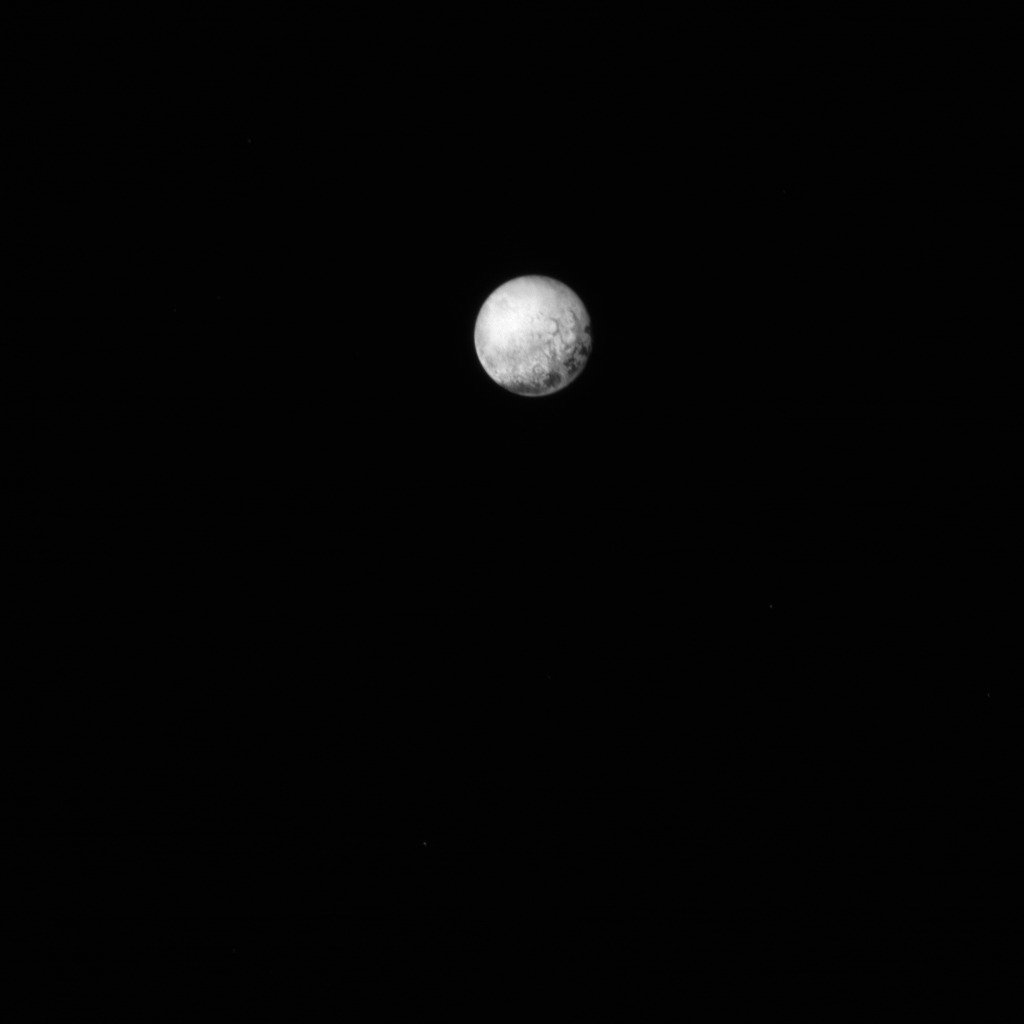
It looks more natural when seen in its real size.
Can't wait for the close-up pictures
If only Clyde Tombaugh could have lived to see where we are now...